


ARTICLE CONTENTSOn this page 9 sections
Ecology and Crop Distribution: Cereals Production
Performance Objectives
By the end of the lesson, students should be able to:
- explain the meaning and types of cereal crops;
- discuss the ecology for cereal production.
Meaning of Cereal Crops
A cereal crop is a member of the grass family cultivated for its edible starchy seeds or grains.
Cereal crops belong to the botanical family Poaceae, formerly known as Gramineae. They constitute the most important group of food crops globally, serving as the primary source of carbohydrates for human consumption and livestock feed. The harvested grain of cereals consists of the endosperm, germ, and bran, which provide essential energy, dietary fibre, and vitamins.
Types of Cereal Crops
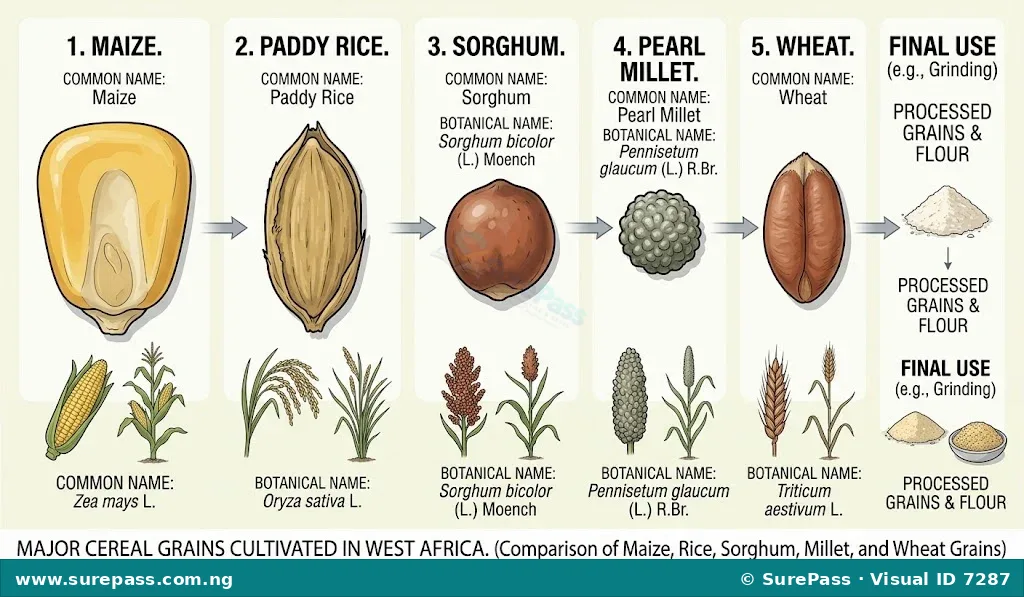
Cereal crops are classified based on their botanical characteristics, growth habits, and environmental preferences. The major types of cereal crops cultivated in Nigeria include:
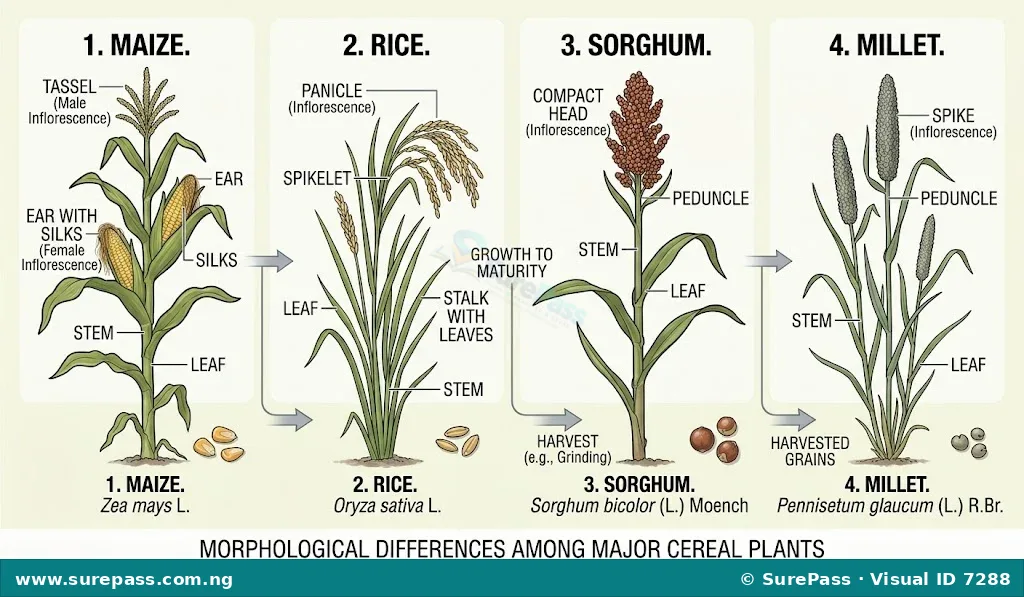
- Maize (Zea mays): Also known as corn, this is a versatile cereal crop grown widely across various ecological zones. It produces grains on a central cob protected by leafy husks. Maize is consumed as boiled or roasted corn, or processed into local foods such as pap (ogi or akamu) and tuwo.
- Rice (Oryza sativa): This is a major staple crop in Nigeria. It is grown either in flooded fields (swamp rice) or on dry land (upland rice). The grains are enclosed in a protective hull or husk which must be removed during milling.
- Sorghum (Sorghum bicolor): Commonly referred to as guinea corn, sorghum is a highly drought-resistant cereal crop. It produces grains on a dense terminal panicle. It is a major food source in the drier northern regions of Nigeria and is also used in industrial beverage brewing.
- Millet (Pennisetum glaucum): This is one of the most drought-tolerant cereal crops, capable of growing in extremely hot and dry environments. It produces small, round grains on a long, cylindrical spike. It is a staple food in the Sahel and Sudan savannah zones.
- Wheat (Triticum aestivum): Wheat is a temperate cereal crop that is grown in the cool, dry harmattan season under irrigation in northern Nigeria. It is highly valued for its gluten content, which makes it ideal for bread, pasta, and pastry production.
Ecology for Cereal Production
Ecology refers to the study of the relationships between living organisms, such as crops, and their physical environment.
The growth, development, and yield of cereal crops are heavily influenced by ecological factors. These factors are broadly divided into climatic factors and soil factors.
Climatic Factors
Climate determines the geographic distribution of cereal crops. The primary climatic factors include:
- Rainfall: Cereal crops have varying water requirements. Rice requires high rainfall (1,000 mm to 2,500 mm per annum) or continuous flooding. Maize requires moderate rainfall (600 mm to 1,200 mm). Sorghum and millet are highly drought-resistant and thrive in areas with low rainfall (300 mm to 800 mm).
- Temperature: Most tropical cereals require warm temperatures for optimum growth. Maize and rice grow best in temperatures between 20°C and 35°C. Wheat, being a temperate crop, requires cool temperatures (15°C to 22°C) during its vegetative growth stage.
- Sunshine (Solar Radiation): Cereals require abundant sunlight for photosynthesis to manufacture carbohydrates. High solar radiation during the grain-filling stage significantly increases crop yield.
- Relative Humidity: High relative humidity favours the spread of fungal diseases in cereals, especially during the flowering and harvesting stages. Dry atmospheric conditions are preferred during harvesting to facilitate proper grain drying.
Soil Factors
The physical and chemical properties of the soil determine the performance of cereal crops. The key soil requirements include:
- Soil Texture and Structure: Maize and wheat prefer deep, well-drained loamy soils rich in organic matter. Rice thrives in heavy clay or clay-loam soils because clay has a high water-holding capacity, which helps maintain flooded conditions. Sorghum and millet can tolerate light, sandy soils with low water retention.
- Soil pH: Most cereal crops grow best in slightly acidic to neutral soils, with a pH range of 5.5 to 7.0. Rice can tolerate slightly more acidic soils (pH 5.0 to 6.5).
- Soil Nutrients: Cereal crops are heavy feeders, requiring substantial amounts of macronutrients, particularly Nitrogen (N) for vegetative growth, Phosphorus (P) for root development and flowering, and Potassium (K) for grain formation and disease resistance.
Ecological Requirements of Specific Cereal Crops
The specific ecological requirements for the major cereal crops cultivated in Nigeria are summarised in the table below:
| Cereal Crop | Annual Rainfall (mm) | Optimum Temperature (°C) | Preferred Soil Type | Ideal Ecological Zone in Nigeria |
|---|---|---|---|---|
| Maize | 600 – 1,200 | 20 – 30 | Well-drained fertile loam | Forest and Guinea Savannah |
| Rice | 1,000 – 2,500 (or irrigation) | 20 – 35 | Heavy clay or clay loam | River basins, swamps, and forest zones |
| Sorghum | 500 – 1,000 | 25 – 35 | Sandy loam to clay loam | Sudan and Guinea Savannah |
| Millet | 300 – 600 | 25 – 40 | Light, sandy, well-drained soil | Sahel and Sudan Savannah |
| Wheat | 300 – 1,000 (mostly irrigated) | 15 – 25 (cool season) | Fertile clay loam or silt loam | High altitudes or Northern dry season plains |
Crop Distribution of Cereals in Nigeria
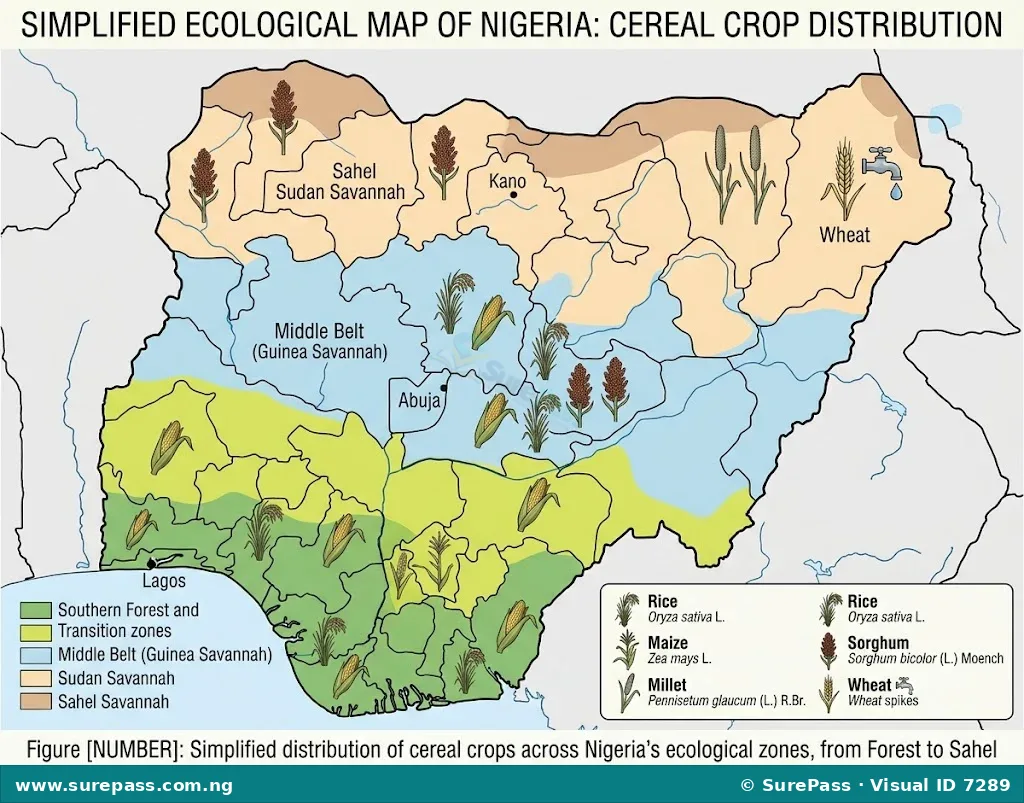
The distribution of cereal crops across Nigeria is directly aligned with the country’s ecological zones, which transition from high rainfall in the south to arid conditions in the far north.
The Southern Forest Zone
This zone is characterised by high rainfall and high relative humidity. Rice is the dominant cereal crop here, particularly in swampy river valleys (fadama areas) and coastal plains. Early maize is also widely grown in this zone, though high humidity during harvest can present drying challenges.
The Guinea Savannah (Middle Belt)
This zone has moderate rainfall and a distinct dry season. It is the transition zone where both forest and savannah crops thrive. Maize is highly productive in this region. Sorghum and upland rice are also widely cultivated due to the favourable combination of sunshine and moderate rainfall.
The Sudan and Sahel Savannah (Northern Zone)
These zones are characterised by low rainfall, short wet seasons, high temperatures, and low relative humidity. Sorghum and millet are the dominant crops because of their physiological adaptations to drought. Wheat is grown in these zones during the cool, dry harmattan months (November to February) under irrigation systems, such as those in the Lake Chad basin and major river valleys.
Summary of Cereal Crop Management and Ecology
Understanding the ecological requirements of cereal crops is essential for successful agricultural planning. Farmers must select cereal varieties that match the rainfall, temperature, and soil characteristics of their specific locality. For instance, planting millet in the high-rainfall southern forest zone would lead to crop failure due to excessive moisture and fungal diseases, while planting swamp rice in the dry Sahel without irrigation would result in severe drought stress.
Study Questions
The following questions are provided for self-evaluation:
- Define cereal crops and state the botanical family to which they belong.
- List five major types of cereal crops grown in Nigeria, providing the botanical name for each.
- Explain how soil texture influences the choice of land for rice cultivation compared to maize cultivation.
- Discuss three climatic factors that affect the distribution of cereal crops in Nigeria.
- Identify the primary ecological zones in Nigeria where millet and sorghum are predominantly grown, and explain why they thrive in those areas.



0 comments
Open the discussion when you need it. Comments stay collapsed until requested so the initial article remains light.