



ARTICLE CONTENTSOn this page 10 sections
Cutting
Performance Objectives
By the end of the lesson, students should be able to:
- explain the meaning of cutting.
- cut using different methods.
Meaning of Cutting
Cutting is a vegetative propagation method in which a portion of a parent plant, such as a stem, leaf, or root, is severed and placed under favourable environmental conditions to stimulate the growth of roots and shoots, thereby forming a new, independent plant.
Vegetative propagation is a form of asexual reproduction. This means that the new plant produced from a cutting is genetically identical to the parent plant. Farmers and horticulturists widely use this method because it preserves the desirable characteristics of the parent plant, such as fruit quality, flower colour, and disease resistance. It also allows plants to reach maturity and produce yields much faster than plants grown from seeds.
Methods of Cutting
Cuttings are classified based on the part of the plant from which they are obtained. The three primary methods of cutting are stem cutting, leaf cutting, and root cutting.
Stem Cutting
Stem cutting is the most common method of vegetative propagation. It involves removing a portion of a stem containing one or more buds and placing it in a rooting medium. Stem cuttings are further divided into three categories based on the maturity of the wood:
- Hardwood Cuttings: These are prepared from mature, woody, and dormant stems. The wood is firm and does not bend easily. This method is highly successful for many woody ornamental plants and food crops. Examples of plants propagated by hardwood cuttings include cassava, hibiscus, and bougainvillea.
- Semi-Hardwood Cuttings: These are taken from woody stems that are partially mature, usually after a flush of growth has completed. The wood is firmer than softwood but not as woody as hardwood. Examples of plants propagated by semi-hardwood cuttings include citrus species and ixora.
- Softwood or Herbaceous Cuttings: These are obtained from succulent, non-woody, and actively growing green stems. These cuttings root very quickly but require high humidity to prevent wilting. Examples of plants propagated by softwood or herbaceous cuttings include sweet potato, waterleaf, and coleus.
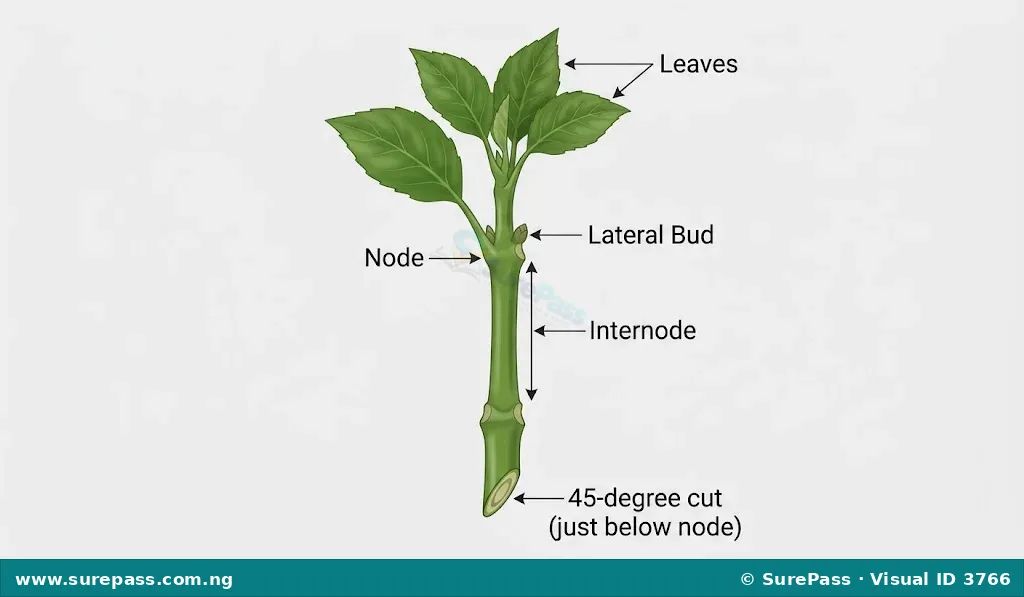
Observe the diagram below showing the correct anatomical parts of a stem cutting.
Leaf Cutting
Leaf cutting involves using a leaf blade, or a leaf with its petiole (leaf stalk), to produce a new plant. This method is common in horticultural practices for propagating indoor ornamental plants. The leaf tissue has the ability to generate both adventitious roots and shoots when placed in a moist medium. Examples of plants propagated by leaf cuttings include mother-in-law’s tongue (Sansevieria) and begonia.
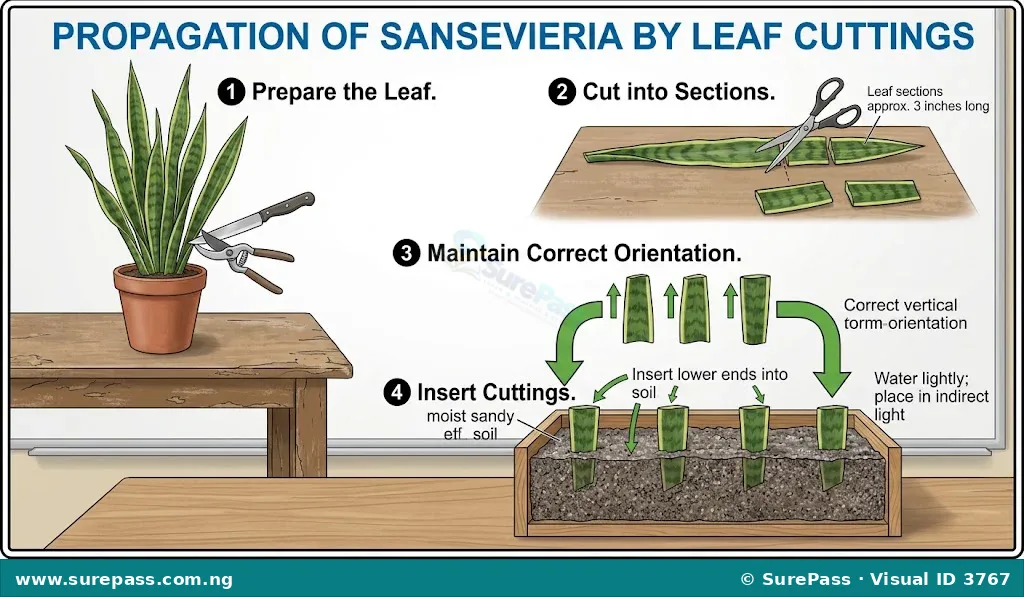
Observe the diagram below showing how a leaf cutting is prepared and planted.
Root Cutting
Root cutting involves taking sections of the roots of a parent plant during its dormant season and planting them to produce new shoots. This method is less common than stem cutting but is highly effective for specific plant species that naturally produce suckers from their roots. Examples of plants propagated by root cuttings include breadfruit and guava.
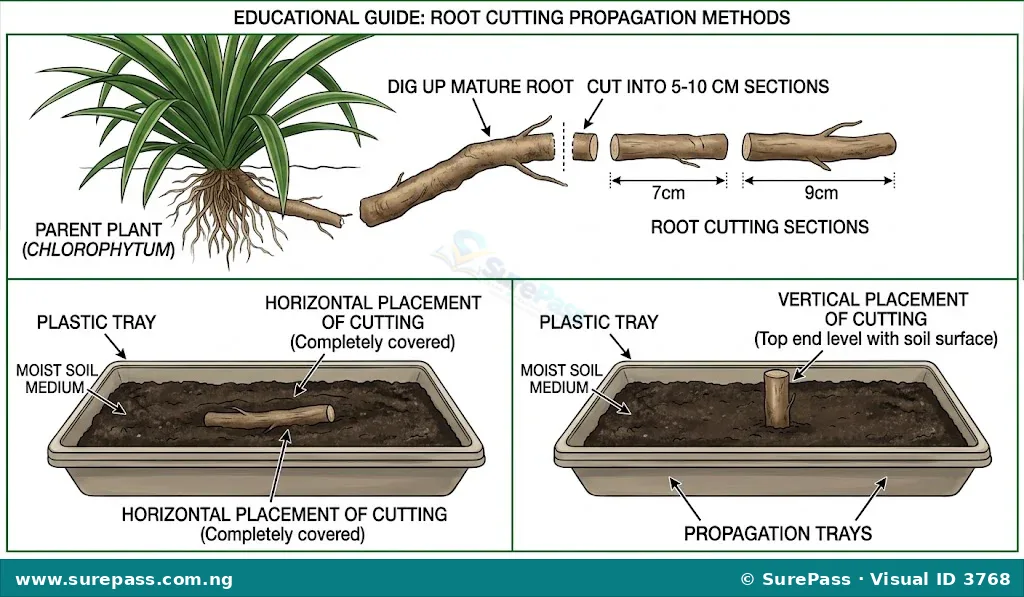
Observe the diagram below showing the preparation of root cuttings.
Tools and Materials for Cutting
Successful propagation by cutting requires specific tools and materials to ensure clean cuts and healthy root development. The essential tools and materials include:
- Secateurs (Pruning Shears): Used for making clean, sharp cuts on hardwood and semi-hardwood stems without crushing the plant tissues.
- Sharp Knife: Used for preparing softwood, herbaceous, and leaf cuttings.
- Hand Trowel: Used for mixing soil and filling planting pots or nursery beds.
- Watering Can: Used for applying water gently to the cuttings to maintain moisture without washing away the soil.
- Rooting Medium: A mixture of clean river sand, loam soil, or peat moss that provides aeration, support, and moisture retention for the developing roots.
- Rooting Hormone (Optional): A chemical powder or liquid containing synthetic auxins that stimulate rapid root initiation at the base of the cutting.
How to Prepare and Plant Stem Cuttings
Stem cuttings must be prepared and planted carefully to prevent infection and encourage rapid root growth. The procedure involves the following steps:
- Select a healthy, disease-free parent plant with desirable characteristics.
- Identify a vigorous shoot and use sharp secateurs to cut a section of the stem measuring 15 to 25 centimetres in length.
- Make the top cut straight across the stem, about 1 centimetre above a node, to reduce water loss.
- Make the basal (bottom) cut at a 45-degree angle immediately below a node. The slanted cut increases the surface area for root development and prevents water from pooling on the cut surface.
- Remove the leaves from the lower half of the cutting to reduce transpiration (water loss) and prevent the leaves from rotting in the soil.
- Dip the basal end of the cutting into a rooting hormone powder if available.
- Insert the lower half of the cutting into a pre-moistened rooting medium at an angle, ensuring that at least two nodes are buried beneath the soil surface.
- Firm the soil gently around the base of the cutting to eliminate air pockets and ensure good contact between the stem and the soil.
- Water the cutting gently using a watering can.
How to Prepare and Plant Leaf Cuttings
Leaf cuttings require careful handling to prevent the delicate leaf tissues from rotting before roots can form. The procedure involves the following steps:
- Select a mature, healthy leaf from a parent plant such as Sansevieria.
- Use a sharp, clean knife to cut the leaf horizontally into sections of about 7 to 10 centimetres in length.
- Keep track of the polarity (the original top and bottom of each section) because planting a leaf section upside down will prevent root formation.
- Insert the basal (bottom) end of each leaf section vertically into a moist sandy rooting medium, burying about one-third of the section.
- Place the container in a warm, shaded area with high humidity.
- Water moderately to keep the medium moist but not waterlogged.
How to Prepare and Plant Root Cuttings
Root cuttings are prepared during the dormant season of the plant when root energy reserves are highest. The procedure involves the following steps:
- Expose the root system of a healthy parent plant carefully by digging around the base.
- Select roots that are about the thickness of a pencil and cut them close to the main stem.
- Cut the selected roots into sections of 5 to 10 centimetres in length. Make a straight cut at the end closest to the plant crown (proximal end) and a slanted cut at the outer end (distal end) to maintain correct polarity.
- Fill a shallow tray or pot with a well-drained rooting medium.
- For vertical planting, insert the root cutting into the medium with the straight cut (proximal end) pointing upwards and level with the soil surface.
- For horizontal planting, lay the root sections flat on the surface of the medium and cover them with about 1 to 2 centimetres of soil or clean sand.
- Water the medium thoroughly and place the container in a shaded nursery environment.
Care of Plant Cuttings
Once cuttings are planted, they require specific environmental conditions to survive and develop roots. Proper care involves the following practices:
- Moisture Management: The rooting medium must be kept consistently moist but never waterlogged. Excess water excludes oxygen from the soil, leading to the rotting of the cuttings.
- Humidity Control: Softwood and leaf cuttings benefit from high humidity. Covering the propagation pots with clear plastic bags can help retain humidity around the foliage.
- Shading: Cuttings should be kept in a semi-shaded area away from direct sunlight. Direct sunlight increases transpiration and can scorch the unrooted cuttings.
- Weed Control: Hand-pull any weeds that emerge in the propagation beds or pots to prevent competition for moisture and space.
- Transplanting: Once the cuttings have developed strong root systems and new leaf shoots, they should be hardened off by gradually exposing them to more sunlight before transplanting them to the main field or larger pots.
Summary of Cutting Methods
The table below summarises the different cutting methods, the plant parts used, and common examples of crops propagated by each method.
| Cutting Method | Plant Part Used | Key Characteristics | Examples of Plants |
|---|---|---|---|
| Hardwood Stem Cutting | Mature, woody stem | Taken during dormancy; firm wood | Cassava, Hibiscus, Bougainvillea |
| Softwood Stem Cutting | Succulent, green stem | Taken from active growth; roots quickly | Sweet potato, Waterleaf |
| Leaf Cutting | Leaf blade or leaf with petiole | Requires high humidity; produces adventitious roots | Sansevieria (Mother-in-law’s tongue), Begonia |
| Root Cutting | Section of root | Taken during dormancy; polarity must be maintained | Breadfruit, Guava |





0 comments
Open the discussion when you need it. Comments stay collapsed until requested so the initial article remains light.