



ARTICLE CONTENTSOn this page 11 sections
Vegetative Propagation (Cuttings, Budding, Grafting, and Layering)
Performance Objectives
By the end of the lesson, students should be able to:
- explain the meaning and importance of vegetative propagation;
- discuss the types of vegetative propagation;
- discuss compatibility in vegetative propagation;
- identify materials for vegetative propagation;
- identify tools for vegetative propagation;
- identify the right time for vegetative propagation.
Meaning of Vegetative Propagation
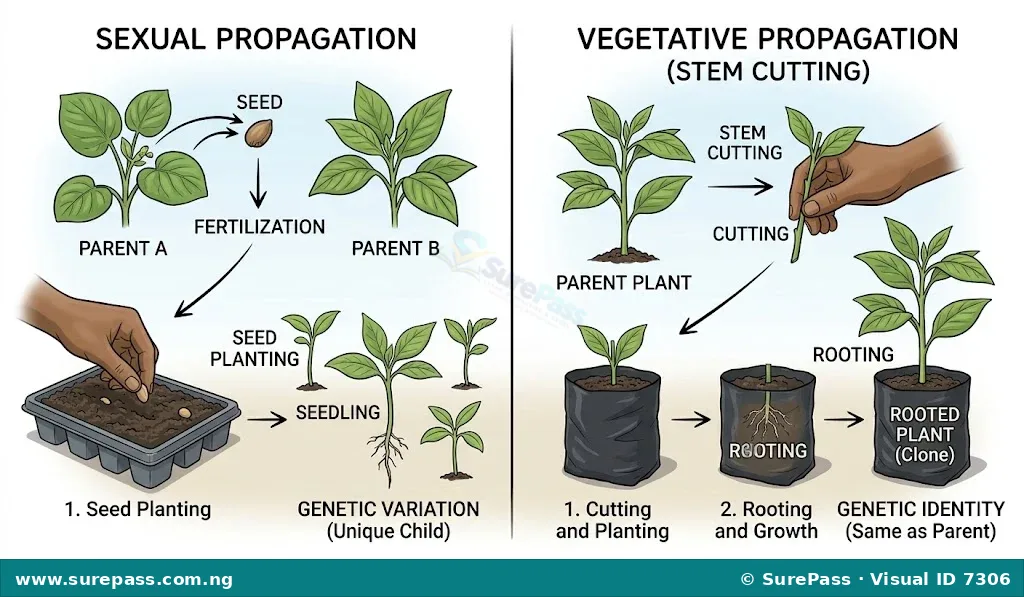
Vegetative propagation is an asexual method of plant reproduction where new plants are produced from the vegetative parts of a parent plant, such as the roots, stems, or leaves, without the involvement of seeds or pollination.
This process relies on the presence of meristematic tissues in vegetative organs. Meristematic cells possess the ability to divide rapidly and differentiate into various plant tissues, allowing a detached stem, root, or leaf to regenerate missing organs like roots or shoots. Because the offspring arise from a single parent through mitotic cell division, they are genetically identical to the parent plant. These genetically identical offspring are referred to as clones.
Importance of Vegetative Propagation
Vegetative propagation is widely used in agriculture and horticulture. It offers several advantages over sexual propagation by seeds.
The main reasons for using vegetative propagation include:
- Preservation of Desirable Traits: Since offspring are clones of the parent plant, excellent characteristics such as high yield, disease resistance, fruit sweetness, and growth habit are preserved without genetic variation.
- Early Maturity: Vegetatively propagated plants bypass the prolonged juvenile phase characteristic of seedlings. They grow, flower, and bear fruit much earlier than plants grown from seeds.
- Propagation of Seedless Varieties: Certain commercial crops do not produce viable seeds. Vegetative propagation is the only viable method to multiply such crops, ensuring their continued cultivation.
- Overcoming Seed Dormancy: Some plant seeds have long dormancy periods or very low germination rates. Vegetative propagation bypasses these seed-related challenges, ensuring rapid and reliable crop establishment.
- Combining Desirable Characteristics: Methods like grafting and budding allow farmers to combine the robust, disease-resistant root system of one plant with the high-yielding shoot system of another plant.
- Higher Survival Rate: Vegetative propagules are often larger and more resilient than tiny seedlings, giving them a higher survival rate when transplanted into the field.
Examples of crops commonly propagated vegetatively in Nigeria include:
- Cassava (propagated by stem cuttings)
- Sweet potato (propagated by stem/vine cuttings)
- Yam (propagated by tubers)
- Citrus species (propagated by budding)
- Mango (propagated by grafting)
- Ginger (propagated by rhizomes)
- Cocoa (propagated by budding or stem cuttings)
Types of Vegetative Propagation
Vegetative propagation is broadly divided into natural methods and artificial methods. Natural methods involve the plant reproducing through its own specialized structures, while artificial methods are techniques developed by humans to multiply plants.
Planting (Natural Vegetative Structures)
Many plants naturally develop specialized underground or sub-aerial storage organs that can be detached and planted to produce new individuals.
The primary natural vegetative structures used for planting include:
- Tubers: Swollen underground stems or roots that store food and bear buds or “eyes” from which new shoots grow. Examples include yam and Irish potato.
- Rhizomes: Horizontal underground stems that grow horizontally and produce shoots and roots at their nodes. Examples include ginger and turmeric.
- Bulbs: Short underground stems surrounded by fleshy, scale-like leaves that store food. Examples include onion and garlic.
- Corms: Short, swollen, vertical underground stems wrapped in dry, paper-like leaves. Examples include cocoyam.
- Runners or Stolons: Horizontal above-ground stems that trail along the soil surface, producing roots and shoots at the nodes. Examples include sweet potato and strawberry.
Cuttings
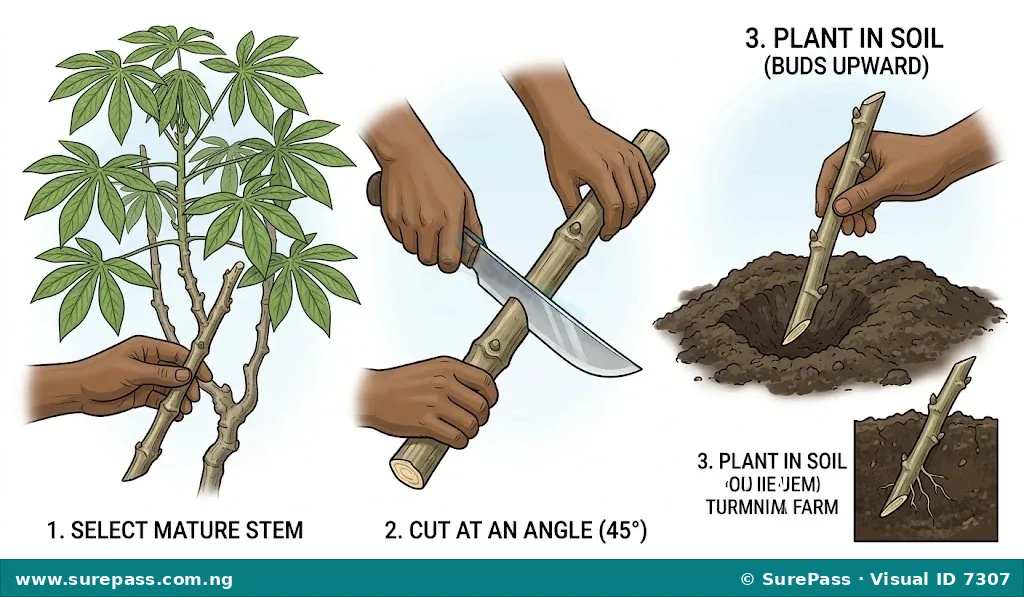
Cutting is an artificial propagation method where a portion of a stem, root, or leaf is detached from a parent plant and placed in a suitable growing medium to develop roots and shoots.
The types of cuttings are:
- Stem Cuttings: The most common type, where a section of a mature stem containing nodes and buds is cut and inserted into moist soil. Examples include cassava, sugarcane, and hibiscus.
- Root Cuttings: Sections of roots are cut and placed horizontally or vertically in the soil to produce adventitious shoots. Examples include breadfruit and guava.
- Leaf Cuttings: A leaf blade, sometimes with the petiole, is placed in a moist medium where it develops roots and shoots from the veins or base. Examples include Bryophyllum and Begonia.
Budding
Budding is a specialized form of grafting in which a single vegetative bud (the scion) is taken from a desirable parent plant and inserted into the bark of a rooted plant (the rootstock) so that they unite and grow as one plant.
The two main parts involved in budding are:
- The Scion (or Bud): The detached bud containing the genetic material of the desired plant variety.
- The Rootstock: The rooted plant that receives the bud, providing the root system and absorbing water and nutrients from the soil.
Common budding techniques include T-budding (where a T-shaped incision is made in the rootstock bark) and patch budding (where a rectangular patch of bark is removed and replaced with a matching patch containing a bud). Budding is widely used in the propagation of citrus fruits, cocoa, and rubber.
Grafting
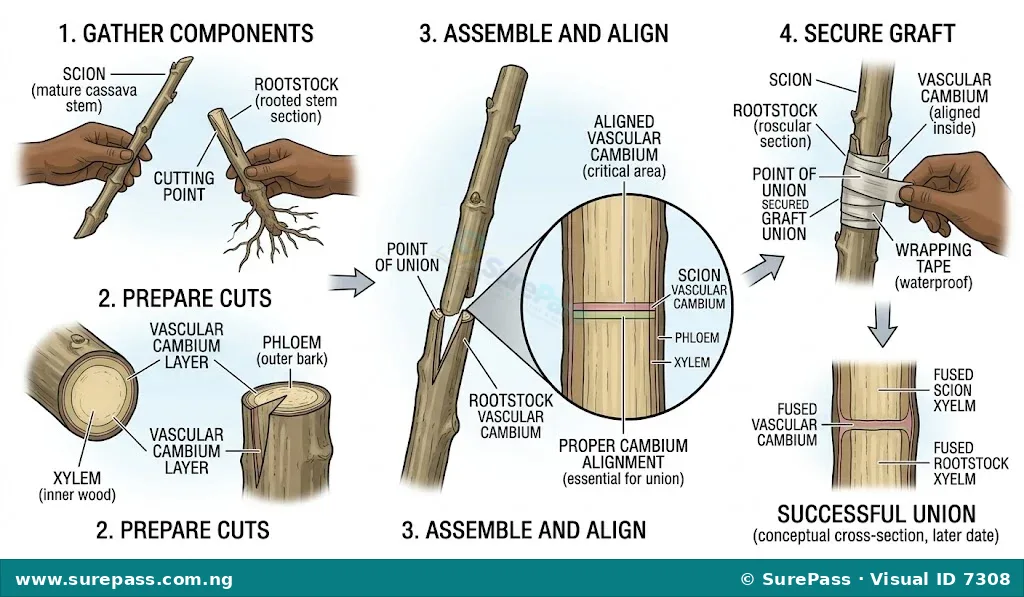
Grafting is an artificial propagation technique where a shoot section containing several buds (the scion) is joined with a rooted stem (the rootstock) of another plant in such a way that their cambium layers align, heal, and grow together as a single plant.
Unlike budding, which uses a single bud, grafting uses a twig or stem section called the scion. For grafting to be successful, the vascular cambium (the layer of actively dividing cells just beneath the bark) of both the scion and rootstock must be placed in direct contact. This allows the vascular tissues (xylem and phloem) to fuse, ensuring the flow of water and nutrients between the rootstock and the scion.
Common grafting methods include cleft grafting, whip-and-tongue grafting, and side grafting. Grafting is highly successful in mango, avocado, and rubber propagation.
Layering
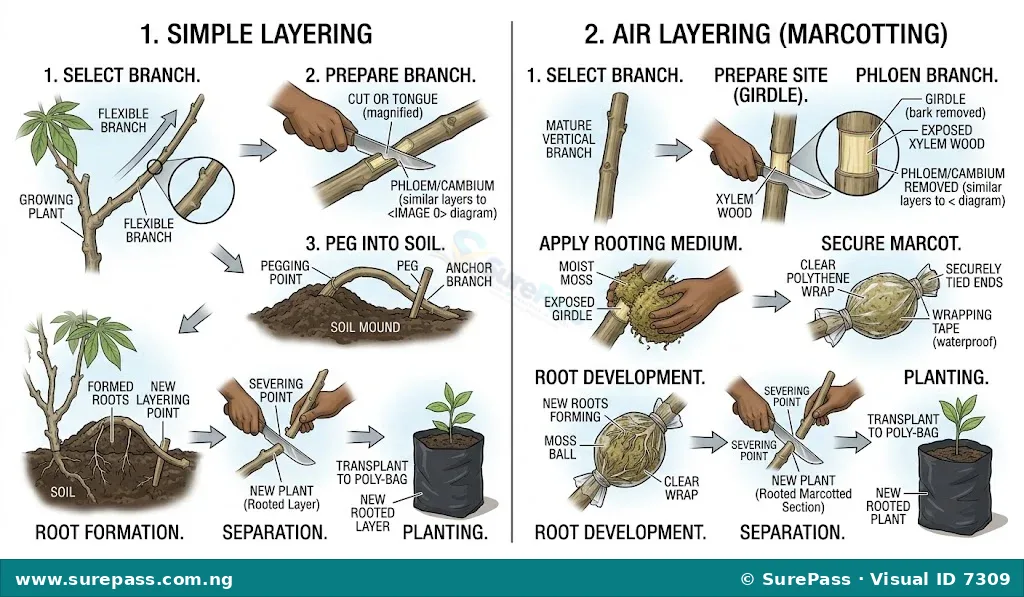
Layering is a propagation method where roots are induced to form on a stem or branch while it is still physically attached to the parent plant. Once roots develop, the stem is severed from the parent to become an independent plant.
Because the stem remains attached to the parent plant during root formation, it continues to receive water, minerals, and organic food, which minimizes transplanting shock.
The two primary types of layering are:
- Simple Layering: A low-hanging, flexible branch is bent down to the ground, wounded slightly at a node, pegged into the soil, and covered with moist earth, leaving the tip exposed. Roots develop at the buried node. Examples include cashew and jasmine.
- Air Layering (Marcotting): Used for plants with rigid branches that cannot be bent to the ground. A ring of bark is removed from an aerial branch, wrapped with moist organic material like sphagnum moss or coconut coir, and enclosed in a polythene sheet to retain moisture. Roots form at the wounded site. Examples include guava, mango, and citrus.
Compatibility in Vegetative Propagation
Compatibility in vegetative propagation is the ability of two different plant parts, specifically the scion and the rootstock, to successfully unite, form a functional vascular connection, and grow together as a single plant.
When the scion and rootstock are compatible, cell division at the graft interface produces a callus tissue that bridges the gap between them. This callus differentiates into new xylem and phloem vessels, establishing a continuous vascular system.
If the scion and rootstock are incompatible, they fail to form a strong union. This condition is known as graft incompatibility.
The factors that determine compatibility include:
- Botanical Relationship: Plants that belong to the same species or genus are highly compatible (e.g., grafting sweet orange scion onto sour orange rootstock). Grafting plants from different families is almost always unsuccessful.
- Physiological and Biochemical Factors: The chemical substances, sap composition, and growth hormones of the scion and rootstock must be compatible. If one partner produces toxic compounds or has a vastly different growth rate, the union will fail.
- Structural Alignment: The physical size and shape of the cambium layers must match. Poor physical contact prevents vascular connection, leading to graft failure even if the plants are botanically related.
The consequences of graft incompatibility include:
- Failure to form a graft union (the scion dies quickly).
- Yellowing of leaves and premature defoliation.
- A weak physical union that easily breaks under wind pressure or physical load.
- Marked differences in growth rate between the scion and rootstock, leading to swelling at the graft joint.
Materials for Vegetative Propagation
Successful vegetative propagation requires specific plant materials and protective substances.
The essential materials used in vegetative propagation are:
- Scion or Budwood: A healthy, disease-free shoot or twig containing mature buds, selected from a high-yielding parent plant. It determines the fruit or flower characteristics of the new plant.
- Bud: A small, dormant vegetative shoot removed from the budwood for insertion into the rootstock during budding.
- Rootstock: A healthy, rooted plant, often grown from seed, selected for its vigorous root system, soil adaptation, and resistance to soil-borne pests and diseases.
- Layering Branch: A healthy, flexible branch on a parent plant selected for root induction.
- Grafting or Budding Wax: A protective mixture applied to graft unions to seal the wound. It prevents moisture loss (desiccation) and protects the exposed tissues from fungal and bacterial infections.
- Wrapping Material (Polythene Strips or Budding Tape): Strong, flexible plastic strips used to wrap the graft or bud union tightly. This holds the scion and rootstock in close contact and prevents water from entering the wound.
Tools for Vegetative Propagation
Specialized horticultural tools are required to make clean, precise cuts that facilitate rapid healing and tissue fusion.
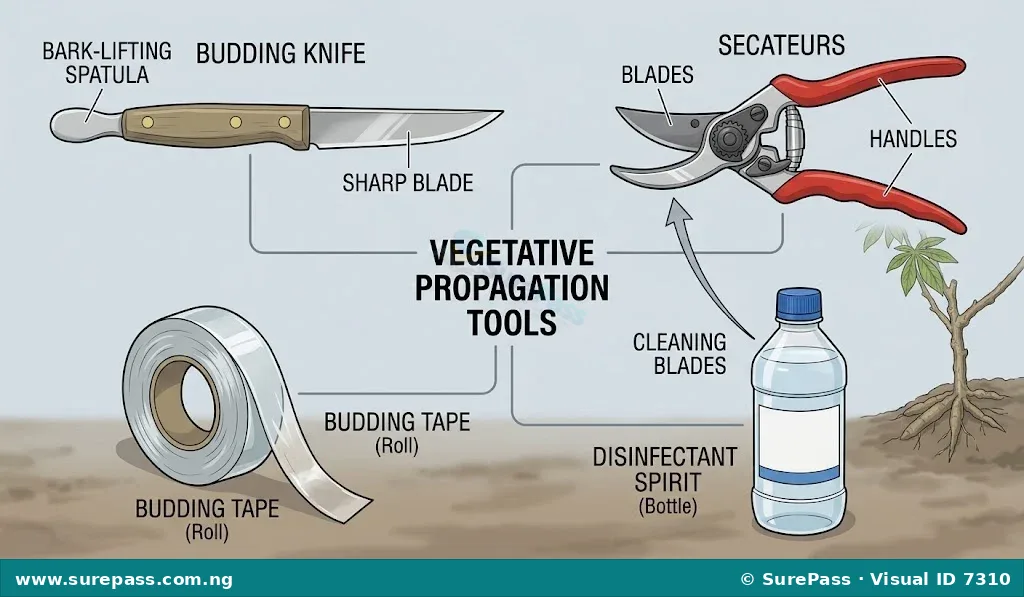
The primary tools used for vegetative propagation are:
- Grafting and Budding Knife: A highly specialized knife with an extremely sharp, single-beveled blade. It is used to make clean, smooth cuts on the scion and rootstock without crushing the delicate cambium cells. It often has a spatula-like end used to lift the bark during budding.
- Pruning Shears or Secateurs: Hand-held cutting tools used to cut back branches, harvest scions, trim rootstocks, and prepare stem cuttings. They must be sharp to prevent crushing the plant stems.
- Sharpening Stone (Whetstone): Used to maintain the razor-sharp edges of knives and secateurs. Dull tools tear plant tissues, leading to poor graft unions and infection.
- Disinfectant (Methylated Spirit or Ethanol): Used to sterilize cutting tools before and after use. This prevents the transmission of viral, bacterial, and fungal pathogens from infected plants to healthy ones.
Appropriate Time for Vegetative Propagation
The timing of vegetative propagation is critical to its success. The physiological state of the plant and environmental conditions must favor rapid cell division and wound healing.
The appropriate times for vegetative propagation and the reasons for them are:
- Active Growth Period (Early to Mid-Rainy Season): This is the ideal season for budding, grafting, and layering in Nigeria. During this period, plants are actively growing, and sap flow is high. High sap flow makes the bark “slip” or peel easily from the wood, which is essential for making clean incisions in budding. Active growth also means rapid cambial cell division, leading to quick healing of the union.
- Cool Hours of the Day (Early Morning or Late Afternoon): Propagation operations should be carried out when temperatures are low. High temperatures during midday increase transpiration (water loss) from the scion or cutting, causing it to dry out and die before a vascular connection can be established.
- High Relative Humidity: Periods of high humidity reduce the rate of evaporation from wounded plant tissues, keeping the scion and rootstock cells turgid and viable during the healing process.
Practical Procedures in Vegetative Propagation
This section provides step-by-step instructions for performing key vegetative propagation techniques.
How to Prepare and Plant Stem Cuttings
This procedure is used to propagate crops like cassava and hibiscus.
The required materials and tools are:
- Mature parent stems
- Secateurs or a sharp cutlass
- Moist, well-prepared soil or nursery bed
- Disinfectant
The procedure involves the following steps:
- Sterilize the cutting tool with disinfectant.
- Select a healthy, mature, semi-hardwood stem from the parent plant.
- Cut a section of the stem about 20 to 30 centimeters long, ensuring it contains at least 3 to 4 viable nodes or buds. Make the bottom cut at a 45-degree angle to increase the surface area for root development and to identify the bottom end.
- Insert the bottom end of the cutting into the moist soil at an angle of about 45 degrees, ensuring that at least two nodes are buried beneath the soil surface.
- Ensure the buds on the exposed part of the cutting are pointing upwards.
- Water the soil regularly to keep it moist but not waterlogged.
How to Perform T-Budding
This procedure is commonly used to propagate citrus species.
The required materials and tools are:
- Healthy rootstock plant
- Budwood containing mature buds
- Budding knife
- Budding tape or polythene strips
- Disinfectant
The procedure involves the following steps:
- Clean the budding knife with disinfectant.
- Make a vertical cut about 2.5 centimeters long through the bark of the rootstock stem, about 15 to 20 centimeters above the ground.
- Make a horizontal cut across the top of the vertical cut to form a “T” shape. Use the spatula end of the budding knife to gently loosen the flaps of bark.
- Select a healthy bud from the budwood. Cut a shield-shaped piece of bark containing the bud, ensuring a thin sliver of wood is attached behind the bud.
- Gently slide the bud shield down under the loosened flaps of the T-cut on the rootstock until the bud is positioned in the center of the cut.
- Wrap the union tightly with budding tape, starting from the bottom and working upwards. Leave the actual bud exposed so it can breathe and grow, but seal all other cut surfaces to prevent water entry and drying.
- After 14 to 21 days, inspect the bud. If it remains green, the union is successful. Cut the wrapping tape to allow the bud to expand, and cut back the top of the rootstock to force the bud into active growth.
How to Perform Air Layering (Marcotting)
This procedure is used for woody plants like guava and mango.
The required materials and tools are:
- A healthy, mature branch on a parent plant
- Sharp budding knife
- Moist sphagnum moss, sawdust, or rich organic soil
- Clear polythene sheet
- Strong twine or string
- Disinfectant
The procedure involves the following steps:
- Select a pencil-thick, healthy branch on the parent plant.
- Using a sterilized knife, make two circular cuts through the bark about 3 to 5 centimeters apart.
- Remove the ring of bark between the cuts, exposing the white wood (cambium layer) underneath. Scrape the exposed wood gently to remove the cambium cells and prevent the bark from growing back.
- Squeeze excess water from a handful of moist sphagnum moss or organic soil, and pack it tightly around the exposed wound.
- Wrap the ball of moss completely with a clear polythene sheet to seal in the moisture.
- Tie both ends of the polythene wrap tightly to the branch using twine to prevent water from entering or escaping.
- Observe the wrap over several weeks. When roots are visible through the clear plastic, cut the branch off the parent plant just below the lower tie.
- Carefully remove the plastic wrap without disturbing the root ball, and plant the newly rooted layer in a nursery pot or directly into the field.
Summary of Vegetative Propagation Methods
The table below summarizes the vegetative propagation methods, the plant parts used, and common crop examples.
| Propagation Method | Plant Part Used | Common Crop Examples |
|---|---|---|
| Planting (Tubers) | Underground storage root or stem | Yam, Irish potato |
| Planting (Rhizomes) | Horizontal underground stem | Ginger, turmeric |
| Cuttings | Stem, root, or leaf sections | Cassava, sugarcane, sweet potato, hibiscus |
| Budding | Single vegetative bud (scion) and rootstock | Citrus (orange, lemon), cocoa, rubber |
| Grafting | Stem twig with buds (scion) and rootstock | Mango, avocado, rubber |
| Layering | Attached aerial branch or low-hanging stem | Guava, cashew, lemon, jasmine |




0 comments
Open the discussion when you need it. Comments stay collapsed until requested so the initial article remains light.