



ARTICLE CONTENTSOn this page 5 sections
Crop ecology
Performance Objectives
By the end of the lesson, students should be able to:
- explain the meaning and components of crop ecology;
- identify the ecological zones of Nigeria;
- discuss soil factors and weather conditions for planting.
Meaning and Components of Crop Ecology
Ecology is the study of the relationships between living organisms and their physical environment.
Crop ecology is the study of the relationships between crop plants and their surrounding environment.
Understanding crop ecology is essential for successful agricultural production. It helps farmers determine how environmental factors influence crop growth, development, and yield. By studying these relationships, agriculturalists can select the most suitable crops for specific environments and adopt management practices that maximize food production while preserving natural resources.
The environment of a crop plant is divided into two main components: biotic components and abiotic components.
Biotic Components
Biotic components consist of all the living organisms within the crop environment that interact with the crop plants. These interactions can be beneficial, harmful, or neutral.
The major biotic components in crop ecology are:
- Soil Microorganisms: Bacteria, fungi, and actinomycetes decompose organic matter, releasing essential nutrients for crop uptake. Some, like Rhizobium bacteria, fix atmospheric nitrogen in the root nodules of leguminous crops.
- Pests: Insects, rodents, and birds feed on crop leaves, stems, roots, or seeds, causing physical damage and reducing crop yields.
- Pathogens: Fungi, bacteria, and viruses cause diseases in crops, leading to stunted growth, wilting, leaf spots, or death of the plants.
- Weeds: Unwanted plants grow alongside crops and compete with them for space, sunlight, water, and soil nutrients.
- Pollinators: Insects such as bees and butterflies, as well as birds, assist in the transfer of pollen grains from the anthers to the stigmas of flowers, facilitating fertilization and fruit formation.
- Human Activities: Farmers alter the crop environment through land clearing, tillage, weeding, fertilizer application, irrigation, and pest control.
Abiotic Components
Abiotic components consist of the non-living physical and chemical factors in the environment that affect crop growth and survival.
The major abiotic components in crop ecology are:
- Climatic Factors: These include rainfall, temperature, sunlight, wind, and relative humidity. They determine the atmospheric conditions of the crop habitat.
- Edaphic (Soil) Factors: These include soil texture, soil structure, soil pH, soil moisture, soil aeration, and soil nutrient content. They determine the physical and chemical properties of the medium in which crops grow.
- Physiographic Factors: These include topography (the slope of the land) and altitude (height above sea level), which influence local climate, water drainage, and soil erosion.
Observe the diagram below showing the interaction between a crop plant and its biotic and abiotic environment.
Ecological Zones of Nigeria
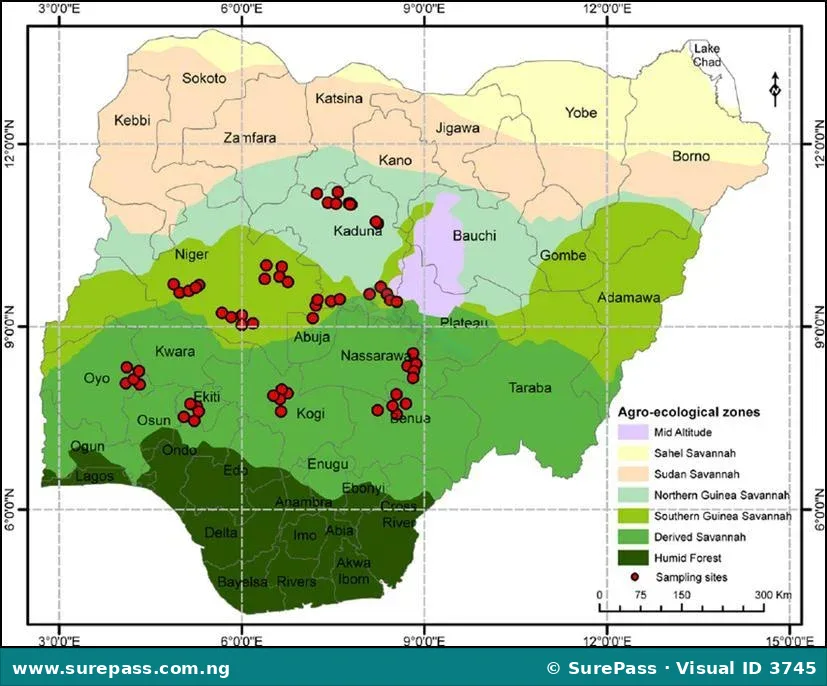
Nigeria is characterized by diverse ecological zones that run horizontally across the country. These zones are determined primarily by the gradient of annual rainfall, which decreases from the humid coastal south to the dry, arid north. The temperature and relative humidity also vary across these zones, influencing the natural vegetation and the types of crops that can be successfully cultivated.
The major ecological zones of Nigeria are:
- Mangrove Swamp Forest
- Rainforest
- Montane Forest and Grassland
- Guinea Savannah
- Sudan Savannah
- Sahel Savannah
Look at the map shown below to identify the geographical distribution of these ecological zones across Nigeria.
1. Mangrove Swamp Forest
This zone is located along the coastal areas of southern Nigeria, particularly in the Niger Delta region. It experiences high annual rainfall, often exceeding 2,500 mm, and high relative humidity throughout the year. The soil is waterlogged, salty, and poorly aerated. The dominant vegetation consists of red and white mangrove trees with stilt roots. Due to the waterlogged and saline conditions, crop cultivation is limited, but swamp rice can be grown in some reclaimed areas.
2. Rainforest Zone
The rainforest zone lies immediately north of the mangrove swamps in southern Nigeria. It experiences a high annual rainfall ranging from 1,500 mm to 2,500 mm, distributed over a long wet season of about eight to nine months. Temperatures are high and stable, averaging around 27°C. The vegetation is characterized by tall, evergreen trees arranged in layers, with abundant climbing plants and epiphytes. The soil is generally deep and fertile, though prone to leaching. This zone is highly suitable for tree crops such as cocoa, oil palm, rubber, and kola, as well as root and tuber crops like yam, cassava, cocoyam, and sweet potato.
3. Montane Forest and Grassland
This zone is found in high-altitude areas of Nigeria, such as the Jos Plateau in Plateau State, the Mambilla Plateau in Taraba State, and the Obudu hills in Cross River State. Due to the high elevation, temperatures are cool and temperate, often ranging between 15°C and 22°C. Rainfall is moderate to high. The vegetation consists of short grasses and montane forests. The cool climate allows for the cultivation of specialized crops that do not thrive in the hot lowlands, such as Irish potatoes, tea, coffee, apples, and various temperate vegetables.
4. Guinea Savannah
The Guinea Savannah is the largest ecological zone in Nigeria, covering the middle belt region. It is divided into the Southern Guinea Savannah and the Northern Guinea Savannah. The annual rainfall ranges from 1,000 mm to 1,500 mm, with a distinct dry season lasting four to five months. The vegetation consists of tall grasses interspersed with medium-sized, fire-resistant trees. The soils are moderately fertile. This zone is often referred to as the “food basket of the nation” because it supports a wide variety of crops, including grains like maize, rice, and sorghum, legumes like cowpea and groundnut, and root crops like yam and cassava.
5. Sudan Savannah
This zone lies north of the Guinea Savannah. It experiences a lower annual rainfall of about 600 mm to 1,000 mm, with a long, intense dry season lasting six to seven months. Temperatures are high during the day and low at night. The vegetation consists of short, sparse grasses and scattered, thorny trees such as acacia and baobab. The soils are sandy and low in organic matter. The Sudan Savannah is highly suitable for the cultivation of cereal crops like millet, sorghum, and maize, as well as legumes like cowpea and groundnut. Cotton and sesame are also major cash crops in this zone.
6. Sahel Savannah
The Sahel Savannah is located in the extreme northeastern and northwestern parts of Nigeria, bordering the Sahara Desert. It experiences very low annual rainfall, usually less than 500 mm, with a short wet season of only three to four months. The dry season is long, hot, and dusty, characterized by the dry harmattan wind. The vegetation is sparse, consisting of short, hardy grasses, thorny shrubs, and drought-resistant trees. Crop production in this zone is highly dependent on irrigation. The primary crops grown are millet, sorghum, wheat, and vegetables like onions and tomatoes under irrigation systems.
Soil Factors and Weather Conditions for Planting
The success of crop establishment and subsequent growth depends on the physical and chemical properties of the soil, as well as the prevailing atmospheric weather conditions at the time of planting.
Soil Factors for Planting
Soil is the medium that provides mechanical support, water, air, and essential nutrients to crops. The key soil factors that must be considered before planting include:
- Soil Texture: Soil texture refers to the relative proportion of sand, silt, and clay particles in the soil. Loamy soil, which is a balanced mixture of sand, silt, and clay, is the most suitable soil texture for planting most crops because it retains sufficient moisture while allowing good drainage and aeration.
- Soil Structure: Soil structure refers to the arrangement of soil particles into aggregates or clumps. A crumb or granular soil structure is ideal for planting because it provides a balance of macropores for air and water movement and micropores for water retention, allowing easy root penetration and seed germination.
- Soil pH: Soil pH is a measure of the acidity or alkalinity of the soil. Most crops grow best in slightly acidic to neutral soils with a pH range of 6.0 to 7.5. Extreme acidity or alkalinity limits the availability of essential plant nutrients and can inhibit root development.
- Soil Nutrient Content: The soil must contain adequate amounts of essential plant nutrients. These include macronutrients (nitrogen, phosphorus, potassium, calcium, magnesium, and sulfur) and micronutrients (iron, zinc, copper, manganese, boron, and molybdenum). Fertile soils support rapid seedling establishment and vigorous vegetative growth.
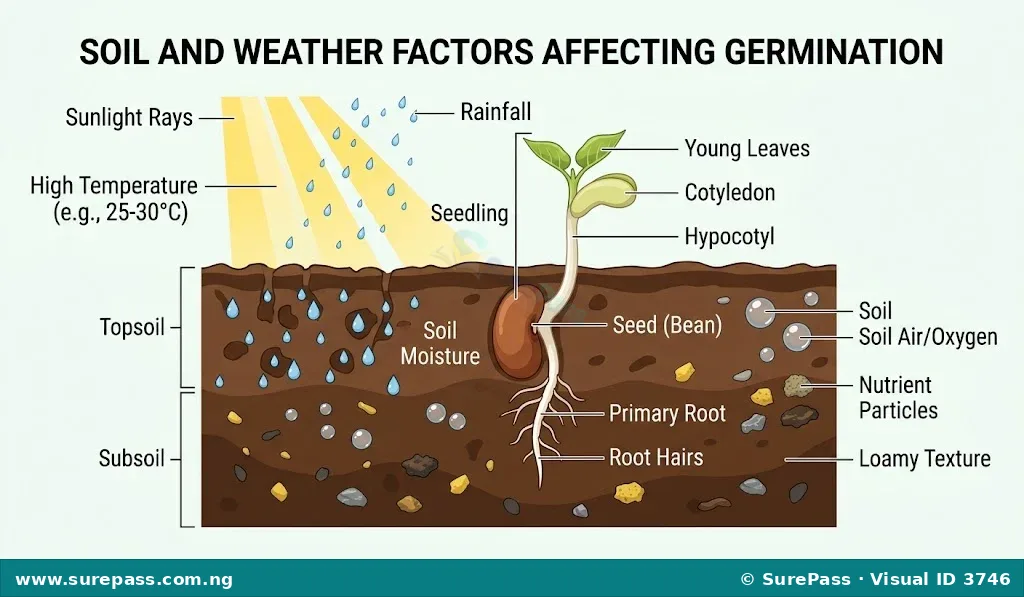
- Soil Moisture: Adequate soil moisture is critical at the time of planting to trigger seed germination. Water softens the seed coat, activates enzymes, and facilitates the transport of nutrients to the developing embryo. Dry soils lead to poor germination and seedling mortality.
- Soil Aeration: Soil pores must contain sufficient oxygen to support root respiration and the activities of beneficial soil microorganisms. Waterlogged soils lack oxygen, which suffocates plant roots and causes seeds to rot before germination.
Observe the diagram below showing how soil factors and weather conditions interact to support a germinating seed.
Weather Conditions for Planting
Weather conditions determine the atmospheric environment of the crop. Planting must be timed to coincide with favorable weather conditions to ensure high germination rates and healthy seedling growth. The critical weather conditions include:
- Rainfall: Rainfall provides the primary source of moisture for rain-fed agriculture. Planting is usually carried out at the onset of the rainy season when the soil has received enough moisture to sustain germination. Excessive rainfall immediately after planting can wash away seeds or cause soil compaction, while a lack of rain leads to seedling wilting.
- Temperature: Every crop species has an optimum temperature range for seed germination and growth. Warm temperatures accelerate chemical reactions and enzyme activities within the seed, promoting rapid germination. Extremely high temperatures can scorch young seedlings, while very low temperatures delay germination and stunt growth.
- Sunlight: Sunlight is the source of energy for photosynthesis, the process by which green plants manufacture their food. Young seedlings require adequate sunlight to produce food for growth. Insufficient sunlight leads to etiolation, a condition where plants become pale, thin, and abnormally elongated as they search for light.
- Wind: Moderate wind movement promotes air circulation around crops, reducing excessive humidity and the spread of fungal diseases. However, strong winds can cause lodging (blowing down of crops), physical damage to young seedlings, and rapid loss of soil moisture through increased evaporation.
- Relative Humidity: Relative humidity is the amount of moisture present in the air. High relative humidity reduces the rate of transpiration (water loss from plant leaves), which helps young seedlings conserve water during hot days. However, excessively high humidity creates a favorable environment for the spread of fungal and bacterial diseases.
The table below summarizes the relationship between the ecological zones of Nigeria, their climatic characteristics, and the dominant crops cultivated in each zone.
| Ecological Zone | Average Annual Rainfall | Vegetation Type | Major Crops Cultivated |
|---|---|---|---|
| Mangrove Swamp Forest | Above 2,500 mm | Mangrove trees with stilt roots | Swamp rice |
| Rainforest | 1,500 mm – 2,500 mm | Tall, evergreen trees with dense canopy | Cocoa, oil palm, rubber, kola, yam, cassava, cocoyam |
| Montane Forest / Grassland | Moderate to High (Cool temperatures) | Short grasses and montane trees | Irish potato, tea, coffee, temperate vegetables |
| Guinea Savannah | 1,000 mm – 1,500 mm | Tall grasses with scattered trees | Maize, guinea corn (sorghum), rice, cowpea, yam, cassava |
| Sudan Savannah | 600 mm – 1,000 mm | Short grasses and thorny shrubs | Millet, sorghum, groundnut, cowpea, cotton, sesame |
| Sahel Savannah | Below 500 mm | Sparse, hardy grasses and desert shrubs | Millet, sorghum, irrigated wheat, onions, tomatoes |





0 comments
Open the discussion when you need it. Comments stay collapsed until requested so the initial article remains light.