


ARTICLE CONTENTSOn this page 8 sections
Fertilizer
Performance Objectives
By the end of the lesson, students should be able to:
- explain the meaning and types of fertilizer;
- discuss the uses of fertilizer;
- discuss the methods of fertilizer application.
Meaning of Fertilizer
A fertilizer is any natural or synthetic substance containing chemical elements that is added to the soil or applied directly to plant tissues to supply one or more nutrients essential for plant growth.
In continuous cultivation, crops absorb essential nutrients from the soil, which gradually depletes soil fertility. Fertilizers are applied to replenish these lost nutrients, ensuring that crops have an adequate supply of elements necessary for their physiological processes, growth, and yield.
Types of Fertilizer
Fertilizers are broadly classified into two main groups based on their origin and composition. These are organic fertilizers and inorganic fertilizers.
Organic Fertilizers
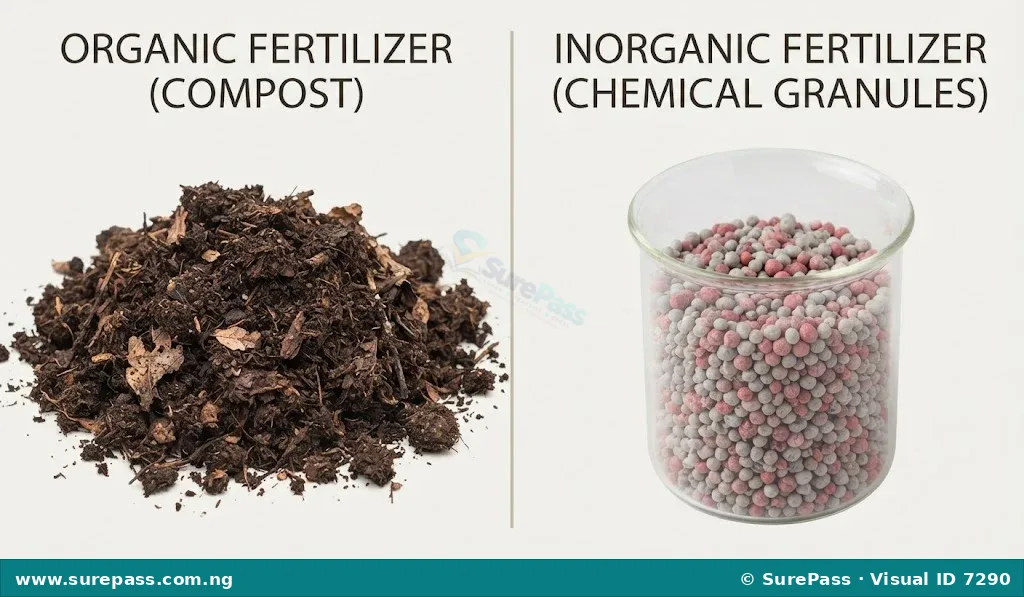
Organic fertilizers are derived from decayed plant and animal materials. They are natural substances that undergo decomposition by soil microorganisms before releasing nutrients to the soil. In addition to supplying nutrients, organic fertilizers improve soil structure, increase water-holding capacity, and promote microbial activity.
Common examples of organic fertilizers include:
- Farmyard Manure: This consists of animal wastes, such as dung and urine, mixed with animal bedding materials like straw or wood shavings.
- Compost Manure: This is a mixture of decayed organic materials, including crop residues, kitchen wastes, and weeds, decomposed under controlled conditions.
- Green Manure: This involves growing fast-growing leguminous crops and ploughing them back into the soil while they are still green and succulent.
- Poultry Droppings: This is the waste collected from poultry pens, which is highly rich in nitrogen and organic matter.
Inorganic Fertilizers
Inorganic fertilizers, also known as chemical or mineral fertilizers, are manufactured synthetically from non-living materials. They contain concentrated plant nutrients that are readily soluble and easily absorbed by plants. Inorganic fertilizers are classified based on the number of primary nutrients they contain.
The classifications of inorganic fertilizers include:
- Straight Fertilizers: These contain only one primary plant nutrient. Examples include Urea (supplying Nitrogen), Single Superphosphate (supplying Phosphorus), and Muriate of Potash (supplying Potassium).
- Compound or Mixed Fertilizers: These contain two or more primary plant nutrients chemically combined or physically mixed. A common example is NPK fertilizer (such as NPK 15-15-15), which supplies Nitrogen, Phosphorus, and Potassium in specific ratios.
Observe the image below to see the physical differences between organic and inorganic fertilizers.
Uses of Fertilizer
Fertilizers play a critical role in crop production and soil management. Their primary functions are directed toward enhancing crop productivity and maintaining soil health.
The main uses of fertilizers in agriculture include:
- Restoring Soil Fertility: Continuous cropping depletes soil nutrients. Fertilizers replenish these essential elements, restoring the productive capacity of the soil.
- Promoting Vegetative Growth: Nitrogen-rich fertilizers stimulate rapid vegetative growth, leading to healthy green leaves, stems, and branches.
- Enhancing Root Development: Phosphatic fertilizers promote strong root growth and development, which helps plants absorb water and nutrients from deeper soil layers.
- Improving Crop Yield and Quality: The application of balanced fertilizers increases the size, weight, and nutritional quality of seeds, fruits, and tubers.
- Correcting Nutrient Deficiencies: When crops show symptoms of nutrient deficiency, such as yellowing of leaves (chlorosis), targeted fertilizers are applied to correct the specific deficiency.
- Accelerating Maturity and Flowering: Potassium and phosphorus-rich fertilizers encourage early flowering, fruit set, and uniform ripening of crops.
Methods of Fertilizer Application
The choice of fertilizer application method depends on the crop type, soil conditions, topography, and the type of fertilizer being used. Proper application ensures that nutrients are efficiently absorbed by plants while minimizing losses through leaching, volatilization, or surface runoff.
The diagram below illustrates the different methods of applying fertilizer to crops.
1. The Broadcasting Method
Broadcasting is the even distribution of fertilizer over the entire soil surface. This method is commonly used for closely spaced crops, pastures, and cereal crops like rice and wheat. It can be done manually by hand or mechanically using fertilizer spreaders.
The practical procedure for broadcasting fertilizer involves the following steps:
- Measure the required quantity of fertilizer based on the field area.
- Ensure the soil surface is moist but not waterlogged to prevent the fertilizer from washing away.
- Walk systematically across the field, throwing the fertilizer granules evenly in a sweeping motion of the hand.
- For better distribution, divide the fertilizer into two equal portions; broadcast the first half in one direction (e.g., north to south) and the second half crosswise (e.g., east to west).
- Incorporate the fertilizer lightly into the soil using a hand rake or hoe where necessary to reduce nutrient loss.
2. The Ring Method
The ring method involves applying fertilizer in a circular band around individual plants. This method is highly efficient for widely spaced crops, such as fruit trees, maize, and oil palm, as it places nutrients directly within the reach of the plant’s root system.
The practical procedure for the ring method involves the following steps:
- Identify the drip line of the plant, which is the circular area directly beneath the outermost edge of the plant’s canopy where active roots are located.
- Use a stick or hand hoe to dig a shallow groove, about 3 to 5 centimetres deep, in a complete circle around the plant. Keep the groove at least 10 to 15 centimetres away from the plant stem to avoid fertilizer burn.
- Measure the recommended dose of fertilizer for the individual plant.
- Distribute the fertilizer evenly along the circular groove.
- Cover the groove with soil immediately to prevent nutrient loss through evaporation or surface runoff.
3. The Side Placement Method
Side placement involves placing fertilizer in a continuous band or in localized pockets along one or both sides of a crop row. This method is suitable for crops grown in rows, such as maize, cowpea, and okra, ensuring that the fertilizer is close to the roots without touching the stems.
The practical procedure for side placement involves the following steps:
- Locate the crop rows and determine the side of the row where the fertilizer will be placed.
- Dig a shallow furrow or a series of small pockets parallel to the crop row, keeping a distance of about 5 to 10 centimetres from the plant stems.
- Place the fertilizer uniformly along the furrow or distribute equal amounts into each pocket.
- Cover the furrow or pockets with soil and press it down lightly to secure the fertilizer.
4. The Band Placement Method
Band placement is the application of fertilizer in narrow bands or strips near the seed or plant row, usually at the time of planting. The fertilizer is placed slightly below and to the side of the seed to prevent direct contact, which could damage the germinating seed.
The practical procedure for band placement involves the following steps:
- Dig a planting furrow along the seedbed.
- Dig a second, narrower furrow parallel to the planting furrow, positioned about 5 centimetres to the side and 5 centimetres deeper than the seed depth.
- Apply a continuous, thin band of fertilizer along the bottom of the fertilizer furrow.
- Cover the fertilizer band with a thin layer of soil.
- Sow the seeds in the planting furrow and cover them with soil, ensuring they do not come into direct contact with the fertilizer band.
5. The Incorporation Method
Incorporation is the process of mixing fertilizer thoroughly into the topsoil layer. This method is highly effective for organic manures and volatile inorganic fertilizers (like Urea) because it places the nutrients directly into the root zone and prevents loss into the atmosphere.
The practical procedure for incorporation involves the following steps:
- Spread the fertilizer or organic manure evenly over the soil surface.
- Use a hand hoe, spade, or garden fork to till the soil, turning it over to mix the fertilizer with the top 10 to 15 centimetres of soil.
- Rake the soil surface to level the bed and break up any large soil clods.
- Water the soil lightly to initiate the dissolution and release of nutrients.
Safety Precautions in Fertilizer Application
Fertilizers contain concentrated chemical compounds that can be hazardous if handled improperly. Important safety tips include:
- Wear Protective Gear: Hand gloves, nose masks, and protective boots should be worn during application to prevent skin irritation and inhalation of chemical dust.
- Avoid Direct Contact with Stems and Leaves: Inorganic fertilizers should not touch plant foliage or stems directly, as this can cause chemical burns (fertilizer burn).
- Apply Under Favourable Weather Conditions: Avoid applying fertilizer during heavy rains to prevent leaching and runoff, and avoid windy days when broadcasting to prevent the fertilizer from blowing away.
- Wash Hands Thoroughly: Hands and any exposed skin must be washed thoroughly with soap and clean water immediately after handling fertilizers.
- Store Safely: Fertilizers must be stored in a cool, dry place, out of reach of children and animals, and away from water sources.
Summary of Fertilizer Application Methods
The table below summarizes the key features of each fertilizer application method.
| Application Method | Best Suited Crops | Key Advantage | Primary Precaution |
|---|---|---|---|
| Broadcasting | Closely spaced crops, pastures, cereals | Fast and covers large areas easily | High risk of nutrient loss if not incorporated |
| Ring Method | Tree crops, widely spaced crops | Delivers nutrients directly to the root zone | Keep ring away from the stem to avoid burns |
| Side Placement | Row crops (maize, okra, cowpea) | Efficient nutrient uptake along crop rows | Do not place too close to the plant roots |
| Band Placement | Sown seeds, row crops at planting | Provides early nutrients to young seedlings | Avoid direct contact between seed and fertilizer |
| Incorporation | Organic manure, volatile fertilizers | Reduces nutrient loss to the atmosphere | Requires physical labour to mix with soil |


0 comments
Open the discussion when you need it. Comments stay collapsed until requested so the initial article remains light.