


ARTICLE CONTENTSOn this page 6 sections
Cropping Patterns
Performance Objectives
By the end of the lesson, students should be able to:
- explain the meaning and importance of cropping pattern;
- carry out different cropping patterns.
Meaning of Cropping Pattern
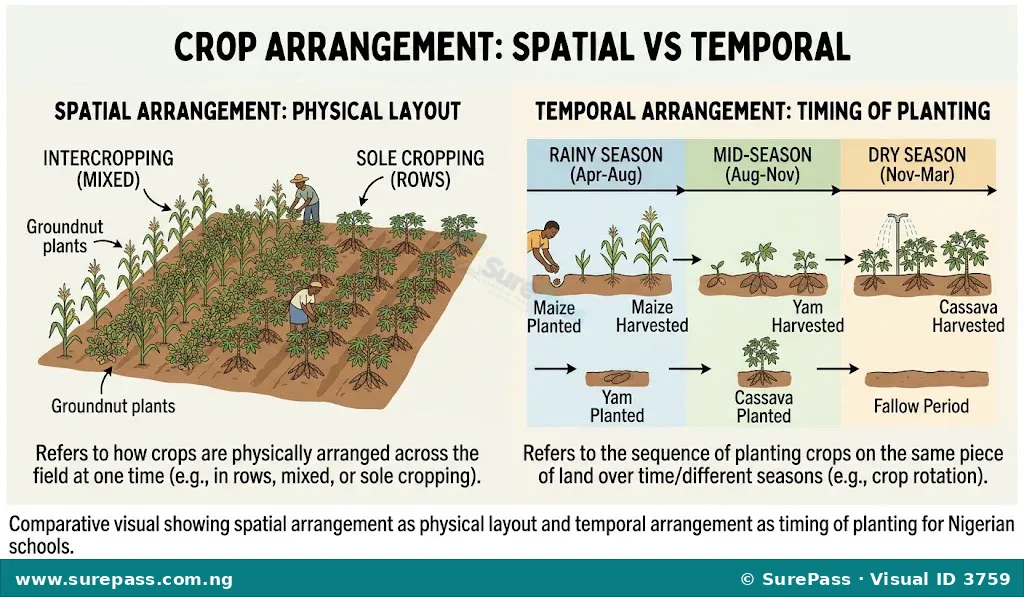
Cropping pattern refers to the spatial and temporal arrangement of crops on a given area of land over a specific period.
The spatial arrangement refers to how crops are physically distributed across the field, including row spacing, plant density, and the mixing of different crop species. The temporal arrangement refers to the timing and sequence of planting and harvesting crops on the same piece of land over different seasons or years. Choosing an appropriate cropping pattern is a fundamental decision in agricultural management, as it directly influences soil health, resource utilization, and overall crop yield.
Importance of Cropping Patterns
Adopting systematic cropping patterns is essential for sustainable agricultural production. The main reasons for adopting specific cropping patterns include:
- Soil Fertility Maintenance: Alternating or mixing crops with different nutrient requirements prevents the depletion of specific soil nutrients. For example, incorporating leguminous crops helps fix atmospheric nitrogen into the soil, benefiting subsequent or companion crops.
- Pest and Disease Control: Continuous cultivation of a single crop allows pest and pathogen populations to build up in the soil. Changing the crop species breaks the life cycles of these pests and diseases, reducing their impact.
- Weed Suppression: Different crops provide varying levels of soil cover. Dense canopy crops shade out weeds, reducing weed growth and the need for chemical herbicides.
- Erosion Control: Keeping the soil covered with crops of different growth habits throughout the year protects the soil surface from the erosive forces of wind and water.
- Risk Minimization: Growing a variety of crops ensures that if one crop fails due to unfavorable weather, pests, or market price fluctuations, the farmer can still harvest and sell other crops.
- Efficient Resource Utilization: Different crops have different root depths and canopy structures. Mixing them allows for better utilization of sunlight, water, and soil nutrients from different soil layers.
- Balanced Labor Distribution: Planting and harvesting different crops at different times of the year helps distribute farm labor requirements evenly, preventing labor shortages during peak seasons.
Types of Cropping Patterns
Farmers adopt different cropping patterns based on climatic conditions, soil types, available technology, and market demands. The major types of cropping patterns are detailed below.
Monocropping
Monocropping, also known as sole cropping, is the practice of growing only one type of crop on a piece of land at any given time.
This pattern is common in commercial agriculture where mechanization is highly utilized. Examples of crops grown under monocropping include maize, rice, cassava, and oil palm. While it simplifies farm operations and harvesting, it increases the risk of total crop failure and soil degradation if practiced continuously without soil conservation measures.
Mixed Cropping
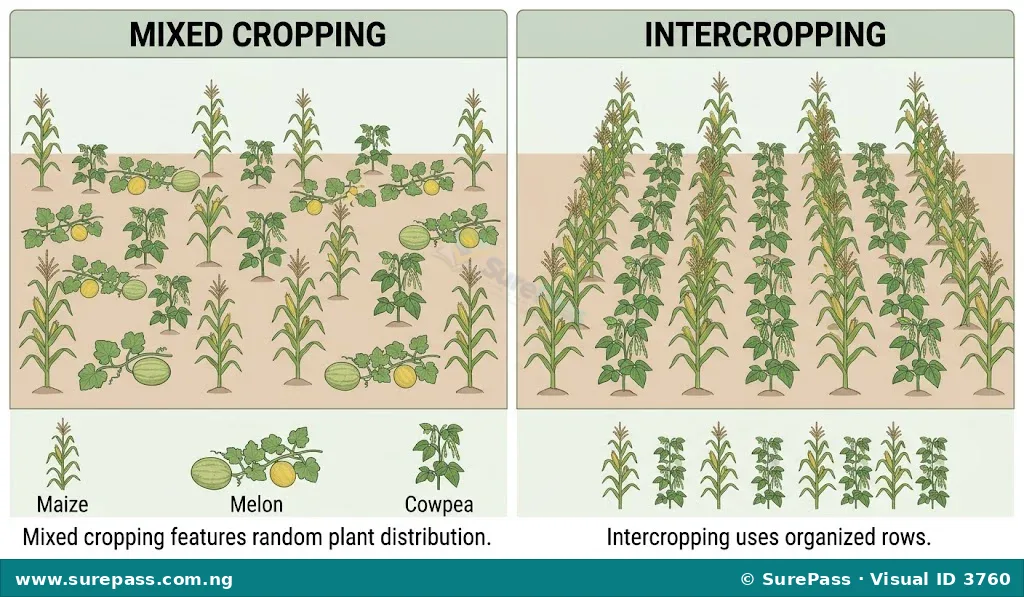
Mixed cropping is the practice of growing two or more crops simultaneously on the same piece of land without any distinct row arrangement.
The seeds of different crops are often mixed together and sown, or planted randomly across the field. This is a traditional farming practice in Nigeria, commonly involving crops like maize, cowpea, melon, and yam. It provides a continuous ground cover and secures food diversity for the farming household.
Intercropping
Intercropping is the practice of growing two or more crops simultaneously on the same piece of land in a definite spatial or row arrangement.
Unlike mixed cropping, intercropping maintains organized rows, which makes weeding, fertilizer application, and harvesting easier. Common examples include planting alternate rows of maize and cowpea, or rows of cassava alternated with groundnut.
Crop Rotation
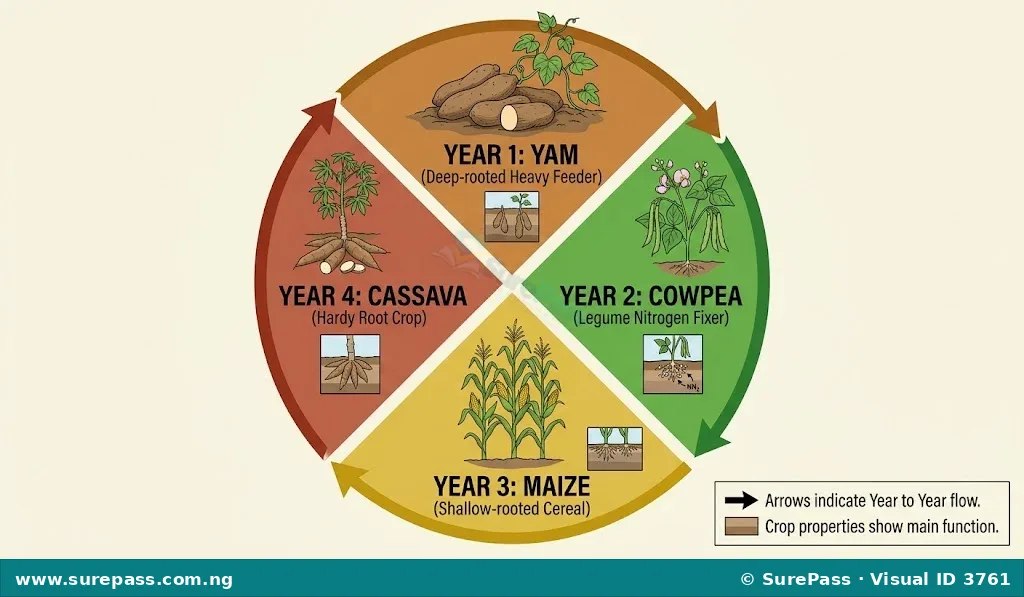
Crop rotation is the practice of growing different types of crops in a planned sequence on the same piece of land over successive seasons.
A typical crop rotation system divides the farmland into plots, and crops are moved from one plot to another in a cycle. The principles of designing an effective crop rotation plan include:
- Deep-rooted crops should be followed by shallow-rooted crops to utilize nutrients from different soil depths.
- Leguminous crops must be included in the rotation to restore soil nitrogen.
- Crops belonging to the same botanical family, such as tomato and pepper, should not follow each other to prevent the carryover of shared pests and diseases.
- Heavy feeders, which consume large amounts of nutrients, should be followed by light feeders or cover crops.
Relay Cropping
Relay cropping is the practice of planting a second crop into an existing standing crop before the first crop is harvested.
The second crop is introduced when the first crop has reached its reproductive stage but has not yet been cleared from the field. This maximizes the use of the growing season, especially in regions with short rainy seasons. An example is planting cowpea into a standing field of mature maize shortly before the maize harvest.
Strip Cropping
Strip cropping is the practice of growing different crops in systematic strips across the slope of the land to control soil erosion.
In this system, strips of erosion-permitting crops, such as maize, are alternated with strips of erosion-resistant cover crops, such as groundnut or melon. The cover crops slow down surface runoff and trap soil particles washed down from the row crop strips.
Practical Guide: Carrying Out Different Cropping Patterns
This section provides practical procedures for establishing two key cropping patterns on the school farm: an intercropping system and a crop rotation system.
How to Establish an Intercropping System (Maize and Cowpea)
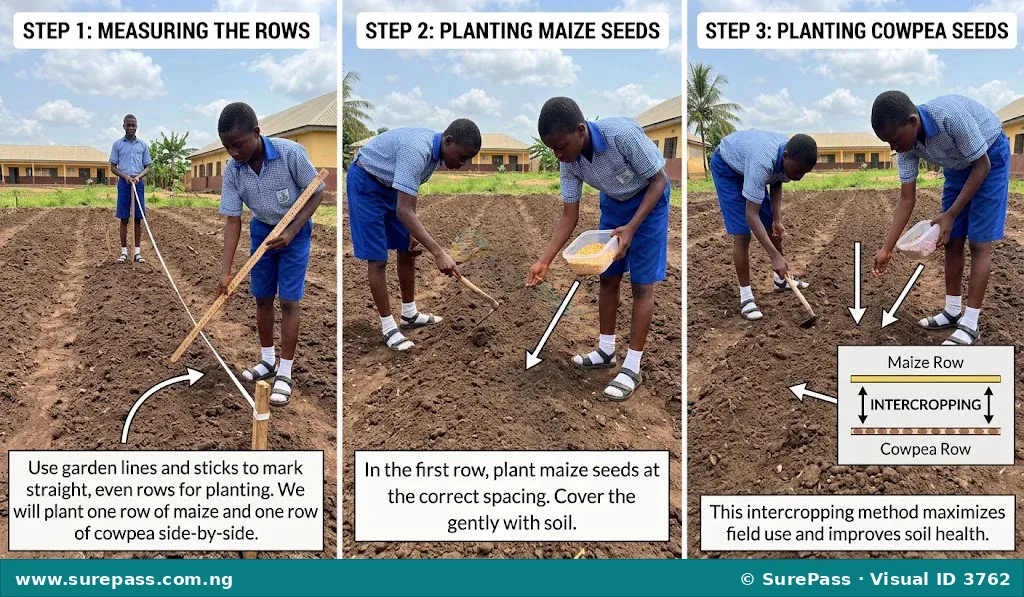
This practical exercise demonstrates how to plant maize and cowpea in a systematic row arrangement to maximize resource use and soil fertility.
The required materials for this practical exercise are:
- Maize seeds
- Cowpea seeds
- Hand hoes
- Measuring tape
- Garden lines and pegs
- NPK 15-15-15 fertilizer
The procedure for establishing the intercropping system involves the following steps:
- Select a flat, well-drained plot of land on the school farm and clear all weeds and debris.
- Use the measuring tape, garden lines, and pegs to mark out a plot measuring 10 meters by 10 meters.
- Mark out planting rows at a spacing of 75 centimeters apart across the plot.
- Plant the maize seeds along the first row at a spacing of 25 centimeters between plants, placing two seeds per hole at a depth of 3 to 5 centimeters.
- Skip the second row to leave space for the companion crop.
- Plant the cowpea seeds along the third row at a spacing of 30 centimeters between plants, placing two seeds per hole at a depth of 2 to 3 centimeters.
- Repeat this alternating pattern of one row of maize and one row of cowpea across the entire plot.
- Apply NPK fertilizer to the maize rows three weeks after planting, placing the fertilizer in a ring or band 10 centimeters away from the base of the plants.
- Keep the plot free of weeds by manual hoeing as necessary until the crop canopy closes.
How to Design and Implement a Four-Year Crop Rotation Plan
This exercise guides the layout and management of a long-term crop rotation system using four distinct plots of land.
The required materials for this practical exercise are:
- Four equal plots of land marked as Plot A, Plot B, Plot C, and Plot D
- Planting materials for four crop groups: Yam (tubers), Cowpea (legumes), Maize (cereals), and Cassava (hardy root crops)
- Garden tools including cutlasses, hoes, and spades
- Wooden labels and permanent markers to label each plot
The implementation of the rotation plan follows the schedule shown in the table below:
| Year | Plot A | Plot B | Plot C | Plot D |
|---|---|---|---|---|
| Year 1 | Yam (Deep root, heavy feeder) | Cowpea (Legume, nitrogen fixer) | Maize (Shallow root, cereal) | Cassava (Hardy root crop) |
| Year 2 | Cowpea (Legume, nitrogen fixer) | Maize (Shallow root, cereal) | Cassava (Hardy root crop) | Yam (Deep root, heavy feeder) |
| Year 3 | Maize (Shallow root, cereal) | Cassava (Hardy root crop) | Yam (Deep root, heavy feeder) | Cowpea (Legume, nitrogen fixer) |
| Year 4 | Cassava (Hardy root crop) | Yam (Deep root, heavy feeder) | Cowpea (Legume, nitrogen fixer) | Maize (Shallow root, cereal) |
The procedure for carrying out this crop rotation plan involves the following steps:
- Divide the designated agricultural site into four equal plots, leaving a 1-meter pathway between the plots for easy access.
- Install wooden labels at the front of each plot, clearly marking them as Plot A, Plot B, Plot C, and Plot D.
- In the first year, prepare the soil according to the specific needs of each crop: make high ridges or mounds for yam in Plot A, prepare flat beds for cowpea in Plot B, make standard ridges for maize in Plot C, and make ridges for cassava in Plot D.
- Plant the designated crops in their respective plots as scheduled for Year 1.
- Manage each plot throughout the growing season by weeding, applying organic manure or fertilizer where necessary, and harvesting at maturity.
- At the beginning of the second year, clear the crop residues and shift the crops to the next plot according to the rotation table (for example, plant cowpea in Plot A where yam was previously grown).
- Repeat the shifting process in Year 3 and Year 4 to complete one full cycle of the rotation.




0 comments
Open the discussion when you need it. Comments stay collapsed until requested so the initial article remains light.