



ARTICLE CONTENTSOn this page 11 sections
Crop varieties
Performance Objectives
By the end of the lesson, students should be able to:
- explain the meaning and importance of crop varieties;
- identify types of crop varieties;
- identify the types of horticultural crops.
Meaning of Crop Varieties
A crop variety is a group of plants within a single botanical species that share distinct, uniform and stable characteristics which distinguish them from other groups within the same species.
In agricultural science, plants belonging to the same species can look or behave differently due to variations in their genetic makeup. For example, while white maize and yellow maize both belong to the species Zea mays, they represent different crop varieties because of differences in grain colour, nutritional content and sometimes maturity periods. Farmers select specific varieties based on the environmental conditions of the farm and the demands of the market.
Importance of Crop Varieties
The selection of the right crop variety is a critical decision in agricultural production. It directly influences the success of the farming enterprise, resource utilization and food security.
The main reasons for the importance of crop varieties include:
- Yield Maximization: Certain improved varieties are bred specifically to produce higher quantities of grains, tubers or fruits per unit area compared to traditional varieties.
- Pest and Disease Resistance: Some crop varieties possess genetic resistance or tolerance to devastating pests and pathogens, reducing the need for expensive chemical pesticides.
- Environmental Adaptation: Specific varieties are developed to tolerate harsh environmental conditions such as drought, soil acidity, salinity or extreme temperatures.
- Maturity Period Control: Early-maturing varieties allow farmers to harvest quickly, escape late-season drought or plant multiple times within a single growing season.
- Quality Improvement: Varieties are often selected for superior market qualities, such as better taste, higher oil content, improved milling quality, longer shelf life or higher nutritional value.
- Uniformity of Growth: Modern crop varieties often grow and mature at the same rate, which makes mechanical harvesting and field management much easier.
Types of Crop Varieties
Crop varieties are broadly classified into two major groups based on their origin, development and genetic structure. These are local varieties and improved varieties.
1. Local Varieties (Landraces)
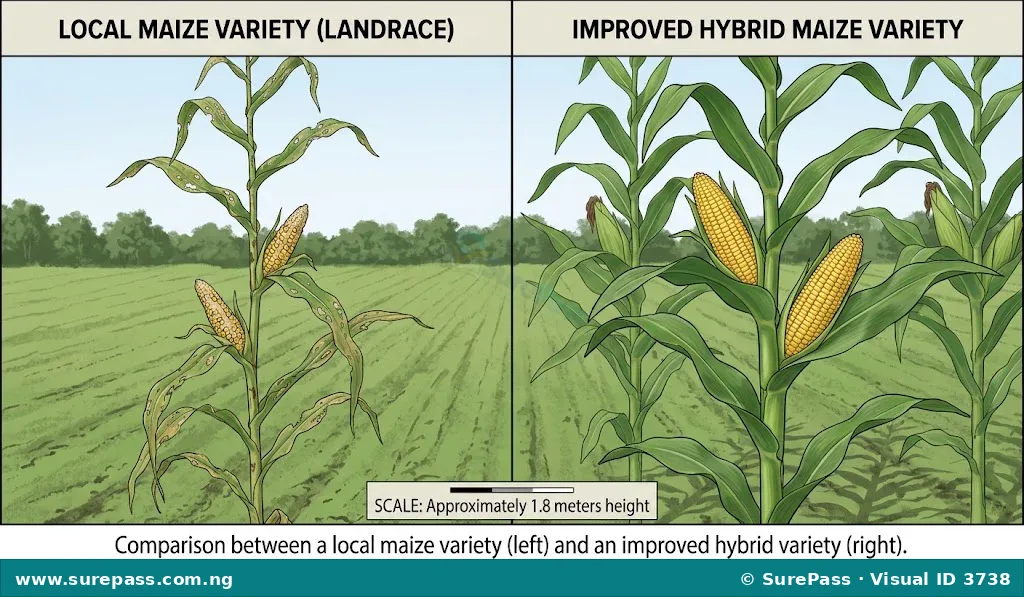
Local varieties, also known as landraces, are traditional crop varieties that have been grown and selected by farmers over many generations in a specific geographic area.
These varieties have adapted naturally to the local climate, soil conditions and endemic pests of their environment. While they are highly resilient and require fewer inputs, they generally produce lower yields and have highly variable growth characteristics.
2. Improved Varieties
Improved varieties are crop plants that have been scientifically bred and developed by plant breeders in research institutes to possess specific desirable traits.
Examples of research institutes in Nigeria that develop these varieties include the International Institute of Tropical Agriculture (IITA) in Ibadan and the Institute for Agricultural Research (IAR) in Zaria. Improved varieties are further divided into sub-types based on their breeding methods.
The main types of improved crop varieties are:
- Hybrids: These are the first-generation offspring (F1) produced by crossing two genetically distinct parent lines of the same species. Hybrids exhibit high vigor, uniform growth and exceptionally high yields, but the seeds harvested from them cannot be replanted in the next season without a significant loss in yield and uniformity.
- Open-Pollinated Varieties (OPVs): These are varieties produced through natural pollination by wind, insects or water. The seeds harvested from open-pollinated crops can be saved and replanted by farmers for several seasons while still maintaining reasonable yield and characteristics.
- Genetically Modified Varieties (GMVs): These are varieties developed by introducing specific genes from other organisms into the crop’s DNA using biotechnology. This process gives the plant unique traits, such as resistance to specific insect pests or tolerance to chemical herbicides.
Observe the visual comparison below showing the differences in growth and yield characteristics between a local crop variety and an improved hybrid variety.
Identification of Crop Varieties
Farmers and agricultural scientists identify different crop varieties by observing specific physical and physiological features. This process is essential for selecting the correct planting materials.
The primary features used to identify crop varieties include:
- Seed Characteristics: Variations in seed colour, shape, size and texture. For example, cowpea varieties can be identified as white, brown, rough-seeded or smooth-seeded.
- Growth Habit: The physical form of the plant, such as erect, semi-erect, climbing or creeping. Cowpea varieties can be erect (bush type) or climbing (vining type).
- Leaf Morphology: Differences in leaf shape, size, colour and hairiness. Cassava varieties are often identified by the shape and number of lobes on their leaves.
- Stem and Petiole Colour: The presence of green, purple or reddish pigment on the stems and leaf stalks. Cassava varieties often show distinct stem and petiole colourations.
- Maturity Period: The time taken from planting to harvest, categorised into early-maturing, medium-maturing or late-maturing varieties.
Meaning of Horticultural Crops
Horticultural crops are high-value plants grown intensively in gardens, orchards or nurseries for food, medicinal purposes, aesthetic value or environmental beautification.
Unlike field crops, which are grown on large expanses of land with minimal individual attention, horticultural crops require intensive cultivation, careful handling, high capital input and specialized post-harvest management due to their highly perishable nature.
Types of Horticultural Crops
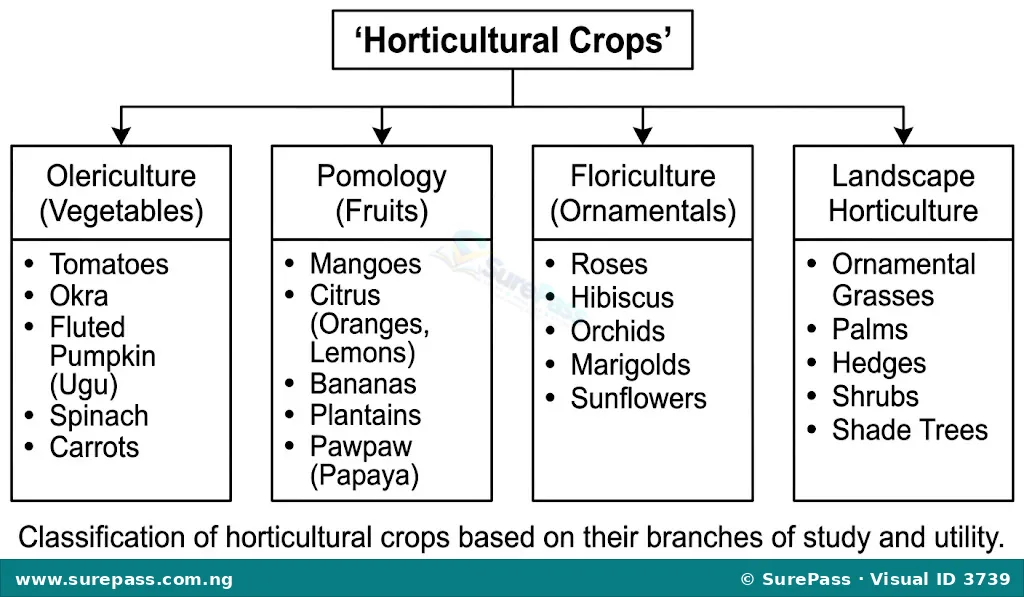
Horticultural crops are classified into four major branches based on their uses and the parts of the plant that are utilized.
The classification of horticultural crops is illustrated in the diagram below.
1. Olericulture (Vegetables)
Olericulture is the branch of horticulture that deals with the production, storage, processing and marketing of vegetable crops.
Vegetables are herbaceous plants whose parts are eaten raw or cooked as part of a meal. They are rich sources of vitamins, minerals and dietary fibre.
Vegetables are grouped based on the edible parts:
- Leafy Vegetables: Plants grown for their edible leaves and shoots. Examples include fluted pumpkin (ugu), waterleaf, bitter leaf, spinach and cabbage.
- Fruit Vegetables: Plants grown for their edible fruits. Examples include tomato, pepper, garden egg, cucumber and okra.
- Root and Tuber Vegetables: Plants grown for their underground storage organs. Examples include carrot, radish and onion.
2. Pomology (Fruits)
Pomology is the branch of horticulture that deals with the cultivation, harvesting and marketing of fruit-bearing crops.
Fruits are the mature, seed-bearing ovaries of flowering plants. They are typically sweet or acidic and are consumed fresh or processed into juices and preserves.
Common examples of fruit crops grown in Nigeria include:
- Citrus Fruits: Sweet orange, lime, lemon, tangerine and grapefruit.
- Tropical Tree Fruits: Mango, avocado pear, guava, cashew and pawpaw.
- Herbaceous Fruits: Pineapple, banana and plantain.
3. Floriculture (Ornamental and Flower Crops)
Floriculture is the branch of horticulture that deals with the cultivation of flowering and ornamental plants for gardens, floral industries and aesthetic purposes.
These plants are grown for their beautiful flowers, attractive foliage, pleasant scent or unique shapes. They are used for indoor decoration, outdoor gardening, bouquets and social ceremonies.
Common examples of floricultural crops include:
- Flowering Plants: Rose, hibiscus, marigold, lily, orchid and pride of Barbados.
- Foliage Plants: Dieffenbachia, croton, fern and palms.
4. Landscape Horticulture
Landscape horticulture is the branch of horticulture that deals with the selection, planting and maintenance of plants to beautify and improve outdoor environments.
This includes the establishment of lawns, parks, recreational areas and the planting of shade trees along roadsides to control erosion and reduce environmental pollution.
Common plants used in landscape horticulture include:
- Turfgrasses: Bahama grass, carpet grass and Bermuda grass used for lawns and sports fields.
- Shade Trees: Masquerade tree (polyalthia), neem tree (dongoyaro) and whistling pine.
- Ornamental Shrubs: Bougainvillea and ixora.
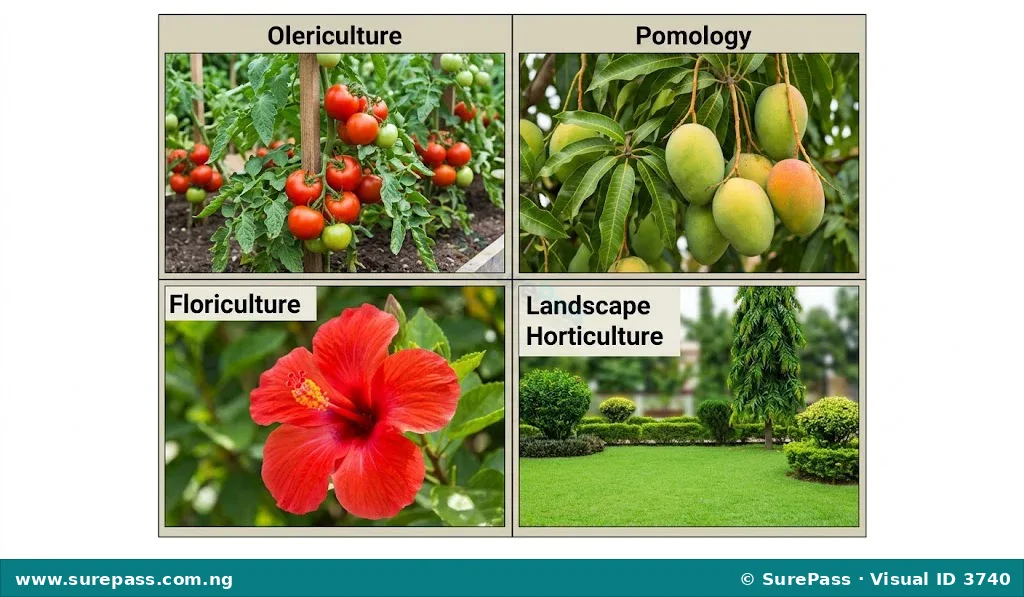
Observe the images below showing representative examples of the different types of horticultural crops cultivated in Nigeria.
Identification of Horticultural Crops
Horticultural crops can be identified and distinguished from agronomic field crops by observing their growth habits, management requirements and physical structures.
The key features used to identify and classify horticultural crops include:
- Growth Environment: Horticultural crops are typically grown in enclosed gardens, nurseries, greenhouses or orchards rather than open, extensive fields.
- Moisture Content and Texture: Most horticultural crops, especially fruits and vegetables, have a very high water content, making them succulent, soft and highly perishable.
- Aesthetic Features: Floriculture and landscape plants are easily identified by their bright flower colours, variegated leaves, pleasant scents and symmetrical growth forms.
- Propagation Methods: Many horticultural crops are propagated vegetatively using budding, grafting, layering or stem cuttings, rather than relying solely on seeds.
Practical Activity: Identifying and Classifying Crop and Horticultural Varieties
This practical activity guides learners on how to observe, identify and classify different crop varieties and horticultural crops using physical specimens.
Required Materials:
- Samples of different maize seeds (white, yellow, sweet corn).
- Samples of different cowpea seeds (brown, white, rough, smooth).
- Fresh specimens of leafy vegetables (ugu, waterleaf).
- Fresh specimens of fruit vegetables (tomato, pepper, garden egg).
- Fresh specimens of fruits (orange, mango, banana).
- Specimens of ornamental plants (hibiscus flower, croton leaf).
- Hand lenses, notebooks and pens.
Procedure:
- Place the seed samples of maize and cowpea on clean sheets of paper on the laboratory bench.
- Use a hand lens to observe the differences in seed coat texture, colour, shape and size. Record these observations in a table.
- Group the seeds of the same species into their respective varieties based on the observed physical differences.
- Examine the fresh specimens of vegetables, fruits and ornamental plants.
- Classify each horticultural specimen into its correct branch: Olericulture, Pomology, Floriculture or Landscape Horticulture.
- Draw and label one representative specimen from each horticultural group in the notebook.
Safety Precautions:
- Do not taste any seed sample, as some planting seeds are treated with toxic chemical preservatives.
- Handle sharp tools such as knives or scalpels with care when cutting fruit specimens.
- Wash hands thoroughly with soap and water after handling plant specimens.
Summary of Key Differences
The table below summarizes the key differences between agronomic field crops and horticultural crops to assist in proper identification.
| Feature | Agronomic Field Crops | Horticultural Crops |
|---|---|---|
| Scale of Cultivation | Grown on a large scale (extensive farming). | Grown on a small, intensive scale (gardens/orchards). |
| Perishability | Low moisture content; easy to store dry (e.g., grains). | High moisture content; highly perishable. |
| Individual Attention | Low attention per plant. | High individual attention per plant (pruning, staking). |
| Primary Use | Staple food, animal feed and industrial raw materials. | Fresh consumption, vitamins, aesthetics and decoration. |





0 comments
Open the discussion when you need it. Comments stay collapsed until requested so the initial article remains light.