


ARTICLE CONTENTSOn this page 8 sections
Planting
Performance Objectives
By the end of the lesson, students should be able to:
- explain the meaning of planting;
- identify different types of planting materials and tools;
- plant using different practices.
Meaning of Planting
Planting is the act of placing planting materials, such as seeds, seedlings, cuttings, or tubers, into the soil or a growing medium to germinate, grow, and develop into mature crops.
This process is a critical stage in crop production and horticulture. Successful planting requires proper soil preparation, correct timing, appropriate depth, and accurate spacing to ensure that crops receive adequate nutrients, sunlight, and water for optimal yield.
Types of Planting Materials
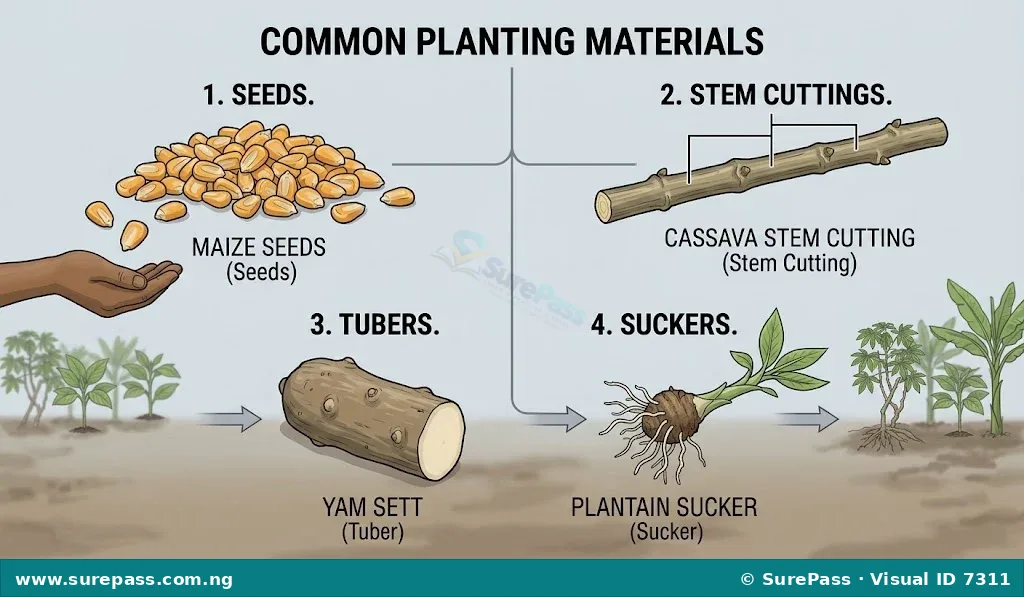
Planting materials are the parts of a plant used to propagate or start new crops. These materials are broadly classified into two main categories: seeds and vegetative materials.
Seeds
Seeds are the product of sexual reproduction in plants. They are the most common planting materials used for grain crops, legumes, and many vegetables. Healthy, viable seeds must be selected to ensure high germination rates.
Examples of crops grown from seeds include:
- Maize
- Cowpea
- Rice
- Okra
- Tomato
Vegetative Materials
Vegetative materials are parts of a plant used for asexual propagation. This method involves using vegetative organs such as stems, roots, leaves, or modified underground structures to grow new plants that are genetically identical to the parent plant.
Common types of vegetative planting materials include:
- Stem Cuttings: Portions of stems containing buds, which are cut and planted directly into the soil. Examples include cassava and sweet potato.
- Tubers: Swollen underground stems or roots that store food. Examples include yam and Irish potato.
- Suckers: Lateral shoots that develop from the base of the parent plant. Examples include plantain, banana, and pineapple.
- Bulbs: Short underground stems surrounded by fleshy leaves. An example is onion.
- Rhizomes: Horizontal underground stems that produce shoots and roots. An example is ginger.
Observe the diagram below showing different types of planting materials.
Planting Tools
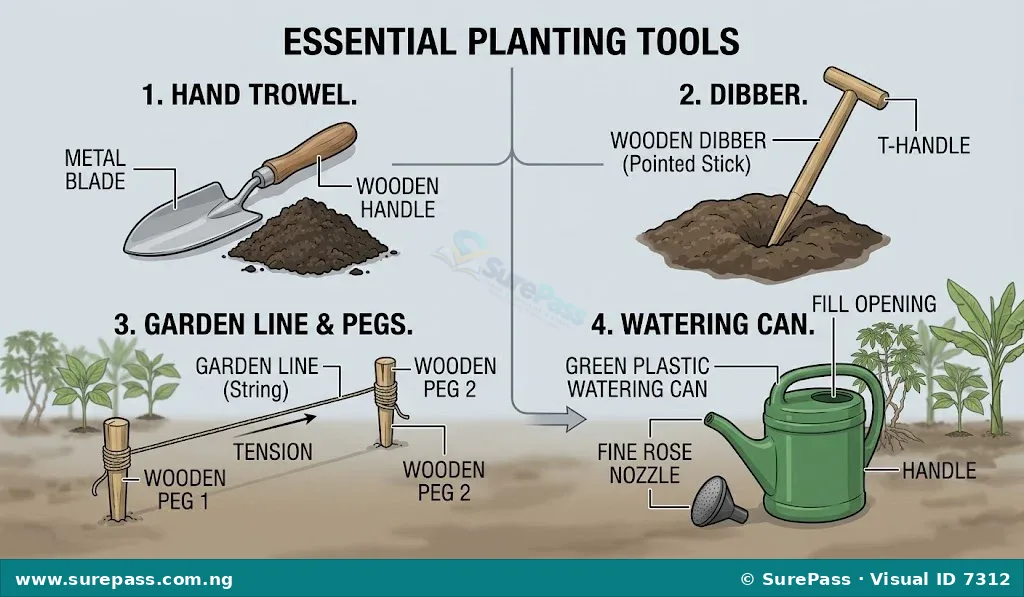
Planting tools are hand-held implements used to prepare the soil, make holes, measure distances, and handle delicate seedlings during the planting process. Using the correct tools prevents damage to planting materials and reduces physical labour.
Common planting tools and their specific uses include:
- Hand Trowel: A small tool with a curved scoop-like blade used for digging small holes and lifting delicate seedlings during transplanting.
- Dibber (or Dibble): A pointed wooden or metal peg used to poke small, uniform holes in the soil for sowing seeds or planting small seedlings.
- Garden Line and Pegs: A strong string stretched between two wooden or metal pegs, used to mark straight rows and maintain accurate spacing on the field.
- Hand Fork: A small tool with three or four prongs used to loosen the soil around seedlings in a nursery bed before they are lifted.
- Watering Can: A portable container with a nozzle or “rose” used to apply water gently to newly planted seeds or transplanted seedlings without washing away the soil.
- Spade and Hoe: Larger tools used to dig planting holes, clear weeds, and create ridges or mounds for vegetative materials like yam tubers.
Look at the planting tools shown below.
Planting Methods and Practices
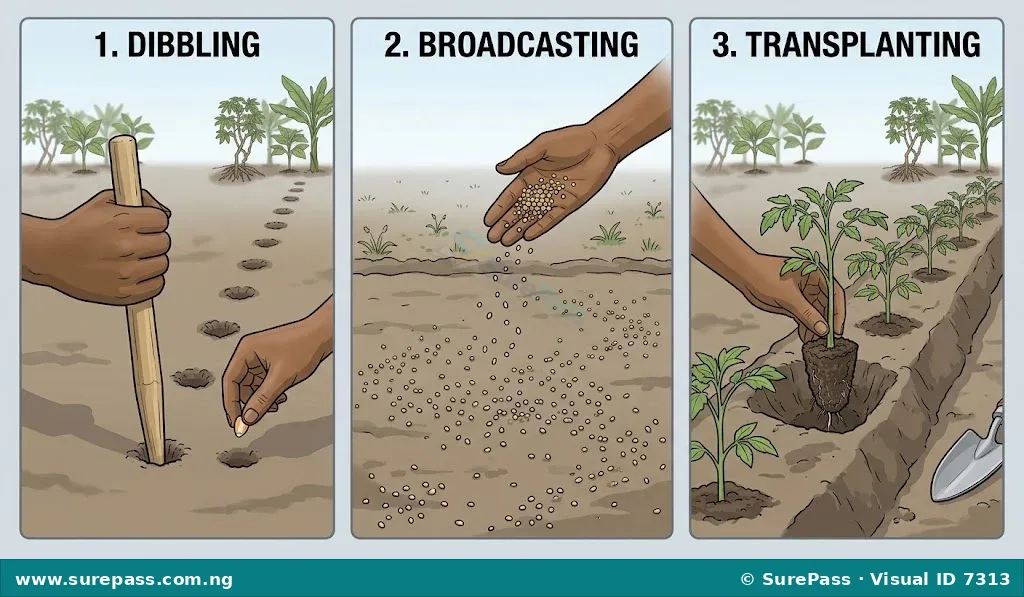
Different crops require different planting methods based on seed size, growth habits, and environmental requirements. The three primary planting practices are dibbling, broadcasting, and transplanting.
Dibbling
Dibbling is the practice of making small holes in the soil at regular intervals and placing one or more seeds or vegetative parts into each hole, which is then covered with soil.
This method ensures precise spacing and depth, which helps in calculating seed rates and makes subsequent operations like weeding and harvesting easier. Crops commonly planted by dibbling include maize, cowpea, groundnut, and melon.
Broadcasting
Broadcasting is the random scattering of seeds over the surface of a prepared seedbed. This method is typically used for small seeds that do not require deep planting.
After scattering, the seeds are usually covered lightly with soil using a rake or by dragging light branches over the field. While broadcasting is fast and requires less labour, it often results in uneven crop distribution, high seed wastage, and difficulty in controlling weeds. Crops commonly planted by broadcasting include rice, forage grasses, and small-seeded vegetables like amaranthus.
Transplanting
Transplanting is the transfer of young, healthy seedlings from a temporary nursery bed or container to their permanent positions in the main field.
This practice is common for crops with very tiny seeds that require close attention and protection during their early stages of growth. Transplanting allows farmers to select only the healthiest seedlings for the field, leading to uniform crop growth. Crops commonly propagated by transplanting include tomato, pepper, onion, cabbage, and cocoa.
Observe the diagram below illustrating the three planting methods.
Practical Procedures for Planting
To achieve successful crop establishment, specific procedures must be followed for each planting method. These step-by-step guides outline the correct techniques for dibbling, broadcasting, and transplanting.
How to Plant Using the Dibbling Method
This procedure is used to plant medium to large seeds in straight, evenly spaced rows.
The required materials are:
- Maize or cowpea seeds
- Garden line and pegs
- Dibber or hand hoe
- Measuring tape
The procedure involves the following steps:
- Clear the planting plot and prepare a clean seedbed.
- Drive two pegs into the ground at opposite ends of the plot and stretch the garden line tightly between them to mark a straight row.
- Use a measuring tape to mark out the recommended planting distance along the garden line.
- Press the dibber into the soil at each marked point to create a hole about 2 to 3 centimetres deep.
- Drop 2 seeds into each hole.
- Cover the hole with loose soil and press down gently with the hand to ensure the seed makes good contact with the soil.
- Repeat the process for subsequent rows, maintaining the recommended inter-row spacing.
- Water the soil gently if it is dry.
How to Plant Using the Broadcasting Method
This procedure is used to sow small seeds evenly over a large surface area.
The required materials are:
- Amaranthus or rice seeds
- Fine dry sand
- Hand rake
- Watering can with a fine rose nozzle
The procedure involves the following steps:
- Prepare a fine, level seedbed free of weeds, stones, and large soil lumps.
- Mix the tiny seeds thoroughly with fine dry sand in a ratio of about one part seed to three parts sand to ensure even distribution.
- Hold the seed-sand mixture and scatter it evenly across the seedbed using a sweeping hand motion.
- Use a hand rake to lightly stir the topsoil, covering the seeds with a thin layer of soil no deeper than 0.5 centimetres.
- Water the seedbed immediately using a watering can with a fine rose nozzle to prevent the seeds from being washed away or buried too deeply.
How to Plant Using the Transplanting Method
This procedure is used to move delicate seedlings from a nursery to the main field with minimal damage.
The required materials are:
- Healthy tomato or pepper seedlings in a nursery bed
- Hand trowel
- Garden line and pegs
- Watering can
The procedure involves the following steps:
- Water the nursery bed thoroughly a few hours before transplanting to soften the soil and make seedling removal easier.
- Prepare the permanent field beds and mark out the planting spots using a garden line and measuring tape.
- Use a hand trowel to dig carefully around a seedling, lifting it out with a ball of soil attached to its roots to protect them from damage.
- Dig a small hole at the marked spot on the permanent bed, deep enough to accommodate the seedling’s root system.
- Place the seedling upright in the hole, ensuring it sits at the same depth it was growing in the nursery.
- Fill the hole with soil and press firmly around the base of the seedling to eliminate air pockets.
- Water the transplanted seedling immediately to help the roots establish contact with the new soil.
- Perform transplanting in the late afternoon or on a cloudy day to reduce water loss and transplanting shock.
Summary of Planting Practices
The choice of planting material, tool, and method depends heavily on the type of crop being cultivated. The table below summarises these relationships for common Nigerian crops.
| Crop | Planting Material | Primary Tool Used | Planting Method |
|---|---|---|---|
| Maize | Seed | Dibber / Hand Hoe | Dibbling |
| Cassava | Stem Cutting | Cutlass / Spade | Planted on ridges (Direct) |
| Tomato | Seedling | Hand Trowel | Transplanting |
| Amaranthus | Seed | Hand Rake | Broadcasting |
| Yam | Tuber (Sett) | Spade / Hoe | Planted in mounds (Direct) |


0 comments
Open the discussion when you need it. Comments stay collapsed until requested so the initial article remains light.