



ARTICLE CONTENTSOn this page 8 sections
Farmland preparations
Performance Objectives
By the end of the lesson, students should be able to:
- explain the meaning of farmland preparations;
- identify types of farmland preparations.
Meaning of Farmland Preparation
Farmland preparation is the series of physical activities carried out on a piece of land to make it suitable and ready for planting crops.
Before seeds or vegetative materials can be planted, the soil must be brought into a physical condition that supports seed germination, root penetration, and nutrient absorption. Farmland preparation alters the soil structure, controls weeds, and incorporates organic matter into the soil. This process is also referred to as tillage, which is divided into primary tillage and secondary tillage operations.
Proper farmland preparation ensures that the soil is loose, well-aerated, and capable of retaining moisture. It also helps in pest and disease control by exposing soil-borne pathogens and insect larvae to sunlight and predators.
Types of Farmland Preparations
Farmland preparation is carried out in a specific, logical sequence. Each stage prepares the soil for the next operation, moving from rough vegetation to a fine, structured seedbed.
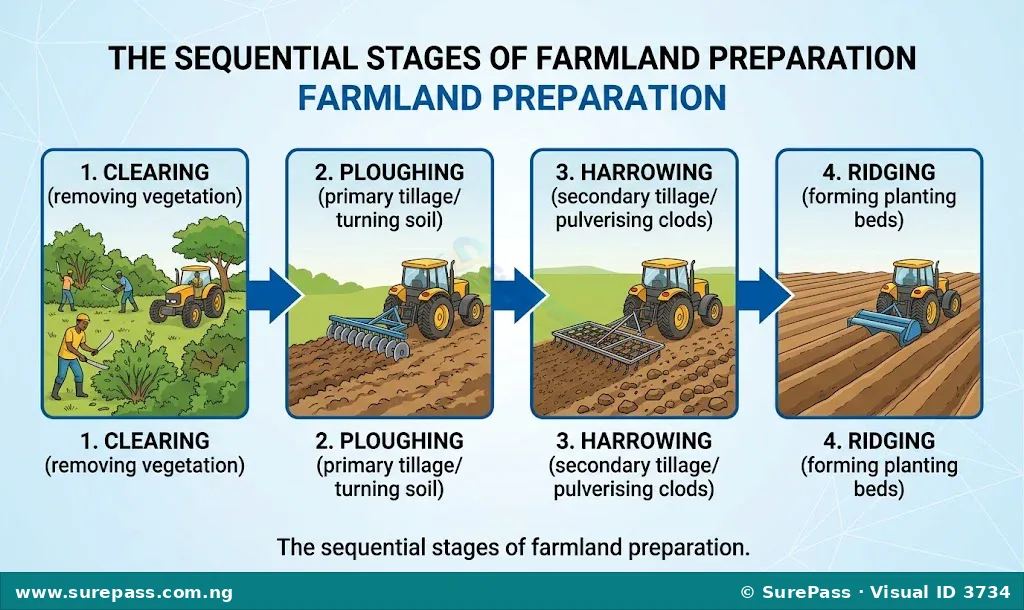
The four main types of farmland preparation are:
- Clearing
- Ploughing
- Harrowing
- Ridging
Clearing
Land clearing is the removal of existing vegetation, weeds, shrubs, trees, and debris from a selected piece of land to make it accessible for cultivation.
This is the first operation in farmland preparation. It can be done manually or mechanically depending on the scale of farming, the vegetation density, and the available resources. In manual clearing, tools such as cutlasses, machetes, axes, and hoes are used to cut down grass and shrubs. In mechanical clearing, heavy machinery such as bulldozers and tree pullers are used to clear large forests.
During clearing, the cut vegetation is sometimes left to dry. It can be gathered and composted, or carefully burned in a controlled manner, although burning is discouraged because it destroys soil organic matter and beneficial soil organisms.
Ploughing
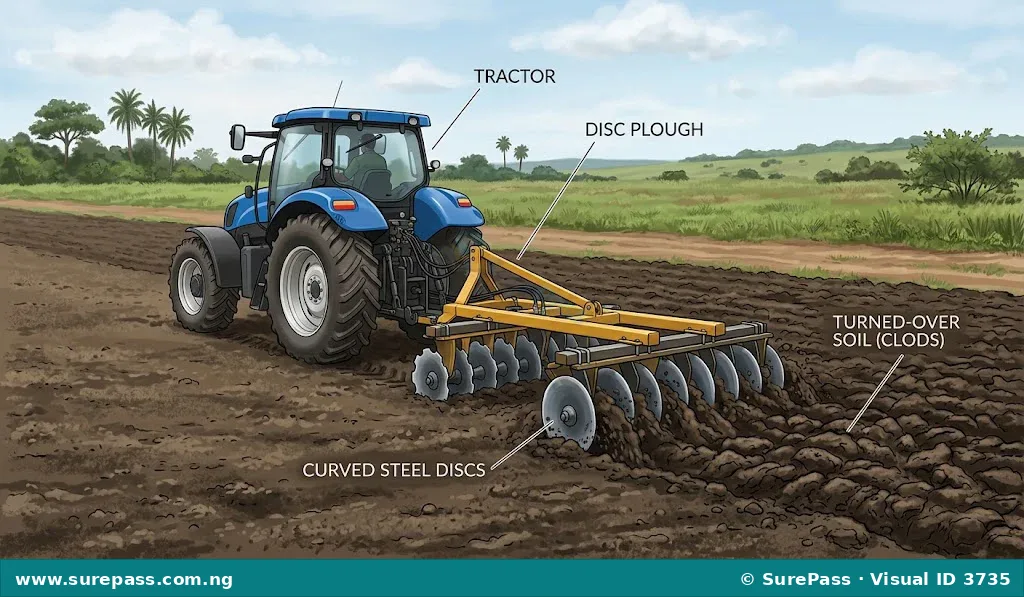
Ploughing is the process of cutting, breaking, and turning over the topsoil to a specific depth to loosen it and bury weeds.
Ploughing is the primary tillage operation. It breaks up compacted soil, improves soil aeration, and increases the capacity of the soil to absorb water. It also buries weeds and crop residues deep into the soil, where they decay and form organic matter.
On small-scale farms, ploughing is done manually using hand hoes or spades. On large-scale commercial farms, ploughing is done mechanically using a tractor-drawn plough. The two main types of tractor-drawn ploughs used in West Africa are the disc plough and the mouldboard plough. The disc plough is highly preferred in tropical soils because it can roll over obstacles like stones and tree roots without breaking.
Harrowing
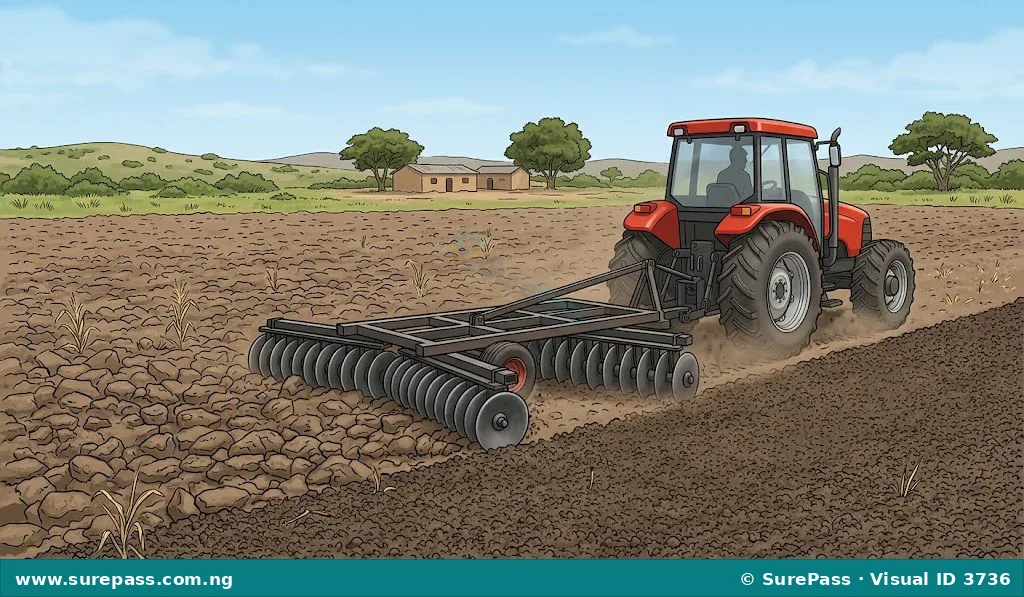
Harrowing is the process of breaking down large soil clods produced during ploughing into smaller, finer particles to create a smooth seedbed.
Harrowing is a secondary tillage operation. The rough, cloddy surface left after ploughing is not suitable for planting small seeds, as the seeds may fall too deep into the gaps or fail to make contact with moist soil. Harrowing pulverises the soil, levels the ground, and destroys any weeds that have germinated after ploughing.
In manual farming, harrowing is done using hand rakes or hoes to break up soil lumps. In mechanised farming, a tractor-drawn disc harrow or spring-tooth harrow is used to pulverise the soil. Harrowing must be done when the soil moisture is moderate; if the soil is too wet, it will stick to the equipment, and if it is too dry, it will create dust and destroy the soil structure.
Ridging
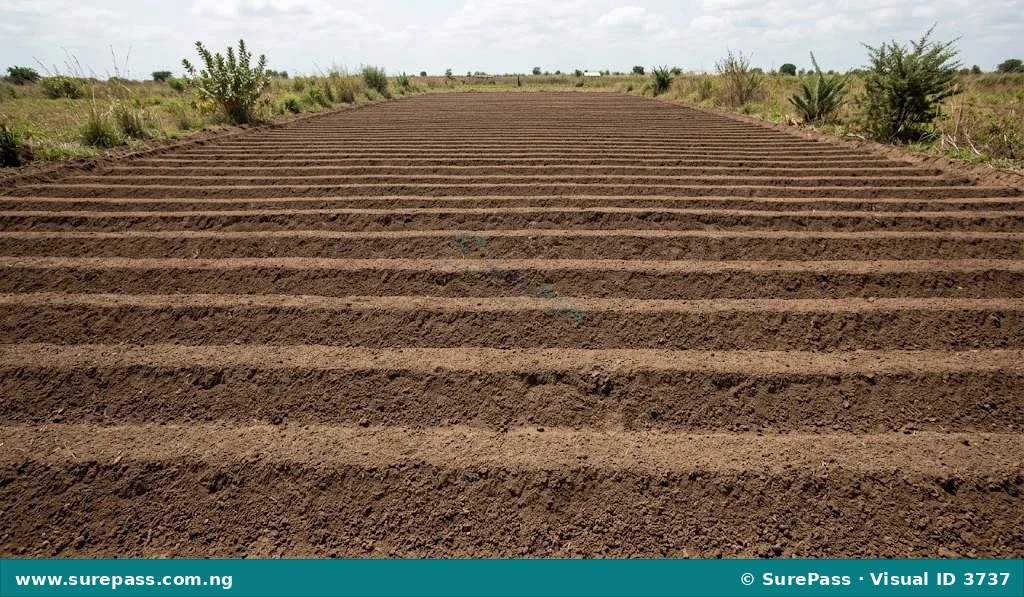
Ridging is the process of gathering loose soil together to form raised mounds or continuous ridges on which crops are planted.
Ridging is the final stage of land preparation before planting. It is particularly important for root and tuber crops like yam, cassava, sweet potato, and Irish potato, as well as crops like maize and groundnuts. Ridges provide a deep, loose soil volume that allows roots and tubers to expand easily. They also improve soil drainage, prevent waterlogging, and make weeding and harvesting much easier.
Manually, ridging is carried out using hand hoes or local ridgers to pull soil into mounds or ridges. Mechanically, a tractor-drawn disc ridger is used to construct uniform ridges across the field. Ridges are usually constructed across the slope of the land to prevent soil erosion by water.
Practical Procedures for Farmland Preparation
Carrying out farmland preparation requires specific skills and the correct use of agricultural tools. Below are the step-by-step procedures for performing each operation.
How to Carry Out Land Clearing
This procedure describes how to clear a plot of land manually using hand tools.
The required tools and materials are:
- Cutlasses or machetes
- Axes (for small tree trunks)
- Rakes
- Personal protective equipment (boots and gloves)
The procedure involves the following steps:
- Put on protective boots and gloves to prevent injuries from thorns, sharp stones, or insects.
- Hold the cutlass firmly by the handle with the dominant hand.
- Bend slightly and swing the cutlass at an angle to cut grass and soft-stemmed shrubs close to the ground level.
- Use an axe to cut down small woody trees, making V-shaped cuts near the base of the trunk.
- Use a rake to gather the cut vegetation and debris into neat heaps at the edges of the plot.
- Leave the gathered debris to decompose naturally, or transport it to a compost pit.
How to Carry Out Ploughing
This procedure describes how to perform primary tillage manually using a hand hoe.
The required tools are:
- Heavy-duty hand hoes
- Spades
The procedure involves the following steps:
- Stand facing the uncleared soil with feet apart for balance.
- Raise the hand hoe to shoulder level and swing it downward into the soil.
- Pull the hoe backward to cut a slice of soil about 15 to 20 centimetres deep.
- Lift and turn the sliced soil over so that the top vegetation and weeds are buried underneath.
- Move backward systematically, repeating the process to create a continuous row of turned-over soil.
How to Carry Out Harrowing
This procedure describes how to break down soil clods manually to create a fine tilth.
The required tools are:
- Light hand hoes
- Garden rakes
The procedure involves the following steps:
- Walk over the ploughed field and identify large lumps or clods of soil.
- Use the back or blade of a light hand hoe to strike and break the large soil clods into smaller pieces.
- Hold a garden rake with both hands and drag it back and forth across the broken soil.
- Pull out any exposed weed roots, stones, or remaining debris gathered by the rake.
- Level the soil surface until it is smooth and uniform.
How to Carry Out Ridging
This procedure describes how to construct planting ridges manually using a hand hoe.
The required tools are:
- Large West African hand hoes
- Measuring tape and pegs
- Garden lines (ropes)
The procedure involves the following steps:
- Use a measuring tape to measure out the spacing between the intended ridges, typically 1 metre apart.
- Drive pegs into the ground at both ends of the field and stretch a garden line between them to ensure the ridge is straight.
- Stand astride the marked line, facing the direction of the ridge.
- Use a large hand hoe to scoop loose soil from both sides of the line, pulling it toward the centre to form a continuous raised mound.
- Shape the top of the ridge to be slightly flat or rounded, ensuring it reaches a height of about 30 to 40 centimetres.
- Move along the line until the entire length of the ridge is completed, then move the garden line to the next row.
Summary of Farmland Preparation Operations
The table below summarises the four operations, their primary purposes, and the tools used for both manual and mechanical systems.
| Operation | Primary Purpose | Manual Tools | Mechanical Tools |
|---|---|---|---|
| Clearing | Removal of vegetation and debris | Cutlass, machete, axe | Bulldozer, slasher |
| Ploughing | Cutting and turning over topsoil | Hand hoe, spade | Disc plough, mouldboard plough |
| Harrowing | Breaking soil clods into fine tilth | Rake, light hoe | Disc harrow, spring-tooth harrow |
| Ridging | Creating raised beds for planting | Large hand hoe, local ridger | Disc ridger |
Safety Precautions in Farmland Preparation
Farmland preparation involves the use of sharp tools and heavy machinery. Adhering to safety guidelines prevents accidents and injuries on the farm.
Important safety tips include:
- Inspect all hand tools before use to ensure handles are tight and blades are secure.
- Wear appropriate protective clothing, including thick boots, hand gloves, and long-sleeved shirts.
- Maintain a safe distance from other workers when swinging cutlasses, axes, or hoes.
- Do not attempt to clear large trees manually; seek assistance or use mechanical tree pullers.
- Keep clear of moving tractors and implement attachments during mechanical operations.
- Clean and oil metal tools after use to prevent rusting, and store them in a dry, secure tool shed.
Evaluation Exercises
The following questions are designed to test the understanding of the concepts covered in this unit:
- Explain the meaning of farmland preparation.
- List the four main types of farmland preparation in their correct chronological order.
- Differentiate between primary tillage and secondary tillage.
- State two reasons why ridging is important for root and tuber crops.
- Identify two manual tools and two mechanical tools used for land clearing.
- Describe the steps involved in manual ridging using a hand hoe.
- State three safety precautions that must be observed during farmland preparation.





0 comments
Open the discussion when you need it. Comments stay collapsed until requested so the initial article remains light.