



ARTICLE CONTENTSOn this page 7 sections
Diphthongs
Performance Objectives
By the end of the lesson, students should be able to:
- describe diphthongs;
- identify diphthongs;
- appropriately pronounce diphthongs;
- give appropriate examples of words in which diphthongs occur word-initially, medially and finally.
What Are Diphthongs?
A diphthong is a vowel sound that involves a glide from one vowel quality to another within the same syllable.
Unlike a monophthong, which is a single, pure vowel sound, a diphthong starts with one vowel sound and smoothly moves towards a second vowel sound. The tongue and lips change position during the production of a diphthong, creating a gliding effect. This means that a diphthong is a combination of two vowel sounds pronounced as one unit.
For example, when pronouncing the word “boy,” the sound /ɔɪ/ begins with the /ɔ/ sound and glides towards the /ɪ/ sound. Similarly, in the word “my,” the sound /aɪ/ starts with /a/ and moves towards /ɪ/.
Characteristics of Diphthongs
Diphthongs have distinct characteristics that differentiate them from other vowel sounds:
- Gliding Movement: The most important characteristic is the smooth transition or glide from one vowel sound to another within a single syllable. The articulators (tongue, lips) move from an initial position to a final position.
- Two Vowel Qualities: Each diphthong consists of two distinct vowel qualities, but they are perceived as a single sound. The first sound is usually stronger and longer, while the second sound is weaker and shorter.
- Single Syllable: A diphthong always occurs within one syllable. It is not two separate vowel sounds in two different syllables.
- Phonetic Representation: Diphthongs are represented by two phonetic symbols, indicating the starting and ending vowel sounds of the glide. For example, /eɪ/ for the sound in “day.”
Common Diphthongs in English
There are eight common diphthongs in English. These can be grouped based on their ending sound:
- Diphthongs ending in /ɪ/ (as in “kit”):
- /eɪ/ as in `face`, `day`
- /aɪ/ as in `my`, `price`
- /ɔɪ/ as in `boy`, `choice`
- Diphthongs ending in /ʊ/ (as in “put”):
- /əʊ/ (or /oʊ/) as in `goat`, `no`
- /aʊ/ as in `mouth`, `now`
- Diphthongs ending in /ə/ (as in “about”):
- /ɪə/ as in `near`, `here`
- /eə/ as in `square`, `hair`
- /ʊə/ as in `poor`, `tour`
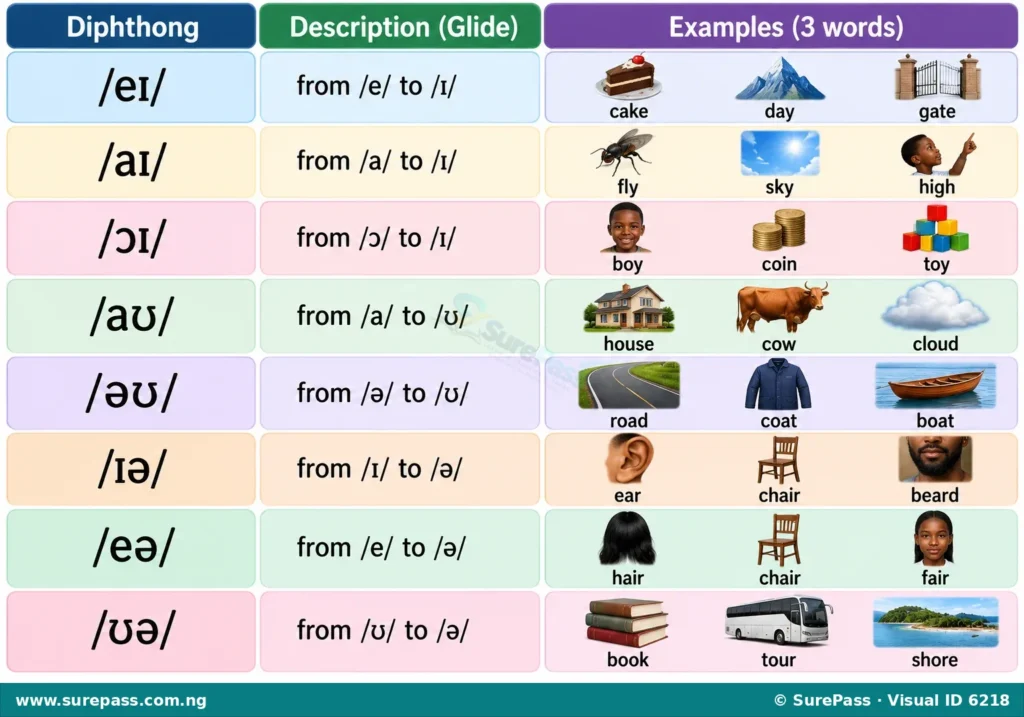
Observe the chart below, which shows the eight diphthongs with their phonetic symbols and example words.
Pronouncing Diphthongs and Their Occurrence in Words
To pronounce diphthongs correctly, it is important to start with the first vowel sound and smoothly glide to the second, without pausing. Practise these sounds using a mirror to observe your mouth movements.
1. The /eɪ/ Diphthong
This diphthong starts with a sound similar to /e/ (as in “bed”) and glides towards /ɪ/ (as in “kit”). The mouth starts slightly open and then closes a little as the sound progresses.
- Word-initial position:
- `eight` /eɪt/
- `aim` /eɪm/
- `able` /ˈeɪbəl/
- Word-medial position:
- `day` /deɪ/
- `face` /feɪs/
- `make` /meɪk/
- Word-final position:
- `play` /pleɪ/
- `say` /seɪ/
- `way` /weɪ/
2. The /aɪ/ Diphthong
This diphthong begins with a sound similar to /a/ (as in “father”) and glides towards /ɪ/ (as in “kit”). The mouth starts wide open and then closes significantly.
- Word-initial position:
- `ice` /aɪs/
- `aisle` /aɪl/
- `I` /aɪ/
- Word-medial position:
- `light` /laɪt/
- `time` /taɪm/
- `bike` /baɪk/
- Word-final position:
- `my` /maɪ/
- `buy` /baɪ/
- `sky` /skaɪ/
3. The /ɔɪ/ Diphthong
This diphthong starts with a sound similar to /ɔ/ (as in “caught”) and glides towards /ɪ/ (as in “kit”). The lips start rounded and then spread slightly.
- Word-initial position:
- `oil` /ɔɪl/
- `oyster` /ˈɔɪstər/
- `ointment` /ˈɔɪntmənt/
- Word-medial position:
- `choice` /tʃɔɪs/
- `noise` /nɔɪz/
- `point` /pɔɪnt/
- Word-final position:
- `boy` /bɔɪ/
- `toy` /tɔɪ/
- `enjoy` /ɪnˈdʒɔɪ/
4. The /əʊ/ (or /oʊ/) Diphthong
This diphthong begins with a sound similar to /ə/ (schwa, as in “about”) or /ɒ/ (as in “hot”) and glides towards /ʊ/ (as in “put”). The lips start slightly open and then round as they close.
- Word-initial position:
- `old` /əʊld/
- `oats` /əʊts/
- `only` /ˈəʊnli/
- Word-medial position:
- `boat` /bəʊt/
- `home` /həʊm/
- `stone` /stəʊn/
- Word-final position:
- `no` /nəʊ/
- `go` /ɡəʊ/
- `slow` /sləʊ/
5. The /aʊ/ Diphthong
This diphthong starts with a sound similar to /a/ (as in “father”) and glides towards /ʊ/ (as in “put”). The mouth starts wide open and then rounds and closes.
- Word-initial position:
- `out` /aʊt/
- `owl` /aʊl/
- `ouch` /aʊtʃ/
- Word-medial position:
- `house` /haʊs/
- `brown` /braʊn/
- `loud` /laʊd/
- Word-final position:
- `now` /naʊ/
- `how` /haʊ/
- `cow` /kaʊ/
6. The /ɪə/ Diphthong
This diphthong starts with a sound similar to /ɪ/ (as in “kit”) and glides towards /ə/ (schwa, as in “about”). The tongue starts high and front, then moves towards the centre.
- Word-initial position:
- `ear` /ɪə/
- `eager` /ˈɪəɡər/ (Note: often pronounced as a monophthong in some accents, but the diphthong is common)
- `idea` /aɪˈdɪə/ (final syllable)
- Word-medial position:
- `near` /nɪə/
- `fear` /fɪə/
- `clear` /klɪə/
- Word-final position:
- `here` /hɪə/
- `beer` /bɪə/
- `deer` /dɪə/
7. The /eə/ Diphthong
This diphthong starts with a sound similar to /e/ (as in “bed”) and glides towards /ə/ (schwa, as in “about”). The mouth starts slightly open and then relaxes.
- Word-initial position:
- `air` /eə/
- `area` /ˈeərɪə/
- `aeroplane` /ˈeərəpleɪn/
- Word-medial position:
- `hair` /heə/
- `care` /keə/
- `share` /ʃeə/
- Word-final position:
- `where` /weə/
- `there` /ðeə/
- `bear` /beə/
8. The /ʊə/ Diphthong
This diphthong starts with a sound similar to /ʊ/ (as in “put”) and glides towards /ə/ (schwa, as in “about”). The lips start rounded and then relax.
- Word-initial position:
- `urea` /jʊˈriːə/ (often pronounced with /j/ sound before the diphthong)
- `usury` /ˈjuːʒʊəri/ (final syllable)
- Word-medial position:
- `poor` /pʊə/
- `tour` /tʊə/
- `sure` /ʃʊə/
- Word-final position:
- `fewer` /ˈfjuːə/ (final syllable)
- `truer` /ˈtruːə/ (final syllable)
Note that the /ʊə/ diphthong is becoming less common in some accents, often replaced by /ɔː/ (as in “door”) or /uːə/ (as in “doer”). However, it is still important to recognise and practise it.
Practising Diphthong Pronunciation
Regular practice is essential for mastering diphthongs. Consider the following steps:
- Listen Carefully: Pay close attention to how native English speakers pronounce words containing diphthongs. Use audio-visual materials and online dictionaries that provide audio pronunciations.
- Use a Mirror: Stand in front of a mirror and observe your mouth and lip movements as you pronounce each diphthong. Try to match the movements described for each sound.
- Exaggerate the Glide: In the beginning, exaggerate the movement from the first vowel sound to the second. This helps to train your articulators.
- Repeat Words: Practise saying words containing diphthongs multiple times. Focus on the clarity of the glide.
- Record Yourself: Record your speech and listen back. Compare your pronunciation with that of native speakers to identify areas for improvement.
- Read Aloud: Read sentences and short passages aloud, paying special attention to words with diphthongs.




0 comments
Open the discussion when you need it. Comments stay collapsed until requested so the initial article remains light.