


ARTICLE CONTENTSOn this page 8 sections
Listening and Speaking: Semi-Vowels and Their Pronunciation for SS 1
Performance Objectives
By the end of the lesson, students should be able to:
- explain the meaning of semi- vowels;
- discuss the characteristics of semi-vowels;
- identify semi- vowels;
- Articulate semi- vowels.
Introduction to Speech Sounds
In English, speech sounds are broadly categorised into vowels and consonants. Vowels are sounds produced with a free flow of air from the lungs, without any obstruction in the mouth. Consonants, on the other hand, are produced with some form of obstruction or narrowing in the vocal tract.
Between these two main categories lies a special group of sounds known as semi-vowels. These sounds share some features with vowels and some with consonants, making them unique in the English sound system.
Meaning of Semi-Vowels
A semi-vowel is a sound that has characteristics of both a vowel and a consonant.
Semi-vowels are also known as glides because their production involves a quick movement or “glide” from one vowel-like position to another, leading into a following vowel sound. They are vowel-like in their articulation because there is no significant obstruction of airflow, but they function as consonants in a syllable structure.
Characteristics of Semi-Vowels
Semi-vowels possess distinct features that set them apart from pure vowels and other consonants. Understanding these characteristics helps in identifying and articulating them correctly.
The main characteristics of semi-vowels are:
- Glide Sounds: Semi-vowels are produced by a rapid movement or glide of the tongue and/or lips from one vowel-like position to another. This movement is quick and leads directly into the next vowel sound.
- Voiced Sounds: Both semi-vowels in English are voiced. This means that the vocal cords vibrate during their production. You can feel this vibration by placing your fingers on your throat while making the sounds.
- No Obstruction of Airflow: Similar to vowels, semi-vowels are produced without any significant blockage or friction in the vocal tract. The air flows relatively freely from the lungs through the mouth.
- Function as Consonants: Despite their vowel-like articulation, semi-vowels always function as consonants in words. They typically occur at the beginning of a syllable and are always followed by a vowel sound. They cannot form the nucleus (the central part) of a syllable on their own.
- Brief Duration: Semi-vowels are typically short in duration. The glide from their initial position to the following vowel happens very quickly.
Identification of Semi-Vowels (/w/ and /j/)
In English, there are two main semi-vowel sounds: /w/ and /j/. These sounds are represented by different letters in spelling, but it is their pronunciation that defines them as semi-vowels.
-
The /w/ Sound:
This sound is often spelled with the letter ‘w’ or ‘wh’. It is a labial-velar glide, meaning it involves both the lips and the back of the tongue.
Examples of words containing the /w/ sound include:
- we
- wet
- wonder
- away
- what
- when
- queen (the ‘qu’ combination often produces a /kw/ sound)
- quick
-
The /j/ Sound:
This sound is often spelled with the letter ‘y’, but can also be found in words with ‘u’ or ‘eu’. It is a palatal glide, involving the front of the tongue.
Examples of words containing the /j/ sound include:
- yes
- yellow
- yawn
- beyond
- use
- union
- few
- Europe
Articulation of Semi-Vowels
Correctly articulating semi-vowels involves specific movements of the lips and tongue. Practising these movements will help you produce the sounds clearly.
Articulating the /w/ Sound
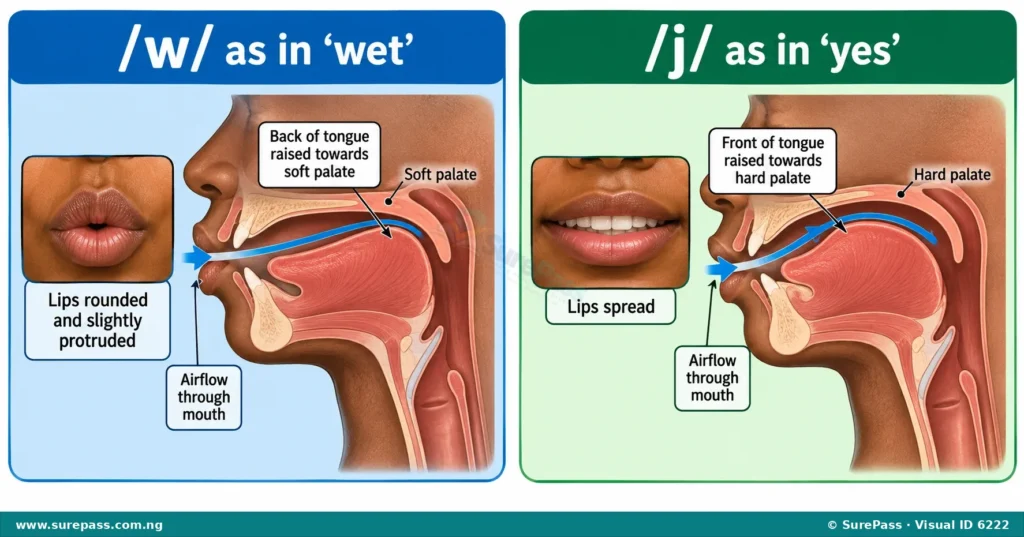
The /w/ sound is produced by rounding and protruding the lips while raising the back of the tongue towards the soft palate. The sound then glides quickly into the following vowel.
The procedure for articulating /w/ involves the following steps:
- Lip Position: Round your lips tightly and push them slightly forward, as if you are about to whistle or say the vowel sound /u:/ (as in ‘moon’).
- Tongue Position: Raise the back part of your tongue towards the soft palate (the soft area at the back of the roof of your mouth).
- Vocal Cords: Make sure your vocal cords are vibrating (voice is on).
- Glide: From this rounded lip and raised tongue position, quickly move your lips and tongue to the position required for the next vowel sound. For example, when saying “wet” /wɛt/, you glide from the /w/ position to the /ɛ/ vowel sound.
- Practice Words: Say words like ‘we’, ‘walk’, ‘water’, ‘queen’, ‘what’. Pay attention to the initial lip rounding and the quick glide.
Articulating the /j/ Sound
The /j/ sound is produced by raising the front of the tongue towards the hard palate while the lips are spread. The sound then glides quickly into the following vowel.
The procedure for articulating /j/ involves the following steps:
- Lip Position: Spread your lips slightly, as if you are smiling or about to say the vowel sound /i:/ (as in ‘sheep’).
- Tongue Position: Raise the front part of your tongue towards the hard palate (the hard area at the front of the roof of your mouth), close to where you would make the /ʃ/ sound (as in ‘shoe’), but without creating friction.
- Vocal Cords: Ensure your vocal cords are vibrating (voice is on).
- Glide: From this spread lip and raised tongue position, quickly move your tongue and lips to the position for the next vowel sound. For example, when saying “yes” /jɛs/, you glide from the /j/ position to the /ɛ/ vowel sound.
- Practice Words: Say words like ‘yes’, ‘yellow’, ‘yawn’, ‘use’, ‘union’, ‘few’. Focus on the initial tongue position and the swift glide.
Practice Articulating Semi-Vowels in Speech
Consistent practice is essential for mastering the articulation of semi-vowels. Use a mirror to observe your lip and tongue movements, and a recording device to listen to your pronunciation.
Practice for /w/
Practice saying the following words and sentences, focusing on the correct lip and tongue movements for /w/:
- Words:
- wet
- weep
- window
- wonder
- away
- always
- what
- when
- where
- queen
- quick
- twenty
- Sentences:
- We went to watch the wrestling match.
- What was the weather like when you were away?
- The quick brown fox jumped over the lazy dog.
- She always wanted to wear a white wedding gown.
Practice for /j/
Practice saying the following words and sentences, focusing on the correct lip and tongue movements for /j/:
- Words:
- yes
- yellow
- yawn
- yet
- beyond
- onion
- use
- union
- Europe
- few
- beauty
- junior
- Sentences:
- Yes, you can use your yellow uniform.
- The young boy yawned during the long lecture.
- It is useful to understand the European Union.
- He gave a few useful tips for the journey.
Remember to pay attention to the glide-like nature of these sounds. They are never held for long but transition smoothly into the next vowel sound.



0 comments
Open the discussion when you need it. Comments stay collapsed until requested so the initial article remains light.