


ARTICLE CONTENTSOn this page 9 sections
Cohesion and Coherence in Writing
Performance Objectives
By the end of the lesson, students should be able to:
- explain the difference between cohesion and coherence in writing;
- identify the major cohesive and coherence devices;
- read a text and identify cohesive and coherence devices in it;
- exemplify cohesion and coherence in writing.
Understanding Cohesion in Writing
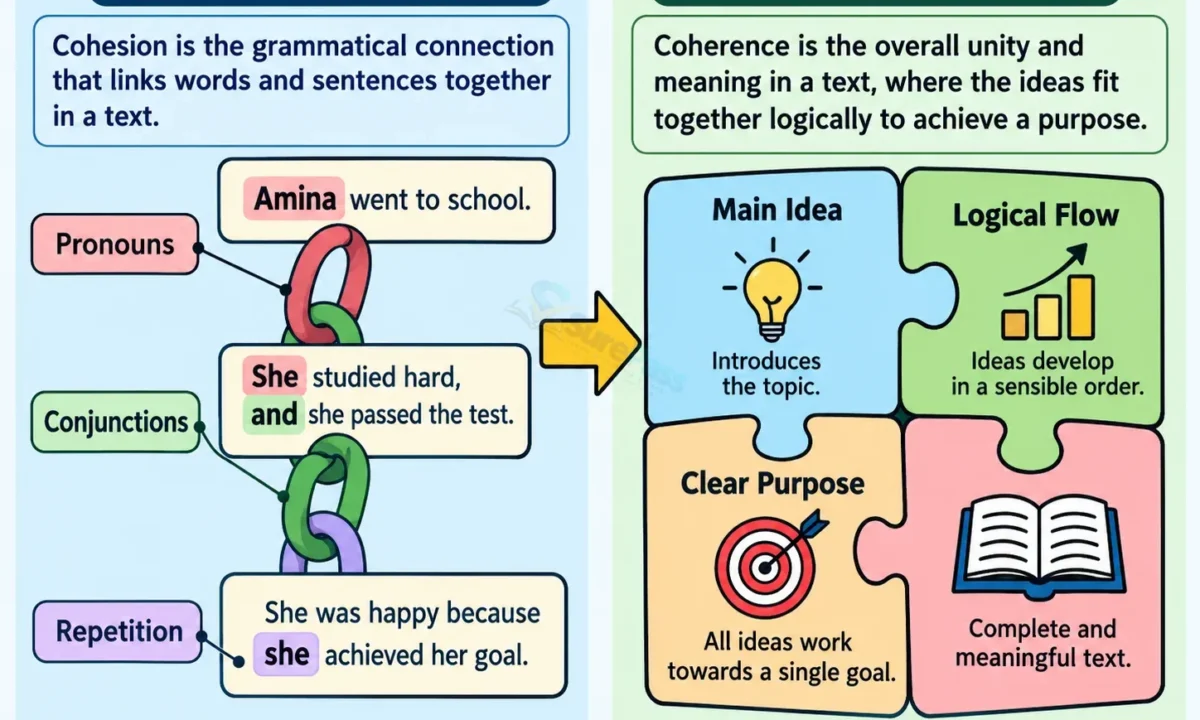
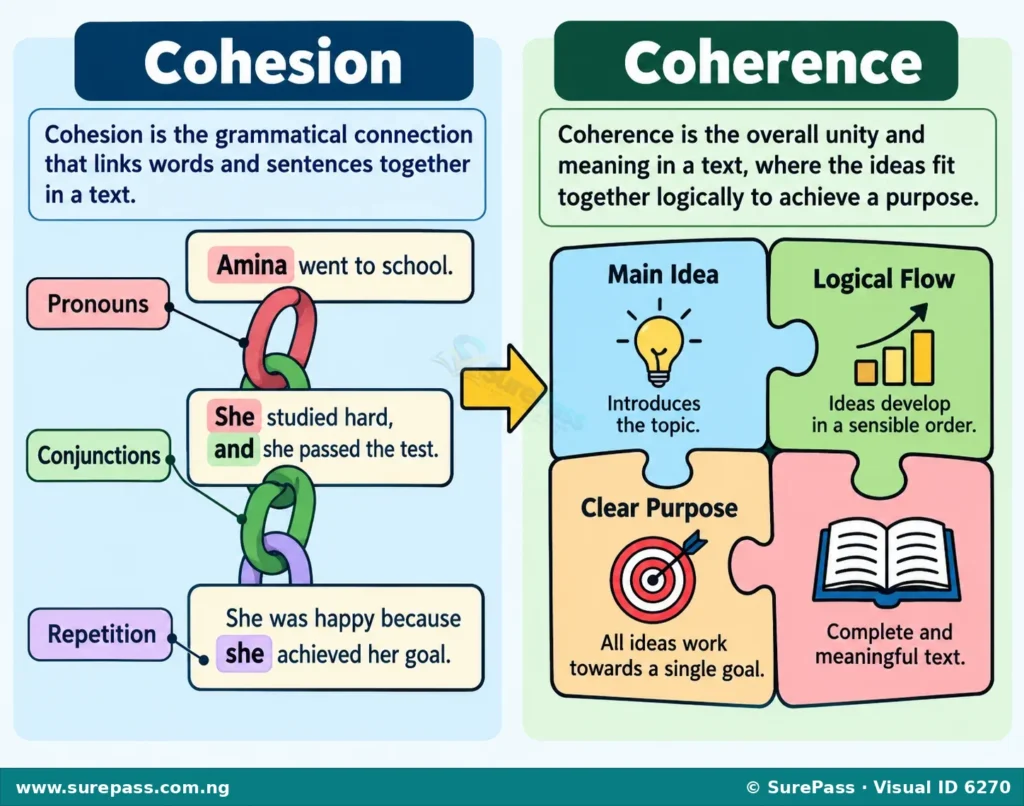
Cohesion refers to the grammatical and lexical links that connect different parts of a text. It is about how sentences and paragraphs are linked together at the surface level of the text. These links create a smooth flow, making the text easy to read and follow. Think of cohesion as the “glue” that holds the words, sentences, and paragraphs together.
When a text has good cohesion, the reader can easily see the connections between ideas. This is achieved through the careful use of specific words and phrases that signal relationships between different parts of the writing.
Understanding Coherence in Writing
Coherence refers to the overall sense and logical organisation of a text. It is about how all the ideas in a piece of writing fit together logically and meaningfully to form a unified whole. Coherence ensures that the text makes sense to the reader and that the main message is clear.
While cohesion is about the links between sentences, coherence is about the logical progression of ideas. A coherent text has a clear purpose, a consistent point of view, and ideas that are presented in a sensible order, making the entire piece understandable.
Difference Between Cohesion and Coherence
Cohesion and coherence are closely related but distinct. Cohesion focuses on the grammatical and lexical connections within the text, like using pronouns or conjunctions. It is about the visible links on the page.
Coherence, on the other hand, is about the underlying logical connection of ideas. A text can have many cohesive devices (like “however,” “therefore,” “it”), but if the ideas do not make sense together, it will still lack coherence. Conversely, a text can be coherent even with fewer explicit cohesive devices if the ideas are naturally well-organised and logically connected.
For effective writing, both cohesion and coherence are essential. Cohesion helps to build coherence, and coherence makes the cohesive links more meaningful.
Major Cohesive Devices
Cohesive devices are words or phrases that help to create connections between sentences and paragraphs. They signal relationships between ideas, making the text flow smoothly. The major cohesive devices include:
- Reference: This involves using pronouns, demonstratives, or articles to refer back to something already mentioned in the text. This avoids repetition and links ideas.
Examples:
- “The student submitted his assignment. He hoped to get a good grade.” (He refers to the student)
- “I bought a new book. It is very interesting.” (It refers to a new book)
- “Look at that car. The car is very fast.” (That and the refer to car)
- Conjunctions/Connectors: These are words or phrases that link sentences, clauses, or paragraphs, showing the relationship between them. They can indicate addition, contrast, cause and effect, sequence, or comparison.
Examples of conjunctions and connectors include:
- Addition: and, also, in addition, furthermore, moreover
- Contrast: but, however, yet, on the other hand, in contrast
- Cause and Effect: because, so, therefore, as a result, consequently
- Sequence: first, next, then, finally, afterwards
- Comparison: similarly, likewise, in the same way
- Lexical Cohesion: This involves the use of vocabulary to create links within a text. It includes repetition of keywords, use of synonyms, antonyms, or related words.
Examples:
- Repetition: “The rain fell heavily. The continuous rain caused flooding.” (Rain is repeated)
- Synonyms: “The boy was very happy. His joyful expression showed his excitement.” (Happy and joyful are synonyms)
- Antonyms: “The road was wide at the beginning, but it became very narrow towards the end.” (Wide and narrow are antonyms)
- Collocation/Related words: “The doctor examined the patient. He then prescribed some medicine.” (Doctor, patient, medicine are related words)
- Substitution: This involves replacing a word or phrase with a shorter word or phrase to avoid repetition.
Examples:
- “I need a pen. Do you have one?” (One substitutes a pen)
- “She said she would come, and so she did.” (So substitutes come)
- Ellipsis: This is the omission of words or phrases that are understood from the context.
Examples:
- “Did you finish your homework?” “Yes, I did.” (Did implies finished my homework)
- “Some students passed the exam, others did not.” (Did not implies pass the exam)
Major Coherence Devices
Coherence devices are strategies that help to organise ideas logically and make the overall text understandable. They ensure that the writing flows smoothly from one idea to the next, making sense to the reader. The major coherence devices include:
- Logical Organisation of Ideas: This involves arranging information in a clear and sensible order. Common types of logical organisation include:
- Chronological Order: Arranging events in the order they happened (e.g., telling a story, describing a process).
- Spatial Order: Describing things according to their position or location (e.g., describing a room from left to right, top to bottom).
- Order of Importance: Presenting ideas from most important to least important, or vice versa.
- Problem-Solution: Presenting a problem and then offering solutions.
- Cause and Effect: Explaining why something happened and what its results were.
- Clear Topic Sentences: Each paragraph should begin with a clear topic sentence that states the main idea of that paragraph. This helps the reader understand what the paragraph will be about and how it relates to the overall topic.
- Consistent Point of View: Maintaining a consistent perspective throughout the writing (e.g., always using “I,” “we,” or “he/she/it”). Shifting point of view can confuse the reader and disrupt coherence.
- Effective Paragraphing: Grouping related ideas into separate paragraphs. Each paragraph should focus on a single main idea, and there should be clear transitions between paragraphs.
- Repetition of Key Concepts: While direct repetition of words can be a cohesive device, repeating key concepts or themes (using different words or phrases) throughout the text helps to reinforce the main message and maintain focus, contributing to overall coherence.
Identifying Cohesive and Coherence Devices in a Text
Reading a text and identifying these devices helps to understand how writers make their work clear and connected. Let us examine a sample passage:
Sample Passage:
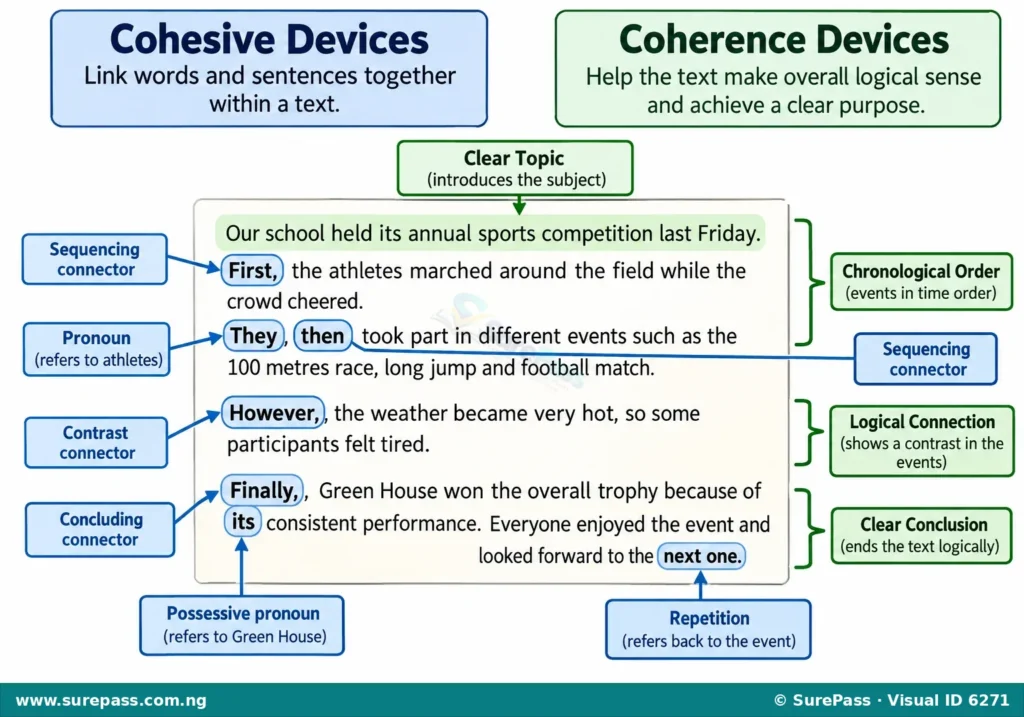
The school organised its annual inter-house sports competition last Saturday. First, the students gathered on the field, eager to participate. Then, the principal gave a speech, emphasising the importance of sportsmanship. Afterwards, the various events began. The athletes ran their races with great determination. They pushed themselves to the limit. However, not everyone could win. Despite this, all participants showed enthusiasm. Finally, the winning house was announced, and its members celebrated joyfully. The competition was a huge success, and everyone looked forward to the next one.
Let us identify the devices:
- Cohesive Devices:
- “First,” “Then,” “Afterwards,” “Finally”: These are conjunctions/connectors that indicate sequence, showing the chronological order of events.
- “They”: This is a pronoun that refers back to “The athletes,” avoiding repetition.
- “However”: This is a conjunction/connector that indicates contrast, showing a shift in idea.
- “Despite this”: This is a transitional phrase that refers back to the idea that “not everyone could win,” linking it to the participants’ enthusiasm.
- “its”: This is a possessive pronoun referring to “the winning house.”
- “next one”: This is a substitution for “next competition,” avoiding repetition.
- Repetition of “competition”: The word “competition” is used multiple times (e.g., “inter-house sports competition,” “The competition was a huge success”), which is a form of lexical cohesion.
- Coherence Devices:
- Logical Organisation (Chronological Order): The entire passage is organised chronologically, describing the events of the sports competition from beginning to end (gathering, speech, events, announcement). This makes the narrative easy to follow.
- Clear Topic: The passage clearly focuses on the “annual inter-house sports competition,” and all sentences contribute to this main topic.
- Consistent Point of View: The passage maintains an objective third-person point of view throughout.
- Effective Paragraphing: Although this is a single paragraph example, in a longer text, each stage of the competition (e.g., opening ceremony, races, prize-giving) would likely be a separate paragraph, each with its own topic sentence, contributing to overall coherence.
Using Cohesion and Coherence in Writing
To write effectively, it is important to consciously apply cohesive and coherence devices. This skill helps to produce clear, logical, and engaging texts.
Steps to Ensure Cohesion and Coherence in Your Writing:
- Plan Your Ideas Logically: Before you start writing, outline your main points. Decide on the best order to present them (e.g., chronological, order of importance, problem-solution). This establishes coherence from the beginning.
- Use Clear Topic Sentences: Start each paragraph with a sentence that clearly states its main idea. This acts as a mini-roadmap for the reader, guiding them through your arguments.
- Employ Reference Devices: Use pronouns (he, she, it, they), demonstratives (this, that, these, those), and articles (a, an, the) to refer back to previously mentioned nouns. This avoids awkward repetition and links sentences smoothly.
Example:
Without cohesion: “My brother loves football. My brother plays football every weekend.”
With cohesion: “My brother loves football. He plays it every weekend.”
- Incorporate Conjunctions and Transitional Phrases: Use words and phrases that show the relationship between your ideas. These act as bridges between sentences and paragraphs.
Examples of how to use them:
- To add information: in addition, furthermore, moreover, also
- To show contrast: however, nevertheless, on the other hand, but
- To indicate cause/effect: therefore, consequently, as a result, because
- To show sequence: first, next, then, finally, afterwards
- To summarise: in conclusion, to summarise, in short
- Repeat Key Words and Concepts (Carefully): While avoiding excessive repetition, strategically repeating important keywords or phrases can reinforce your main ideas and ensure the reader stays focused on the topic. Use synonyms to vary your language.
Example:
Without lexical cohesion: “The government introduced a new policy. The new rule aims to improve education.”
With lexical cohesion: “The government introduced a new policy. This important measure aims to improve education.” (Policy and measure are related concepts.)
- Maintain a Consistent Point of View: Decide on your perspective (e.g., first person “I,” third person “he/she/it”) and stick to it throughout your writing. Shifting perspectives can confuse the reader.
- Use Effective Paragraphing: Ensure each paragraph discusses one main idea. When you move to a new idea, start a new paragraph. This visual separation helps the reader process information logically.
By applying these techniques, you can ensure that your writing is not only grammatically correct but also clear, logical, and easy for your audience to understand.




0 comments
Open the discussion when you need it. Comments stay collapsed until requested so the initial article remains light.