



ARTICLE CONTENTSOn this page 7 sections
Nominalization
Performance Objectives
By the end of the lesson, students should be able to:
- define nominalization;
- give examples of nominalized words;
- demonstrate nominalization.
Meaning of Nominalization
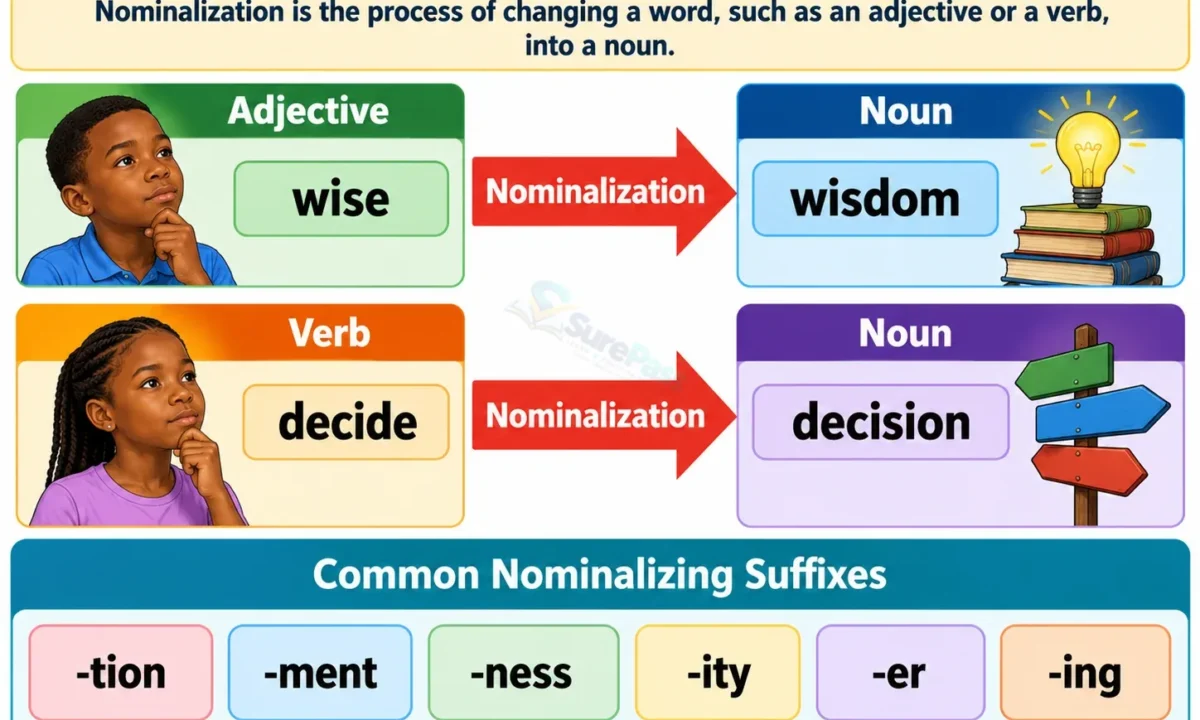
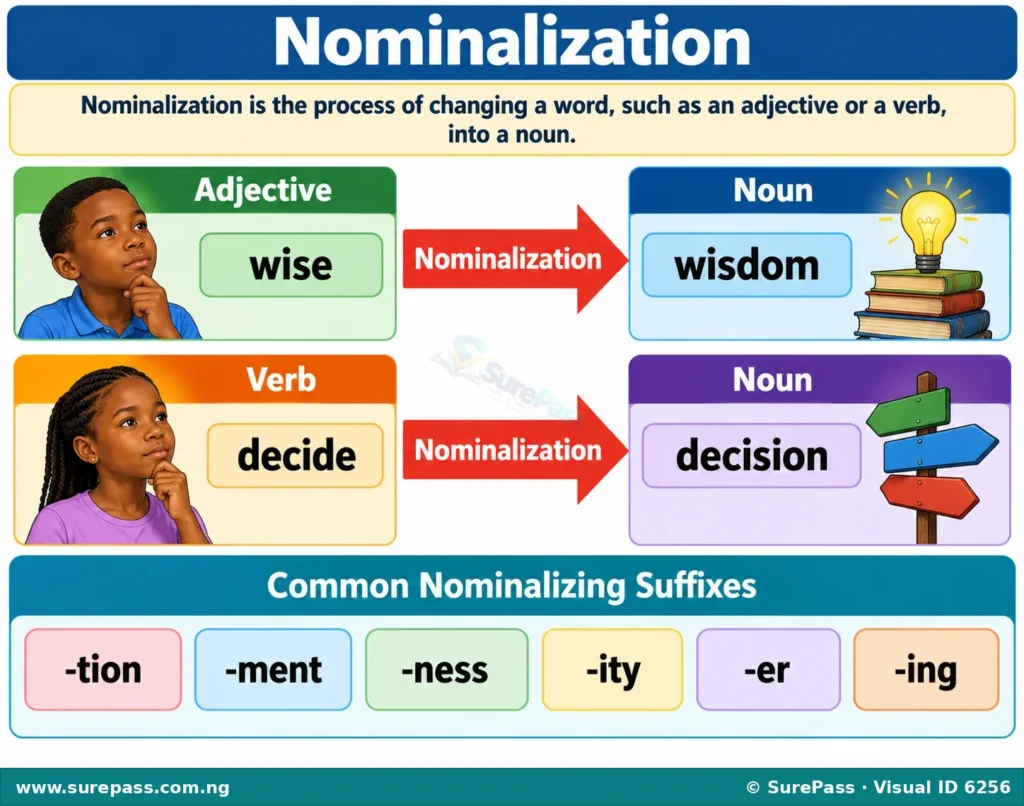
Nominalization is the process of forming a noun from another word, often a verb or an adjective.
This process changes a word that describes an action or a quality into a word that names a concept, an event, a state, or a person. The resulting word functions grammatically as a noun in a sentence.
The Process of Nominalizing
Nominalization usually involves changing the form of a word by adding a suffix or, less commonly, by altering the word’s structure. These changes transform verbs or adjectives into nouns, allowing them to act as subjects, objects, or complements in sentences.
Common suffixes used in nominalization include:
- -tion / -sion: (e.g., educate → education, decide → decision)
- -ment: (e.g., achieve → achievement, govern → government)
- -ness: (e.g., happy → happiness, dark → darkness)
- -ity / -ty: (e.g., intense → intensity, able → ability, creative → creativity)
- -er / -or: (often for agents, e.g., teach → teacher, conquer → conqueror)
- -ing: (for gerunds, e.g., dance → dancing, read → reading)
- -ance / -ence: (e.g., perform → performance, depend → dependence)
- -th: (e.g., strong → strength, wide → width)
Sometimes, the word form changes without a clear suffix, or the word remains the same but changes its grammatical function (e.g., ‘run’ as a verb and ‘a run’ as a noun).
Form Classes (Parts of Speech) for Nominalization
While various word classes can undergo nominalization, verbs and adjectives are the most common sources for forming new nouns.
Nominalization from Adjectives
Adjectives describe qualities or characteristics. When nominalized, they become nouns that refer to those qualities as abstract concepts.
Examples of adjectives and their nominalized forms include:
- wise → wisdom
Original: She is a wise person.
Nominalized: Her wisdom is admired by all.
- intense → intensity
Original: The heat was very intense.
Nominalized: The intensity of the heat was unbearable.
- creative → creativity
Original: He is a very creative artist.
Nominalized: His creativity knows no bounds.
- happy → happiness
Original: The children were very happy.
Nominalized: Their happiness filled the room.
- dark → darkness
Original: The room was dark.
Nominalized: The darkness made it hard to see.
- able → ability
Original: She is able to solve complex problems.
Nominalized: Her ability to solve complex problems is impressive.
- strong → strength
Original: The athlete is very strong.
Nominalized: The athlete demonstrated great strength.
Nominalization from Verbs
Verbs describe actions or states. When nominalized, they become nouns that refer to the action or state itself, or sometimes the agent performing the action.
Examples of verbs and their nominalized forms include:
- decide → decision
Original: The committee will decide the matter.
Nominalized: The committee made a decision on the matter.
- conquer → conqueror
Original: The army will conquer the enemy.
Nominalized: The conqueror led his army to victory.
- dance → dancing
Original: They love to dance.
Nominalized: Their dancing was energetic.
- achieve → achievement
Original: Students should strive to achieve their goals.
Nominalized: The award recognised his academic achievement.
- govern → government
Original: The people elected leaders to govern them.
Nominalized: The government introduced new policies.
- educate → education
Original: Parents have a duty to educate their children.
Nominalized: Education is key to national development.
- read → reading
Original: She likes to read novels.
Nominalized: Reading is her favourite hobby.
- perform → performance
Original: The students will perform a play.
Nominalized: The audience enjoyed the students’ performance.
Functions of Nominalized Words
Nominalized words serve several important functions in English, especially in formal and academic writing:
- To make writing more formal and objective: Nominalization often removes the agent of an action, making statements sound more impersonal and authoritative. For example, instead of “The students discussed the topic,” one might write “A discussion of the topic took place.”
- To condense information: Nominalization can make sentences more concise by turning a clause or a phrase into a single noun. For example, “They decided to build a new school” can become “The decision to build a new school was made.”
- To refer to actions or qualities as concepts: It allows abstract ideas, events, or processes to be treated as concrete entities that can be discussed, analysed, or acted upon. For example, “We need to improve” becomes “The need for improvement is clear.”
- To create abstract nouns: Many abstract nouns that represent ideas, states, or qualities are formed through nominalization (e.g., freedom, justice, happiness).
- To serve as subjects or objects: Once nominalized, these words can function as the subject of a sentence or the object of a verb or preposition, just like any other noun.
Demonstrating Nominalization
To demonstrate nominalization, one must be able to identify the original word class and apply the correct transformation to form a noun. This often involves choosing the appropriate suffix and understanding how the new noun fits into a sentence.
Steps to Nominalize a Word
The procedure involves the following steps:
- Identify the original word: Determine if the word is a verb (describing an action) or an adjective (describing a quality).
- Consider common suffixes: Think about suffixes like -tion, -ment, -ness, -ity, -er, -ing, -ance, -ence, or -th that can be added to the word.
- Form the noun: Apply the appropriate suffix or change the word form to create a noun. Sometimes, there might be slight spelling changes.
- Use the nominalized word in a sentence: Construct a sentence where the new noun functions as a subject, object, or complement, demonstrating its grammatical role.
Practice Examples:
Let us practise nominalizing some words and using them in sentences:
- Word: achieve (verb)
Nominalized form: achievement
Sentence: His academic achievement was celebrated by the school.
- Word: kind (adjective)
Nominalized form: kindness
Sentence: Her act of kindness touched many hearts.
- Word: discuss (verb)
Nominalized form: discussion
Sentence: We had a long discussion about the project.
- Word: responsible (adjective)
Nominalized form: responsibility
Sentence: Taking care of the environment is a shared responsibility.
- Word: employ (verb)
Nominalized form: employment
Sentence: The new factory created many employment opportunities.





0 comments
Open the discussion when you need it. Comments stay collapsed until requested so the initial article remains light.