



ARTICLE CONTENTSOn this page 7 sections
Phrase, Clause and Sentence
Performance Objectives
By the end of the lesson, students should be able to:
- explain the meanings of a phrase, clause and sentence;
- give examples of a phrase, clause and sentence
- identify phrases, clauses and sentences in passages.
Understanding Grammatical Units
In English, words combine to form larger units that carry meaning. These units are essential for constructing clear and effective communication. The three fundamental units are phrases, clauses, and sentences. Understanding each of these helps in writing and speaking accurately.
What is a Phrase?
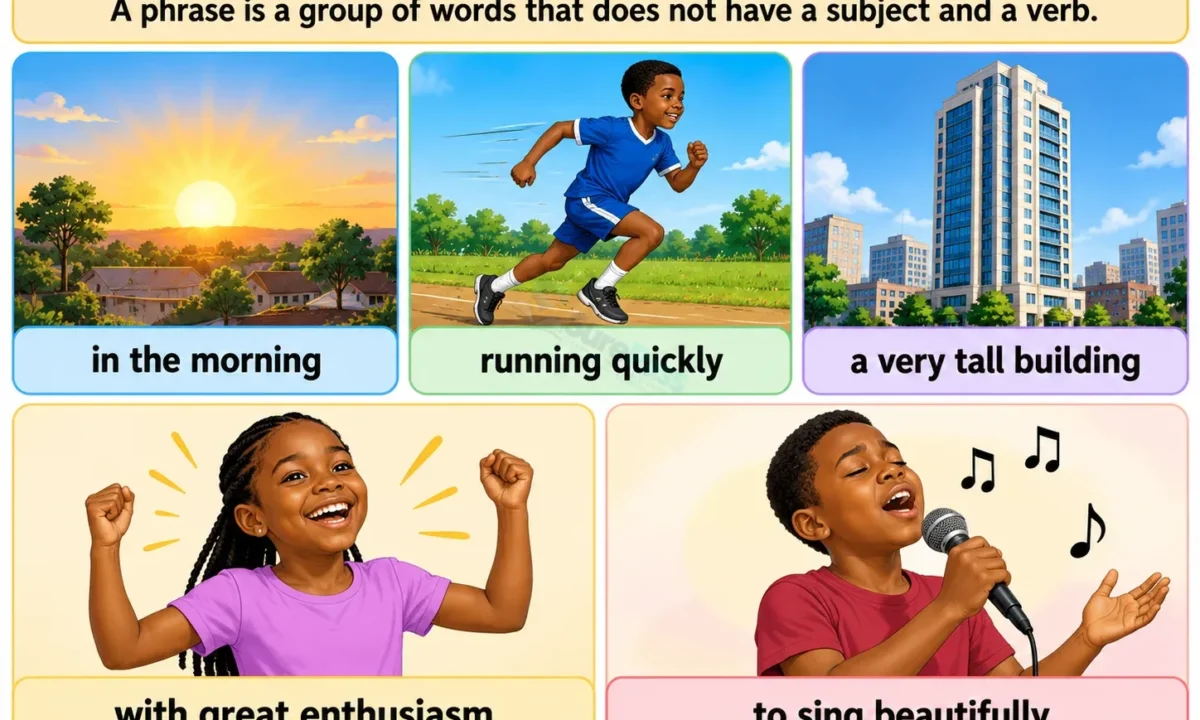
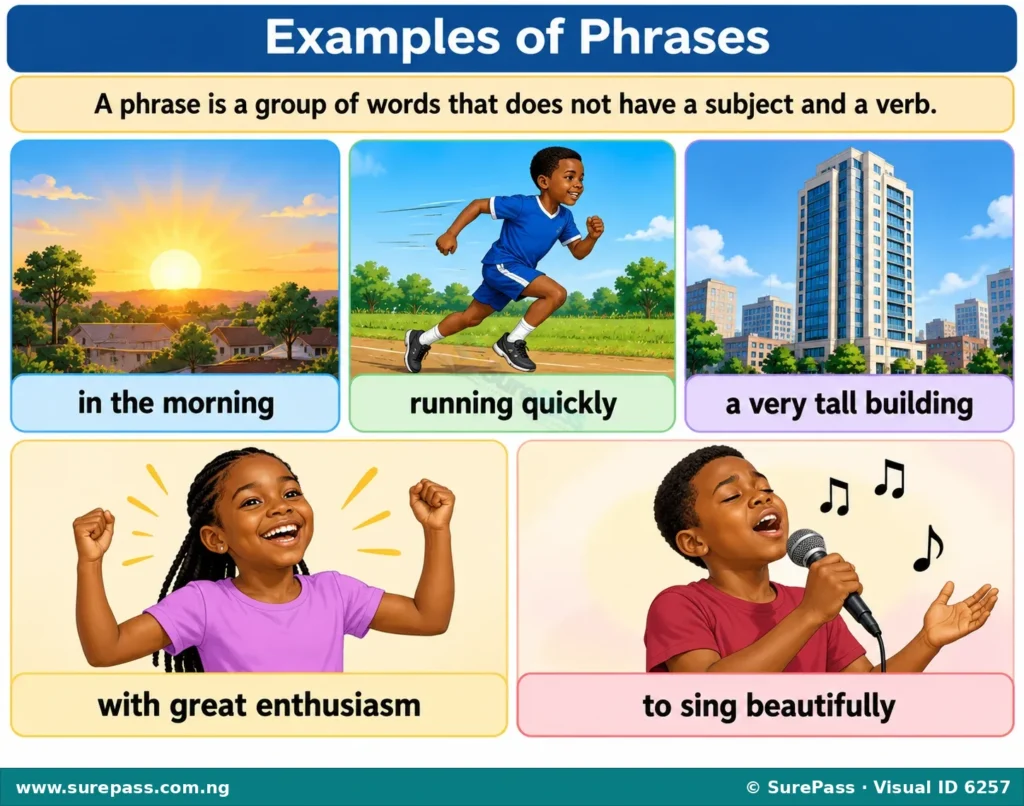
A phrase is a group of words that functions as a single unit in a sentence but does not contain both a subject and a finite verb.
Phrases add detail and meaning to sentences. They can act as nouns, adjectives, or adverbs, but they cannot stand alone as complete thoughts. They are like building blocks that help to expand the information in a sentence.
Examples of phrases include:
- in the morning (prepositional phrase)
- running quickly (participial phrase)
- a very tall building (noun phrase)
- with great enthusiasm (prepositional phrase)
- to sing beautifully (infinitive phrase)
What is a Clause?
A clause is a group of words that contains both a subject and a finite verb.
Unlike phrases, clauses have the potential to express a complete thought, although not all clauses do. Clauses are the core components of sentences, and understanding them is key to building complex sentence structures.
There are two main types of clauses: independent clauses and dependent clauses.
Independent Clauses
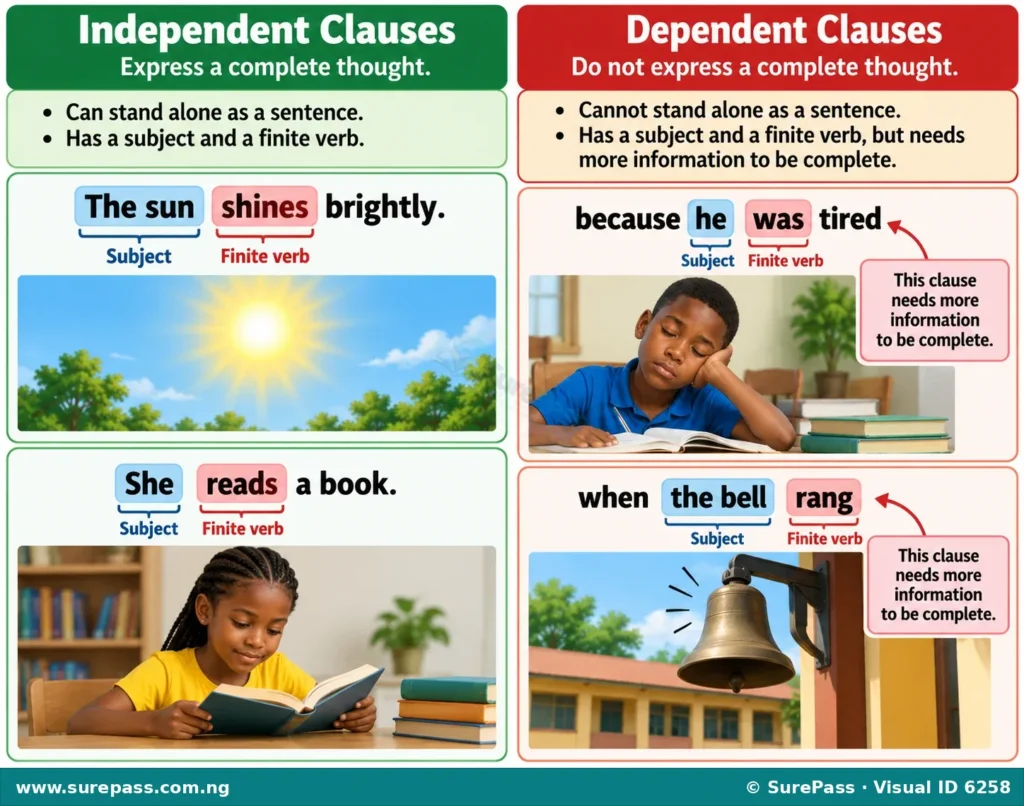
An independent clause is a group of words that contains a subject and a finite verb and can stand alone as a complete sentence.
It expresses a complete thought and does not need any other part of a sentence to make sense. Independent clauses are also known as main clauses.
Examples of independent clauses include:
- The sun shines brightly. (Subject: sun, Verb: shines)
- She reads a book. (Subject: She, Verb: reads)
- Birds sing. (Subject: Birds, Verb: sing)
- He ate the food. (Subject: He, Verb: ate)
- They played football. (Subject: They, Verb: played)
Dependent Clauses
A dependent clause is a group of words that contains a subject and a finite verb but cannot stand alone as a complete sentence.
Dependent clauses, also known as subordinate clauses, rely on an independent clause to make complete sense. They often begin with subordinating conjunctions such as ‘because’, ‘although’, ‘when’, ‘if’, ‘while’, or relative pronouns like ‘who’, ‘which’, ‘that’.
Examples of dependent clauses include:
- because he was tired (Subject: he, Verb: was)
- when the bell rang (Subject: bell, Verb: rang)
- who lives next door (Subject: who, Verb: lives)
- although it was raining (Subject: it, Verb: was raining)
- if you study hard (Subject: you, Verb: study)
What is a Sentence?
A sentence is a group of words that expresses a complete thought and contains at least one independent clause.
A sentence begins with a capital letter and ends with a punctuation mark such as a full stop (.), a question mark (?), or an exclamation mark (!). Sentences are the fundamental units of written communication.
Sentences can be simple, compound, complex, or compound-complex, depending on the number and types of clauses they contain. At this level, the focus is on understanding that a sentence must express a complete thought and contain at least one independent clause.
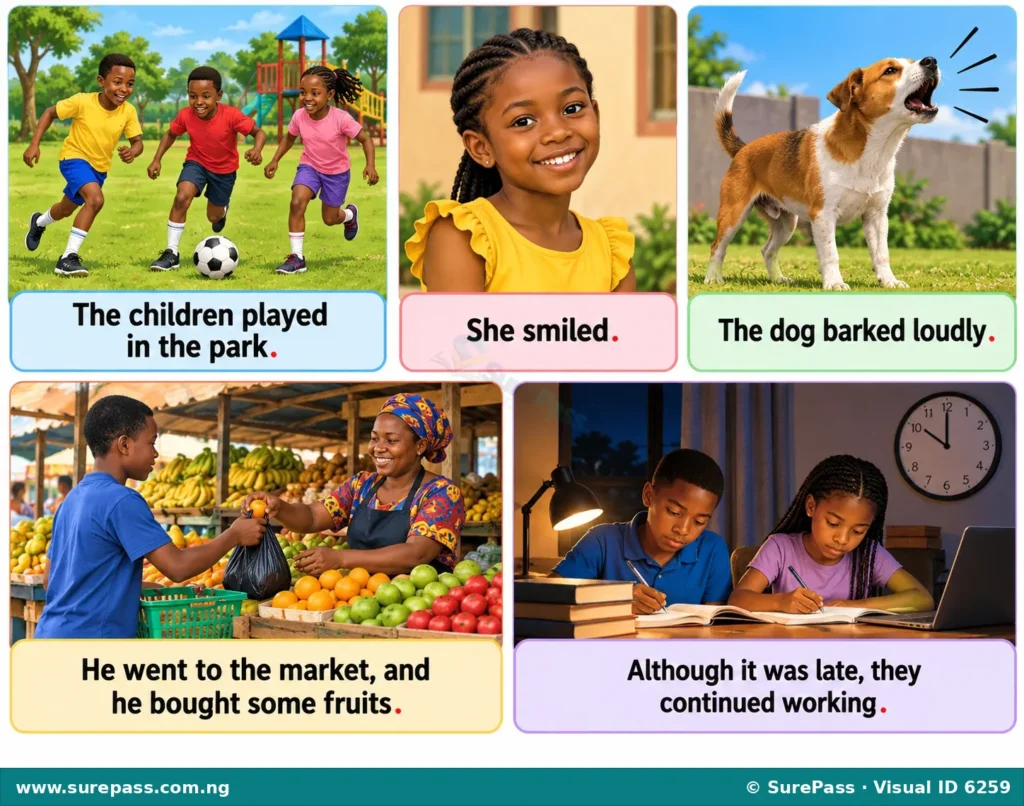
Examples of sentences include:
- The children played in the park. (Simple sentence)
- She smiled. (Simple sentence)
- The dog barked loudly. (Simple sentence)
- He went to the market, and he bought some fruits. (Compound sentence)
- Although it was late, they continued working. (Complex sentence)
Identifying Phrases, Clauses, and Sentences in Passages
To identify phrases, clauses, and sentences in a passage, it is important to look for the presence of a subject and a finite verb, and whether the group of words expresses a complete thought.
Steps for Identification:
- Look for complete thoughts: If a group of words starts with a capital letter and ends with a full stop, question mark, or exclamation mark, and expresses a complete idea, it is likely a sentence.
- Identify subjects and finite verbs: For any group of words, try to find the subject (who or what is performing the action) and the finite verb (the action word that shows tense and agrees with the subject).
- Distinguish between clauses and phrases:
- If a group of words has a subject and a finite verb, it is a clause.
- If it lacks either a subject or a finite verb (or both), it is a phrase.
- Distinguish between independent and dependent clauses:
- If a clause can stand alone and make complete sense, it is an independent clause.
- If a clause cannot stand alone and often starts with a subordinating conjunction or relative pronoun, it is a dependent clause.
Practice Passage:
Read the passage below and identify the phrases, clauses, and sentences.
The young boy, running quickly, arrived at the school gate. Because he was late, he hurried into the classroom. The teacher was already teaching. He quietly took his seat at the back of the room. Although he missed the beginning of the lesson, he tried to catch up.
Identification in the Practice Passage:
- The young boy, running quickly, arrived at the school gate.
- Sentence: This entire group of words expresses a complete thought and contains an independent clause (The young boy arrived at the school gate).
- Phrase: “running quickly” (participial phrase, no subject-verb pair)
- Because he was late, he hurried into the classroom.
- Sentence: This is a complex sentence.
- Dependent Clause: “Because he was late” (Subject: he, Verb: was; cannot stand alone)
- Independent Clause: “he hurried into the classroom” (Subject: he, Verb: hurried; can stand alone)
- The teacher was already teaching.
- Sentence: This is a simple sentence.
- Independent Clause: “The teacher was already teaching” (Subject: teacher, Verb: was teaching; can stand alone)
- He quietly took his seat at the back of the room.
- Sentence: This is a simple sentence.
- Independent Clause: “He quietly took his seat” (Subject: He, Verb: took; can stand alone)
- Phrase: “at the back of the room” (prepositional phrase, no subject-verb pair)
- Although he missed the beginning of the lesson, he tried to catch up.
- Sentence: This is a complex sentence.
- Dependent Clause: “Although he missed the beginning of the lesson” (Subject: he, Verb: missed; cannot stand alone)
- Independent Clause: “he tried to catch up” (Subject: he, Verb: tried; can stand alone)





0 comments
Open the discussion when you need it. Comments stay collapsed until requested so the initial article remains light.