


ARTICLE CONTENTSOn this page 4 sections
Expository Essay
Performance Objectives
By the end of the lesson, students should be able to:
- explain the meaning of expository composition;
- write expository essays.
Meaning of Expository Writing
Expository writing is a type of writing that aims to explain, inform, describe, or clarify a topic. The main purpose of an expository essay is to present facts, ideas, and information in a clear and organised manner, without expressing personal opinions or trying to persuade the reader.
This style of writing focuses on presenting objective information and evidence to support the explanation. It answers questions such as “what is it?”, “how does it work?”, or “why is it important?”. Expository writing is commonly found in textbooks, news articles, instruction manuals, and academic papers.
Writing Expository Essays
Writing an effective expository essay involves several key stages, from understanding the topic to structuring the essay clearly and presenting information logically. The goal is to make the explanation easy for the reader to follow and understand.
Understanding the Topic
Before writing, it is important to fully understand the essay topic. This involves identifying the specific subject to be explained and determining what information is necessary to clarify it for the reader. Research may be required to gather accurate facts, examples, and details.
For example, if the topic is “The Importance of Education,” understanding involves knowing what education is, its various benefits, and how it impacts individuals and society. If the topic is “How to Prepare a Local Dish,” understanding means knowing the ingredients, steps, and cooking methods.
Structure of an Expository Essay
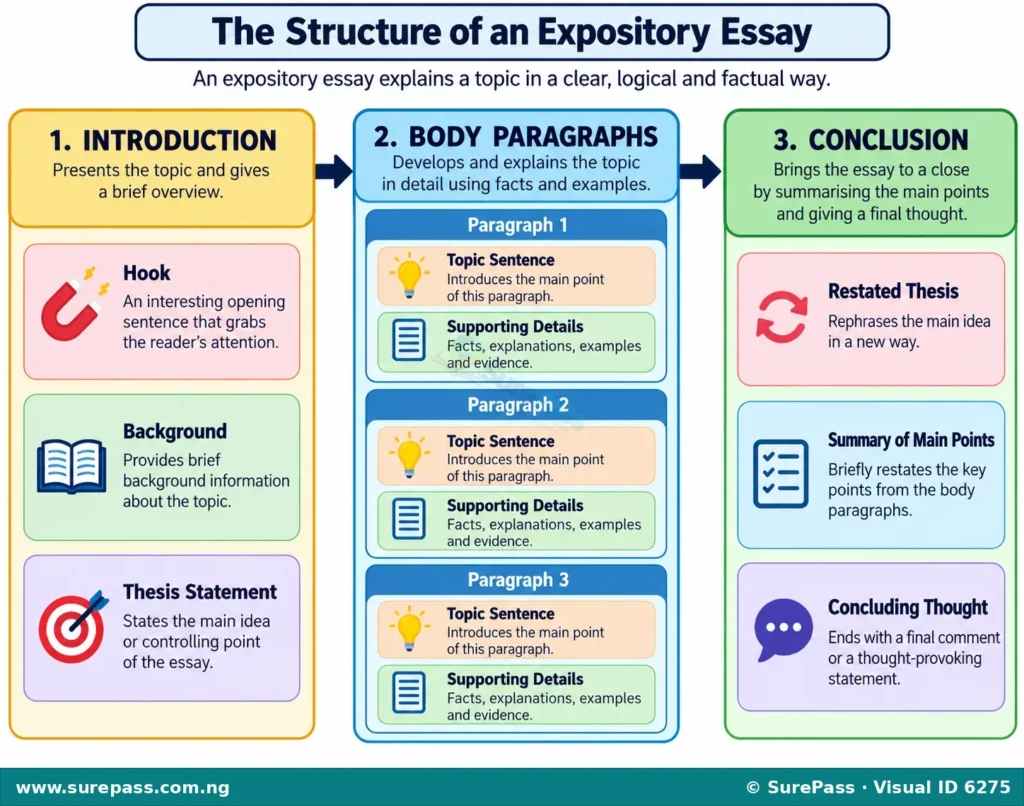
A typical expository essay follows a clear structure to ensure that the information is presented logically and coherently. This structure helps the reader to follow the explanation from beginning to end.
The main parts of an expository essay are:
- Introduction
- Body Paragraphs
- Conclusion
The Introduction
The introduction is the first paragraph of the essay. Its purpose is to introduce the topic to the reader and provide a general overview of what the essay will explain.
A strong introduction typically includes:
- Hook: A sentence or two that grabs the reader’s attention. This could be a general statement about the topic, a surprising fact, or a relevant question.
- Background Information: A few sentences that provide context or necessary background for the topic.
- Thesis Statement: The main idea or central point of the essay. In an expository essay, the thesis statement clearly states what the essay will explain or describe. It acts as a roadmap for the reader.
For example, for an essay on “The Benefits of Regular Exercise,” an introduction might start with a general statement about health, provide some background on physical activity, and then state the thesis: “Regular exercise offers numerous benefits for both physical and mental well-being.”
Body Paragraphs
The body of the essay consists of several paragraphs that develop and support the thesis statement. Each body paragraph focuses on a specific point or aspect of the main topic.
Each body paragraph should contain:
- Topic Sentence: The first sentence of the paragraph, which introduces the main idea of that specific paragraph. It directly supports the overall thesis statement.
- Supporting Details: Facts, examples, statistics, explanations, or descriptions that elaborate on the topic sentence. These details provide evidence and clarity for the point being made.
- Concluding Sentence (Optional): A sentence that summarises the main idea of the paragraph or transitions to the next paragraph.
For an essay on “The Benefits of Regular Exercise,” one body paragraph might discuss physical health benefits (e.g., stronger heart, weight management), another might discuss mental health benefits (e.g., reduced stress, improved mood), and a third might discuss social benefits (e.g., teamwork, new friendships).
The Conclusion
The conclusion is the final paragraph of the essay. Its purpose is to summarise the main points discussed in the body and restate the thesis in a new way.
A good conclusion typically includes:
- Restated Thesis: The thesis statement rephrased in different words.
- Summary of Main Points: A brief overview of the key ideas presented in the body paragraphs.
- Concluding Thought: A final statement that leaves the reader with a lasting impression or a broader understanding of the topic. This could be a reflection, a recommendation, or a prediction related to the topic.
For the “Benefits of Regular Exercise” essay, the conclusion would summarise the physical, mental, and social advantages, restate the importance of exercise, and end with a thought about leading a healthier life.
Language and Style in Expository Essays
The language used in expository essays should be clear, precise, and objective. The aim is to inform, so the writing should avoid ambiguity and personal bias.
- Clarity and Precision: Use clear and specific vocabulary. Avoid vague language or jargon that the reader might not understand.
- Objectivity: Present information neutrally. Avoid using personal pronouns like “I,” “me,” “my,” “you,” or “we” unless specifically required by the prompt (e.g., for a process explanation where “you” refers to the person performing the steps). Focus on facts and evidence.
- Formal Tone: Maintain a formal and academic tone. Avoid slang, contractions, and overly casual language.
- Transitions: Use transition words and phrases to connect ideas between sentences and paragraphs. This helps the essay flow smoothly and logically.
Examples of transition words and phrases include:
- To add information: in addition, furthermore, moreover, also, another, similarly.
- To show cause and effect: therefore, as a result, consequently, because, since.
- To compare or contrast: however, on the other hand, in contrast, similarly, likewise.
- To illustrate: for example, for instance, specifically, to illustrate.
- To summarise: in conclusion, to summarise, in brief, therefore.
Steps for Writing an Expository Essay
The process of writing an expository essay can be broken down into several manageable steps:
- Choose a Topic (if not provided): Select a topic that can be explained clearly and supported with facts.
- Brainstorm and Research: Gather information, facts, examples, and details related to your topic. Organise your ideas.
- Create an Outline: Plan the structure of your essay. Decide what points will go into the introduction, each body paragraph, and the conclusion. This ensures a logical flow.
- Write the Introduction: Start with a hook, provide background, and state your thesis statement.
- Write the Body Paragraphs: Develop each main point in a separate paragraph, starting with a topic sentence and supporting it with details and examples. Use transition words to connect ideas.
- Write the Conclusion: Restate your thesis, summarise your main points, and provide a concluding thought.
- Review and Revise: Check for clarity, coherence, grammar, spelling, and punctuation errors. Ensure that the essay effectively explains the topic without personal opinions.
Example of an Expository Essay Outline
Consider the topic: “How to Stay Healthy”
- Introduction
- Hook: General statement about the importance of health.
- Background: Brief mention of common health challenges.
- Thesis Statement: Staying healthy involves a combination of balanced diet, regular exercise, and adequate rest.
- Body Paragraph 1: Balanced Diet
- Topic Sentence: A balanced diet is fundamental for maintaining good health.
- Supporting Details:
- Eating fruits, vegetables, and whole grains.
- Limiting processed foods, sugar, and unhealthy fats.
- Importance of water intake.
- Body Paragraph 2: Regular Exercise
- Topic Sentence: Physical activity plays a crucial role in keeping the body strong and functional.
- Supporting Details:
- Benefits of cardio exercises (e.g., running, swimming).
- Benefits of strength training (e.g., lifting weights).
- Importance of consistency.
- Body Paragraph 3: Adequate Rest
- Topic Sentence: Sufficient sleep and rest are essential for the body’s recovery and overall well-being.
- Supporting Details:
- How sleep helps repair the body and mind.
- Consequences of sleep deprivation.
- Tips for improving sleep quality.
- Conclusion
- Restated Thesis: A healthy lifestyle is achieved through conscious choices regarding diet, exercise, and rest.
- Summary of Main Points: Briefly mention the importance of nutrition, physical activity, and sleep.
- Concluding Thought: Emphasise that these habits lead to a more energetic and fulfilling life.


0 comments
Open the discussion when you need it. Comments stay collapsed until requested so the initial article remains light.