



ARTICLE CONTENTSOn this page 8 sections
Comprehension: Reading to Identify the Writer’s Mood, Tone and Purpose and the Relationship Between Purpose and Tone
Performance Objectives
By the end of the lesson, students should be able to:
- differentiate between the writer’s mood, tone and purpose;
- recognize the various elements signifying purpose and tone In reading passages;
- recognize the relationship between tone, purpose and meaning in a reading discourse;
- demonstrate clearly purpose and meaning through tone;
- recognize and identify the contrast in tone and mood while listening to another reader.
Understanding Writer’s Mood, Tone, and Purpose
When reading any text, it is important to go beyond just understanding the words on the page. A deeper understanding involves recognising the writer’s feelings, their attitude towards the subject, and their reason for writing. These three elements are known as mood, tone, and purpose.
What is Mood?
Mood refers to the atmosphere or feeling that a piece of writing creates for the reader.
It is the emotional response the text evokes in the person reading it. Mood is often created through the writer’s choice of words, imagery, setting, and overall descriptive details. For example, a story might create a mood of suspense, joy, sadness, or excitement.

What is Tone?
Tone refers to the writer’s attitude towards the subject matter or audience.
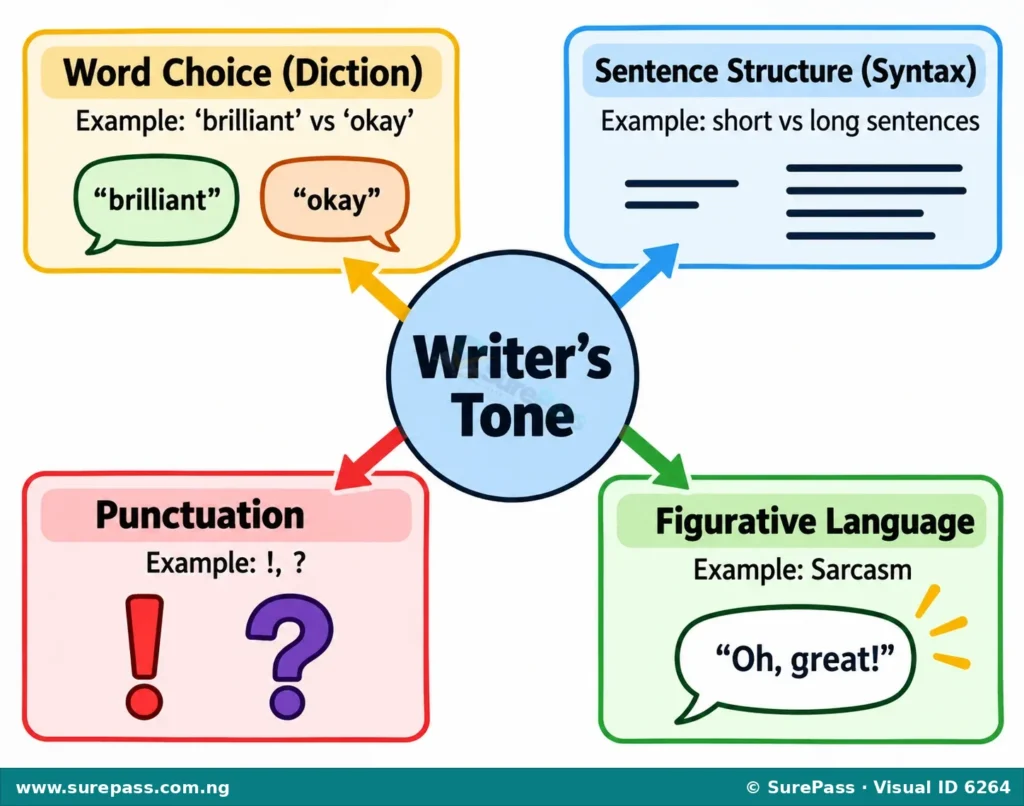
It is how the writer feels about what they are writing, and this attitude is conveyed through their word choice (diction), sentence structure (syntax), punctuation, and use of figurative language. Tone can be formal, informal, serious, humorous, sarcastic, critical, objective, enthusiastic, or many other attitudes. For example, a writer might use a formal tone when writing an official report, or a humorous tone when telling a funny story.
What is Purpose?
Purpose refers to the main reason why the writer created the text.
It is the goal the writer hopes to achieve by communicating with the audience. Common purposes include to inform, to persuade, to entertain, or to describe. For instance, a newspaper article’s purpose is usually to inform, while an advertisement’s purpose is to persuade.
Differentiating Between Mood, Tone, and Purpose
While mood, tone, and purpose are all related to the writer’s communication, they are distinct concepts:
- Mood is about the reader’s feelings (how the text makes the reader feel).
- Tone is about the writer’s attitude (how the writer feels about the subject).
- Purpose is about the writer’s intention (why the writer wrote the text).
Consider a story about a character facing a difficult challenge. The writer might use words that create a mood of tension for the reader. At the same time, the writer’s tone might be one of admiration for the character’s resilience. The overall purpose of the story could be to inspire readers to overcome their own challenges.
Recognising Elements Signifying Purpose and Tone in Passages
To identify the writer’s mood, tone, and purpose, readers must pay close attention to specific elements within the text.
Identifying Mood
To identify the mood of a passage, consider the following:
- Word Choice (Diction): Look for words that evoke strong emotions or sensory details. For example, “gloomy,” “sparkling,” “terrifying,” “peaceful.”
- Imagery: Pay attention to descriptions that appeal to the five senses (sight, sound, smell, taste, touch). Vivid imagery can create a strong atmosphere.
- Setting: The time and place of the story can greatly influence the mood. A dark, abandoned house creates a different mood than a bustling market.
- Figurative Language: Metaphors, similes, and personification can add depth to the mood.
- Pacing: How quickly or slowly the story unfolds can affect the mood. Fast pacing often creates excitement or tension, while slow pacing can create a calm or reflective mood.
Identifying Tone
To identify the writer’s tone, look at these elements:
- Word Choice (Diction): The specific words a writer chooses reveal their attitude. For example, using “childish” instead of “youthful” suggests a critical tone. Using “magnificent” instead of “good” suggests an admiring tone.
- Sentence Structure (Syntax): Short, choppy sentences might indicate urgency or anger, while long, complex sentences might suggest a formal or reflective tone.
- Punctuation: Exclamation marks can show excitement or anger, while question marks can show curiosity or doubt.
- Figurative Language: Sarcasm, irony, and hyperbole are often used to convey a particular tone.
- Connotations: The emotional associations of words, beyond their literal meanings, are crucial. For example, “home” has a warmer connotation than “house.”
Identifying Purpose
To identify the writer’s purpose, consider:
- Content: What information is being presented? Is it facts, opinions, or a story?
- Structure: How is the text organised? Is it a step-by-step guide, a narrative, an argument, or a description?
- Language: Is the language objective and factual (inform), emotional and persuasive (persuade), or imaginative and descriptive (entertain/describe)?
- Call to Action: Does the writer ask the reader to do something, believe something, or feel something?
Common purposes include:
- To Inform: To provide facts, data, or instructions. (e.g., news articles, textbooks, recipes).
- To Persuade: To convince the reader to agree with a viewpoint or take a specific action. (e.g., advertisements, editorials, political speeches).
- To Entertain: To amuse or engage the reader with a story, poem, or humorous piece. (e.g., novels, short stories, jokes).
- To Describe: To create a vivid picture of a person, place, object, or event. (e.g., travel guides, character sketches, nature writing).
Relationship Between Tone, Purpose, and Meaning
The writer’s tone and purpose are closely linked and together they shape the overall meaning of a text. A writer chooses a specific tone to achieve their purpose, and this choice directly impacts how the message is received and understood by the reader.
- Purpose Influences Tone: If a writer’s purpose is to persuade, they might adopt a passionate, urgent, or authoritative tone. If their purpose is to inform, they will likely use an objective, neutral, or formal tone.
- Tone Clarifies Purpose: The tone helps the reader understand the writer’s underlying intention. A sarcastic tone, for example, immediately signals that the writer’s literal words might not be their true meaning, often serving a persuasive or critical purpose.
- Both Shape Meaning: The combination of purpose and tone determines the full meaning conveyed. A factual statement delivered with a sarcastic tone means something entirely different than the same statement delivered with a serious, informative tone. The tone adds a layer of interpretation to the literal words, guiding the reader towards the intended meaning.
For example, a text describing a new government policy. If the purpose is to inform, the tone will be neutral and factual. The meaning is simply the details of the policy. If the purpose is to persuade people to support the policy, the tone might be enthusiastic and optimistic, highlighting benefits. The meaning then includes the positive implications and a call for support. If the purpose is to persuade against the policy, the tone might be critical and alarmist, highlighting potential dangers. The meaning then includes warnings and a call for opposition.
Demonstrating Purpose and Meaning Through Tone
The same words can convey different purposes and meanings depending on the tone used. Consider the simple statement: “That was a great idea.”
- Enthusiastic Tone: If said with excitement and a smile, the purpose is to praise, and the meaning is genuine approval.
- Sarcastic Tone: If said with a sneer and a roll of the eyes, the purpose is to criticise or mock, and the meaning is the exact opposite of the literal words – it was a terrible idea.
- Neutral/Objective Tone: If said calmly and factually, perhaps in a report, the purpose might be to acknowledge a successful outcome, and the meaning is a straightforward observation.
These examples show how tone is not just an embellishment but an integral part of conveying the writer’s true message and achieving their communication goal.
Recognising and Identifying Contrast in Tone and Mood While Listening
When listening to someone read a passage, identifying mood and tone involves paying attention to vocal cues in addition to the words themselves. This skill is crucial for understanding the full message, especially in oral presentations, drama, or poetry readings.
The procedure for identifying mood and tone while listening involves the following steps:
- Listen to Word Choice: Just as in reading, the specific words chosen by the speaker are key. Do they use words that evoke strong feelings or describe attitudes?
- Observe Vocal Inflection: Pay attention to how the speaker’s voice rises and falls. A rising inflection can indicate a question or uncertainty, while a falling inflection can indicate finality or seriousness.
- Notice Pitch and Volume: A high pitch might suggest excitement, fear, or anger, while a low pitch might suggest seriousness, sadness, or authority. Loud volume can indicate anger or emphasis, while soft volume can suggest secrecy, sadness, or intimacy.
- Consider Pacing and Rhythm: How fast or slow the speaker talks, and the rhythm of their speech, can reveal mood and tone. Fast pacing might indicate excitement or nervousness, while slow pacing might suggest thoughtfulness, sadness, or solemnity.
- Identify Emphasis: Listen for words or phrases that the speaker stresses. Emphasis can highlight key ideas, reveal the speaker’s attitude, or indicate sarcasm.
- Recognise Pauses: Strategic pauses can build suspense (mood), indicate thoughtfulness (tone), or allow the audience to absorb information.
- Compare and Contrast: If listening to different readers or different parts of a single reading, actively compare how the vocal elements change. A sudden shift in pitch, volume, or speed often signals a change in mood or tone. For example, a reader might start with a calm, informative tone and then switch to an urgent, warning tone to convey a change in the message’s importance.
By actively listening to these vocal elements, one can effectively identify the mood created for the listener and the speaker’s tone towards the subject.



0 comments
Open the discussion when you need it. Comments stay collapsed until requested so the initial article remains light.