



ARTICLE CONTENTSOn this page 4 sections
Collocation
Performance Objectives
By the end of the lesson, students should be able to:
- explain the meaning of collocation;
- give examples of words that collocate.
Meaning of Collocation
Collocation refers to the natural pairing or grouping of words that frequently occur together in a language. These words sound “right” when used together by native speakers, while other combinations, though grammatically correct, may sound unnatural or wrong.
Understanding collocations is important for speaking and writing English accurately and naturally. It helps learners to sound more like native speakers and to avoid awkward or incorrect phrasing.
Examples of Words that Collocate
Collocations can be formed in various ways, such as adjective + noun, verb + noun, adverb + adjective, and so on. The following are common examples of words that collocate:
- Adjective + Noun:
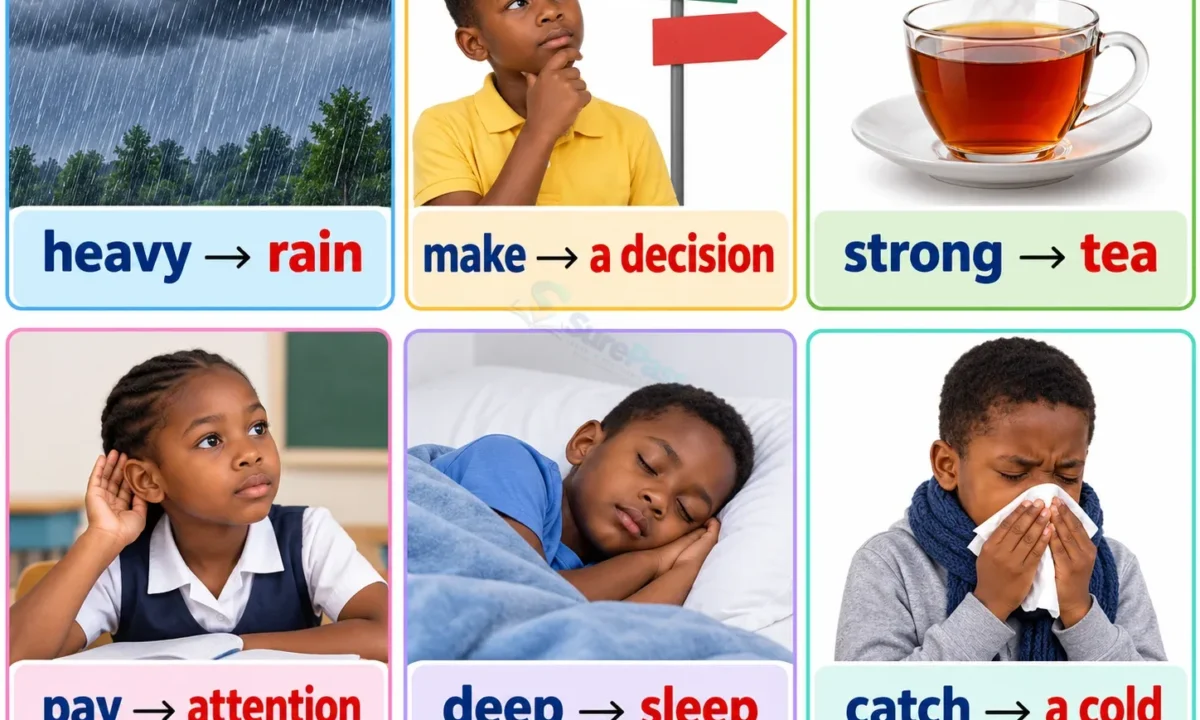
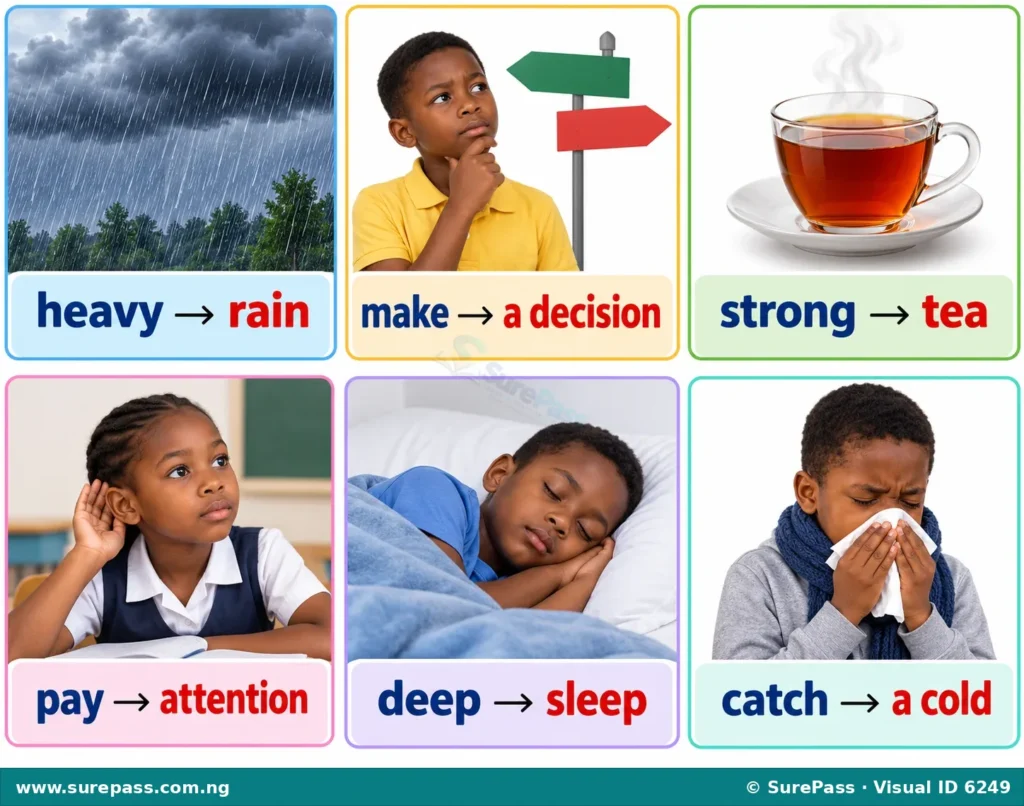
- “Heavy rain” (not “strong rain” or “big rain”)
- “Strong tea” (not “powerful tea”)
- “Deep sleep” (not “profound sleep”)
- “Fast food” (not “quick food”)
- “Bright idea” (not “shining idea”)
- “Serious mistake” (not “grave mistake”)
- Verb + Noun:
- “Make a decision” (not “do a decision”)
- “Take a photo” (not “make a photo”)
- “Pay attention” (not “give attention”)
- “Catch a cold” (not “get a cold”)
- “Break a promise” (not “destroy a promise”)
- “Do homework” (not “make homework”)
- Adverb + Adjective:
- “Completely satisfied” (not “fully satisfied”)
- “Highly recommended” (not “very recommended”)
- “Bitterly disappointed” (not “strongly disappointed”)
- “Ridiculuously cheap” (not “absurdly cheap”)
- “Fully aware” (not “completely aware”)
- Noun + Noun:
- “Traffic jam” (not “traffic block”)
- “Key factor” (not “main factor”)
- “Round of applause” (not “circle of applause”)
- “Sense of humour” (not “feeling of humour”)
- “Rush hour” (not “hurry hour”)
- Verb + Adverb:
- “Speak softly” (not “speak gently”)
- “Run quickly” (not “run fastly”)
- “Work hard” (not “work strongly”)
- “Drive carefully” (not “drive cautiously”)
- “Listen attentively” (not “listen carefully”)
These examples demonstrate how certain words naturally fit together, creating common and acceptable phrases in English. Using these correct pairings helps to improve fluency and accuracy in communication.



0 comments
Open the discussion when you need it. Comments stay collapsed until requested so the initial article remains light.