


ARTICLE CONTENTSOn this page 8 sections
Narrative Composition
Performance Objectives
By the end of the lesson, students should be able to:
- explain the meaning and purpose of narrative composition;
- discuss the types of narrative composition;
- state the features/ elements of a narrative;
- identify the structure of a narrative;
- write a narrative composition.
Meaning and Purpose of Narrative Composition
A narrative composition is a piece of writing that tells a story.
It involves a sequence of events, usually in chronological order, and includes characters, a setting, and a plot. The main goal of a narrative composition is to engage the reader by recounting an experience, real or imagined.
The purpose of narrative composition includes:
- To Entertain: Many stories are written simply to amuse or captivate the reader with interesting events and characters.
- To Inform: Narratives can be used to share information about historical events, cultural practices, or personal experiences.
- To Persuade or Teach a Lesson: Stories often convey moral lessons, values, or insights into human nature. Fables and parables are good examples of narratives with a persuasive purpose.
- To Express Personal Experiences: Writers use narrative to share their own feelings, thoughts, and memories with an audience.
Types of Narrative Composition
Narrative compositions can be categorised based on the nature of the story they tell. The main types include personal, imaginative, and historical/traditional narratives.
Personal Narratives
Personal narratives are stories based on real-life experiences of the writer or someone they know. These stories often reflect on significant moments, challenges, or achievements in a person’s life.
Examples of personal narratives include:
- “How I Overcame My Greatest Fear.”
- “My First Day in Senior Secondary School.”
- “A Memorable Trip to My Village.”
Imaginative Narratives
Imaginative narratives are fictional stories that come entirely from the writer’s imagination. They are not based on real events but create new worlds, characters, and plots. These stories allow for great creativity and can explore fantasy, science fiction, or realistic fiction.
Examples of imaginative narratives include:
- “The Day I Met a Mermaid.”
- “A Journey to the Centre of the Earth.”
- “The Talking Drum of Oba Ade.”
Historical or Traditional Narratives
Historical or traditional narratives tell stories that are rooted in history, folklore, myths, or legends. They often explain the origins of things, recount heroic deeds, or preserve cultural beliefs and values. While they may contain fictional elements, they are often based on historical facts or long-held traditions.
Examples of historical or traditional narratives include:
- “The origin of the River Niger.”
- “How the Tortoise Got Its Cracked Shell.”
- “The Legend of Queen Amina of Zazzau.”
Features and Elements of a Narrative
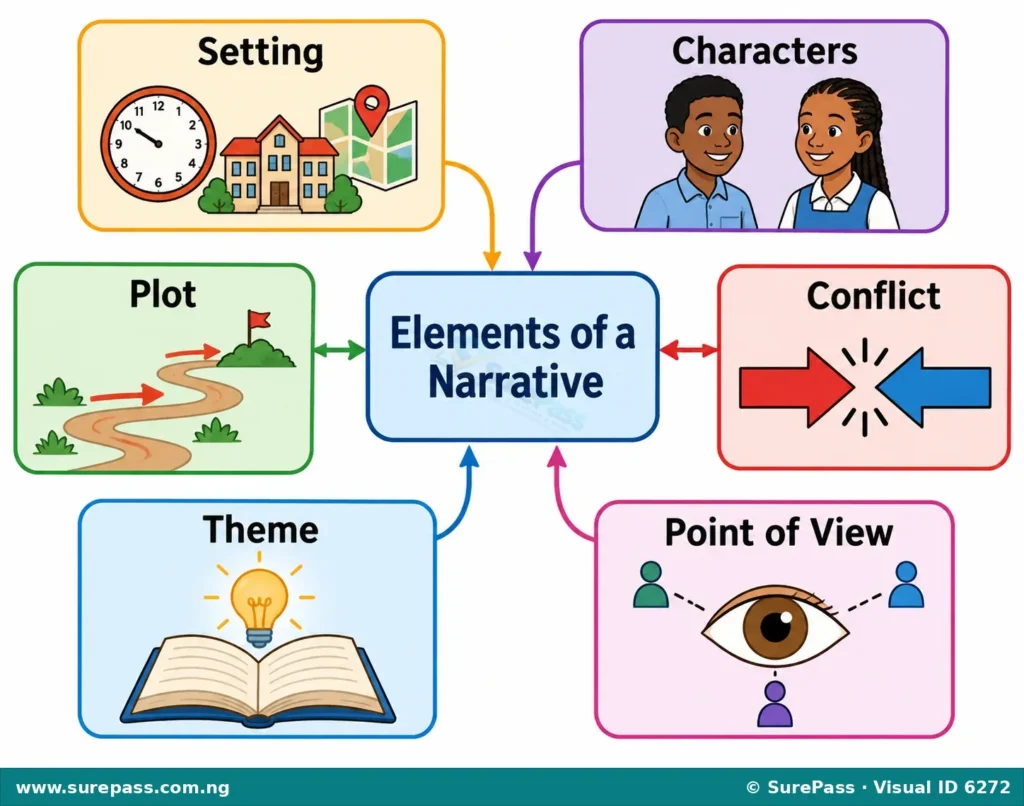
Every good narrative composition contains several key elements that work together to create a complete and engaging story. Understanding these elements helps in both writing and analysing narratives.
The essential features of a narrative include:
- Setting: This refers to the time and place where the story happens. The setting can be a specific location like a school, a market, or a forest, and a specific time like morning, night, or a particular year. A well-described setting helps the reader visualise the story’s environment.
- Characters: These are the people, animals, or even imaginary beings who perform actions and experience events in the story. A narrative usually has a main character (protagonist) and other supporting characters. Characters should be believable and have distinct personalities.
- Plot: This is the sequence of events that make up the story. It includes the beginning, the rising action (where conflict builds), the climax (the turning point), the falling action, and the resolution. The plot drives the story forward.
- Conflict: This is the central problem or struggle that the characters face. Conflict can be internal (a character struggling with their own thoughts or feelings) or external (a character struggling against another character, nature, or society). Conflict makes the story interesting.
- Theme: This is the main message, idea, or lesson that the story conveys. It is often an underlying truth about life, human nature, or society. For example, a story might have themes of courage, friendship, or perseverance.
- Point of View: This is the perspective from which the story is told. Common points of view include first-person (using “I” and “we,” where a character tells the story) and third-person (using “he,” “she,” “it,” “they,” where an outside narrator tells the story).
Structure of a Narrative Composition
A narrative composition typically follows a clear structure to ensure the story flows logically and is easy for the reader to follow. This structure is divided into three main parts: the Introduction, the Body, and the Conclusion.
Introduction
The introduction is the beginning of the story. Its main purpose is to grab the reader’s attention and set the stage for what is to come.
The introduction usually includes:
- Hook: An opening sentence or paragraph that captures the reader’s interest. This could be a question, a surprising statement, a vivid description, or an intriguing event.
- Setting the Scene: Introducing the time and place where the story begins.
- Introducing Main Characters: Briefly presenting the main characters involved in the story.
- Hinting at the Conflict: Giving a subtle idea of the problem or situation that the story will explore, without revealing everything.
Body
The body is the longest part of the narrative, where the main events of the story unfold. It develops the plot, characters, and conflict.
The body typically includes:
- Rising Action: A series of events that build up the tension and lead to the climax. This is where the conflict is introduced and gradually intensifies.
- Character Development: Showing how characters react to events, make decisions, and change throughout the story.
- Climax: The most exciting or intense part of the story, where the main conflict reaches its peak. It is the turning point after which the story cannot be the same.
- Falling Action: The events that happen after the climax, as the tension begins to decrease and the story moves towards its resolution.
Conclusion
The conclusion brings the story to an end. It provides a sense of closure and often leaves the reader with a lasting impression.
The conclusion usually includes:
- Resolution: The outcome of the main conflict. How the problem is solved or how the characters deal with the consequences.
- Summary of Lessons Learned: If applicable, reflecting on the moral or theme of the story.
- Final Thoughts or Feelings: A concluding statement that leaves the reader satisfied or thoughtful.
Language Features of Narrative Composition
Effective narrative writing uses specific language features to make the story engaging, vivid, and realistic. These features help to draw the reader into the world of the story.
Important language features include:
- Past Tense: Most narrative compositions are written in the past tense because they recount events that have already happened. This gives the story a sense of completion and allows the writer to describe a sequence of past actions.
Examples:
- I walked to the market.
- She laughed at the joke.
- They ran quickly to catch the bus.
- Time Connectives: These are words or phrases that show the order or sequence of events in a story. They help to create a smooth flow and make it clear when one event happens in relation to another.
Examples:
- Then, the rain started.
- After that, we decided to go home.
- Suddenly, a loud noise startled everyone.
- Later in the evening, the stars appeared.
- Finally, the long journey came to an end.
- Detailed Descriptive Language: Using vivid adjectives, adverbs, and sensory details helps to bring the story to life. It allows the reader to see, hear, smell, taste, and feel what is happening, making the narrative more immersive and engaging.
Examples:
- “The dark clouds gathered quickly, and thunder roared like a wild beast.” (Instead of “The clouds gathered and thunder was loud.”)
- “The fragrant aroma of freshly baked bread wafted from the kitchen.”
- “He wore a faded, torn shirt and had deep lines etched around his eyes.”
- Direct Speech: Including direct speech (dialogue) makes characters more realistic and allows their personalities to shine through. It also helps to advance the plot and reveal information directly from the characters.
Examples:
- Musa said, “I will not let you hurt my friend!”
- “Where are you going?” asked Mama.
- “I am tired,” whispered the little girl.
- Figurative Language: This involves using words or expressions with a meaning that is different from the literal interpretation. Figurative language adds richness, imagery, and depth to a narrative, making it more interesting and memorable.
Examples of figurative language include:
- Proverbs: Short, well-known sayings that express a general truth or piece of advice. Example: “A stitch in time saves nine.”
- Idioms: Phrases whose meaning cannot be understood from the ordinary meaning of its words. Example: “It was raining cats and dogs” (meaning it was raining very heavily).
- Simile: A comparison between two different things using “like” or “as.” Example: “Her smile was as bright as the morning sun.”
- Metaphor: A direct comparison between two unlike things, stating that one thing is another. Example: “The classroom was a zoo after the teacher left.”
- Personification: Giving human qualities or actions to inanimate objects or animals. Example: “The wind whispered secrets through the trees.”
Writing Narrative Compositions
Writing a good narrative composition requires careful planning, drafting, and revision. By following a structured approach, you can create a compelling story that effectively communicates your ideas.
The process of writing a narrative composition involves the following steps:
- Understand the Prompt: Read the topic or prompt carefully. Identify if it requires a personal, imaginative, or historical/traditional narrative. Understand the core idea or theme you need to address.
- Brainstorm Ideas:
- For a personal narrative, think about real experiences that fit the prompt.
- For an imaginative narrative, let your creativity flow. Think of interesting characters, settings, and plot twists.
- For a historical/traditional narrative, recall stories, legends, or historical facts you know.
- Develop your main idea, characters, and setting.
- Outline Your Story (Structure): Plan the story using the narrative structure:
- Introduction: What is your hook? Who are the main characters? Where and when does the story begin? What hint of conflict will you give?
- Body: What are the main events? How does the conflict develop? What is the climax (the most exciting part)? What happens after the climax?
- Conclusion: How does the story end? What is the resolution? Is there a lesson learned or a final thought?
- Draft Your Composition:
- Write your story following your outline. Do not worry too much about perfection at this stage; focus on getting your ideas down.
- Use past tense consistently.
- Incorporate time connectives to ensure smooth transitions between events.
- Include detailed descriptive language to make your setting and characters vivid.
- Use direct speech to make your characters sound realistic and to move the plot forward.
- Add figurative language (similes, metaphors, proverbs, idioms, personification) to enrich your writing.
- Review and Revise: After drafting, read through your composition critically.
- Content: Does the story make sense? Is the plot clear? Are the characters believable? Is the theme evident?
- Structure: Does it have a clear introduction, body, and conclusion? Does the story flow logically?
- Language: Have you used appropriate vocabulary? Is your descriptive language effective? Are your time connectives used correctly? Is your direct speech punctuated properly?
- Grammar and Spelling: Check for any errors in grammar, punctuation, and spelling.
- Read your story aloud to catch awkward sentences or unclear phrases.
- Edit and Proofread: Make final corrections to ensure your composition is polished and error-free before submitting it.




0 comments
Open the discussion when you need it. Comments stay collapsed until requested so the initial article remains light.