



ARTICLE CONTENTSOn this page 6 sections
Consonant Clusters
Performance Objectives
By the end of the lesson, students should be able to:
- describe consonant clusters;
- identify consonant clusters;
- pronounce consonant clusters;
- give appropriate examples of words in which consonant clusters occur word- initially, medially and finally.
What Are Consonant Clusters?
A consonant cluster is a group of two or more consonant sounds that appear together in a word without any vowel sound between them.
These consonant sounds are pronounced one after the other, blending smoothly to form a single unit. For example, in the word “street”, the sounds /s/, /t/, and /r/ form a consonant cluster. Similarly, in “blue”, the sounds /b/ and /l/ form a cluster.
It is important to distinguish consonant clusters from digraphs. A digraph is two consonants that represent a single sound, such as ‘sh’ in ‘ship’ or ‘ch’ in ‘chair’. In a consonant cluster, each consonant retains its individual sound, even though they are pronounced together.
Pronouncing Consonant Clusters
Pronouncing consonant clusters clearly requires careful articulation of each consonant sound within the cluster. Each sound must be heard distinctly, but they should flow together without a pause or an added vowel sound between them.
For many English learners, especially those whose first languages do not have similar consonant combinations, pronouncing clusters can be challenging. The key is to practise blending the sounds smoothly without inserting an extra vowel sound. For instance, in “drink”, avoid pronouncing it as “d-uh-rink”. Instead, blend the /d/ and /r/ sounds directly.
To improve pronunciation, listen carefully to native speakers or audio recordings of words containing clusters. Pay attention to how the sounds are linked. Then, practise repeating the words, focusing on the precise movement of the tongue, lips, and teeth for each consonant sound in the cluster.
Positions of Consonant Clusters in Words
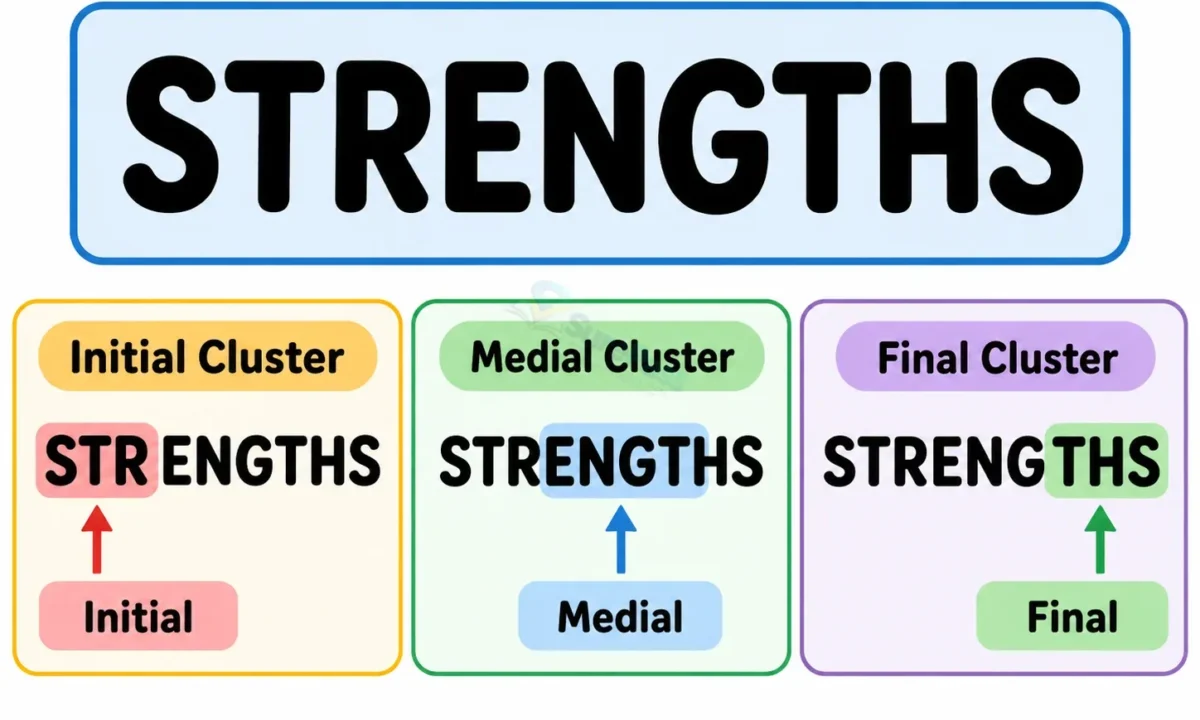
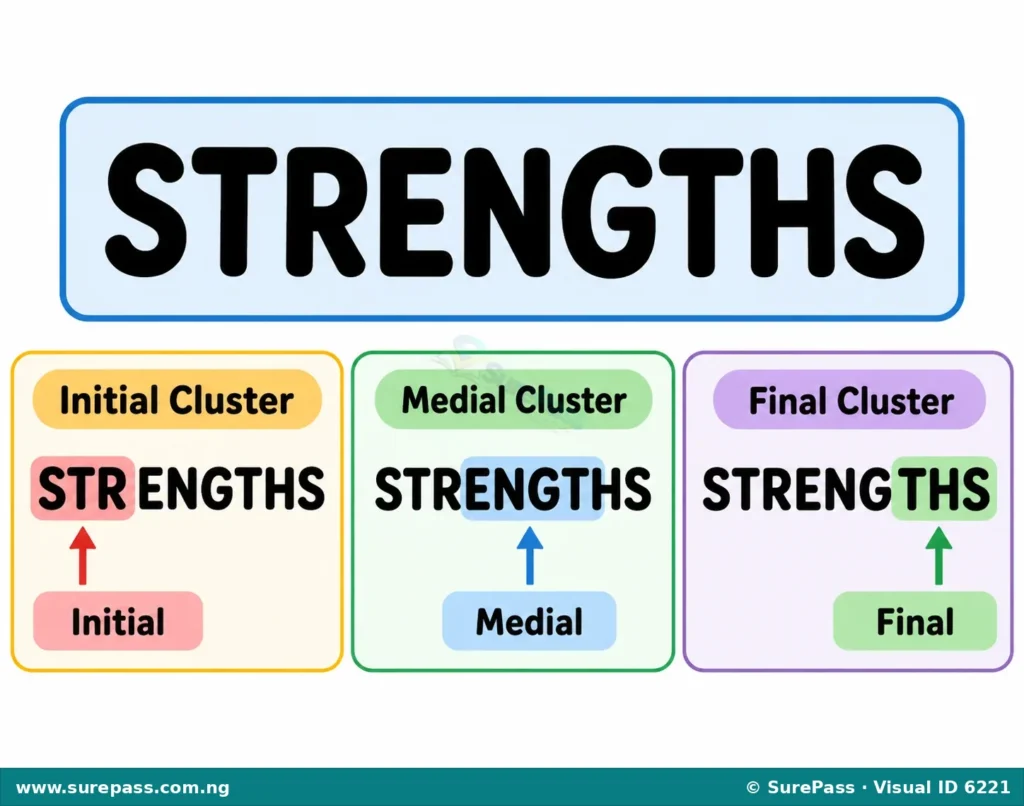
Consonant clusters can appear in different positions within a word: at the beginning (word-initial), in the middle (word-medial), or at the end (word-final).
Word-Initial Consonant Clusters
Word-initial consonant clusters occur at the beginning of a word. These clusters typically consist of two or three consonant sounds.
Examples of words with initial consonant clusters include:
- black
- bring
- clean
- cry
- dream
- fly
- free
- glass
- green
- play
- pray
- score
- sky
- sleep
- smile
- snake
- speak
- stop
- swim
- train
- twin
- three
- strong
- spring
- scream
Word-Medial Consonant Clusters
Word-medial consonant clusters appear in the middle of a word. These clusters can occur within a single syllable or across two syllables.
Examples of words with medial consonant clusters include:
- hundred
- complete
- destroy
- extra
- monster
- compress
- include
- explain
- complex
- athlete
- conflict
- entrance
Word-Final Consonant Clusters
Word-final consonant clusters are found at the end of a word. These clusters can also consist of two or more consonant sounds.
Examples of words with final consonant clusters include:
- act
- lift
- cold
- milk
- help
- jump
- hand
- bank
- want
- kept
- desk
- grasp
- fast
- text
- helps
- tests
- asks
- fifths
- twelfths
Practising Consonant Cluster Pronunciation
Regular practice is essential for mastering the pronunciation of consonant clusters. The following steps can help improve articulation:
The procedure involves the following steps:
- Listen Actively: Pay close attention to how consonant clusters are pronounced in spoken English. Use audio-visual materials, recordings, or a standard pronouncing dictionary to hear the correct sounds.
- Isolate and Repeat: Identify a word with a consonant cluster. First, try to pronounce the cluster on its own, then slowly add the vowel and other sounds to form the complete word. Repeat the word several times, focusing on clarity.
- Slow and Steady: Begin by pronouncing words with clusters slowly. This allows the mouth, tongue, and lips to get used to the movements required for each sound. Gradually increase your speed as you become more comfortable.
- Record Yourself: Use a recording device to record your pronunciation. Listen back to identify areas where you might be adding extra vowel sounds or dropping consonants. Compare your recording with a standard pronunciation.
- Minimal Pairs Practice: Practise words that differ only by the presence or absence of a cluster, or by the specific cluster used (e.g., “train” vs. “rain”, “sleep” vs. “sheep”). This helps to sharpen your ear and articulation.
- Tongue Twisters: Engage in tongue twisters that feature consonant clusters. This can be a fun way to challenge and improve your articulation skills. For example, “She sells seashells by the seashore.”
- Read Aloud: Read texts aloud, paying special attention to words containing consonant clusters. This helps integrate the practice into continuous speech.





0 comments
Open the discussion when you need it. Comments stay collapsed until requested so the initial article remains light.