



ARTICLE CONTENTSOn this page 7 sections
Stress in Connected Speech
Performance Objectives
By the end of the lesson, students should be able to:
- describe stress in connected speech;
- identify words with stress in connected speech;
- pronounce words with stress in connected speech;
- explain types of words in sentences (content and function words).
Understanding Stress in Connected Speech
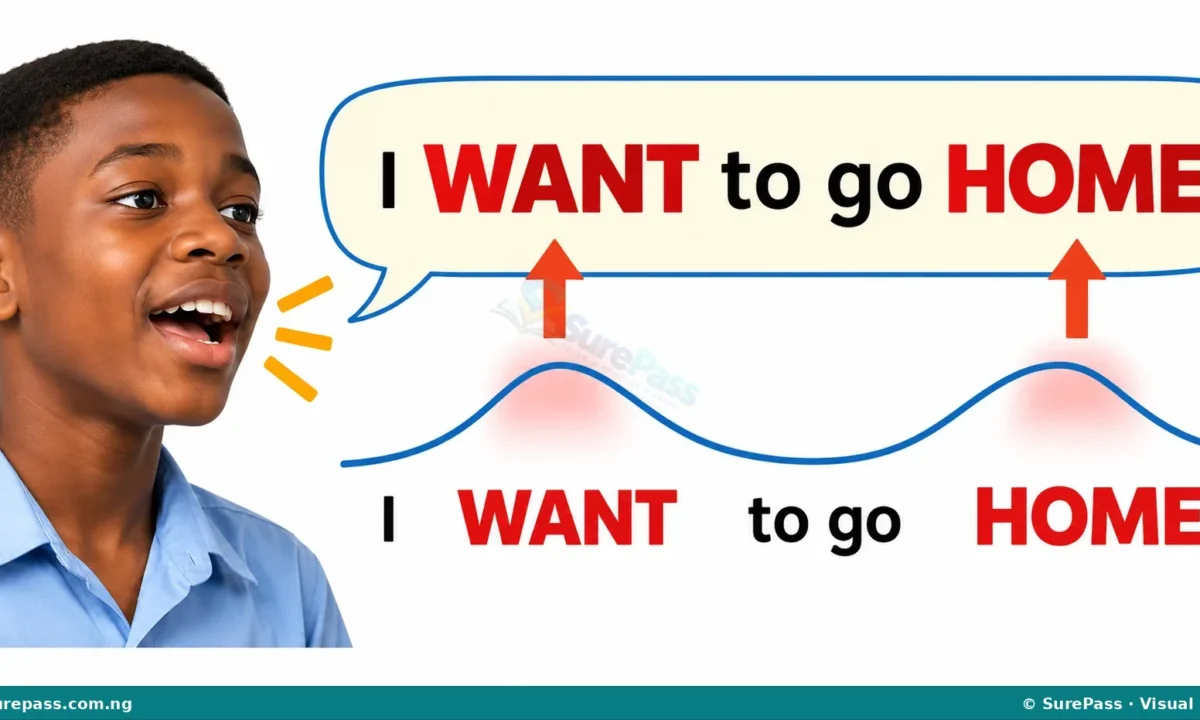
When people speak naturally, they do not pronounce each word in isolation. Instead, words flow together, forming what is known as connected speech. In connected speech, some words or parts of words are given more emphasis than others. This emphasis is called stress.
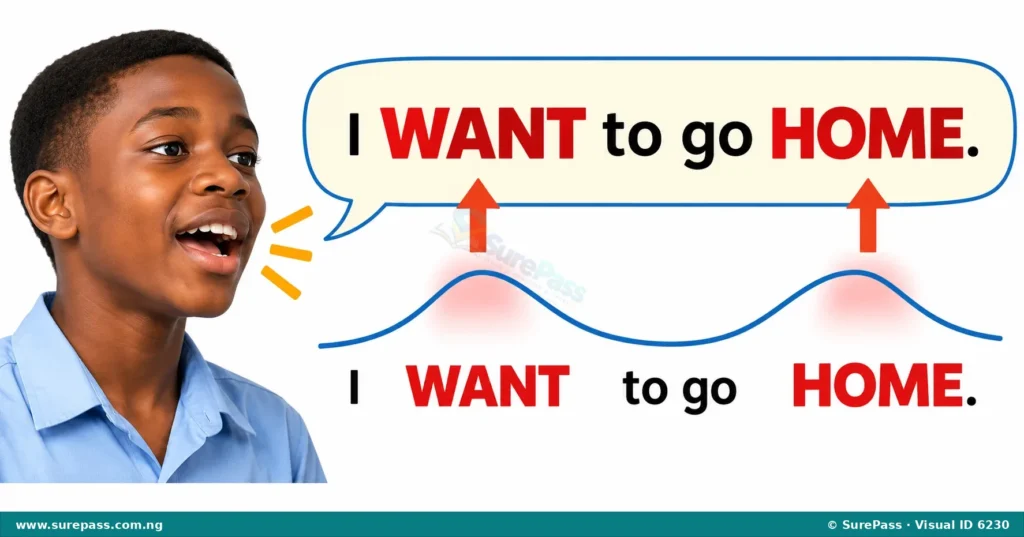
Stress makes certain words or syllables stand out. It involves saying a word or syllable louder, longer, and with a higher pitch compared to the surrounding words or syllables. This pattern of stress helps to convey meaning and rhythm in spoken English.
Identifying Words with Stress in Connected Speech
Not all words in a sentence receive the same amount of stress. Generally, words that carry the main meaning of the sentence are stressed, while words that serve grammatical functions are often unstressed or lightly stressed. This distinction helps listeners understand the important information being communicated.
Consider the sentence: “She BOUGHT a NEW dress.” In this sentence, “BOUGHT” and “NEW” are likely to be stressed because they convey the most important information about the action and the item. The words “She” and “a” are less important for meaning and are therefore unstressed.
Pronouncing Words with Stress in Connected Speech
To pronounce words with stress correctly in connected speech, it is important to identify which words are content words and which are function words. Content words typically receive stress, while function words are usually unstressed.
When a word is stressed, its vowel sound is usually clearer and longer. Unstressed words often have reduced vowel sounds, sometimes becoming a ‘schwa’ sound (/ə/), or they might be pronounced more quickly and quietly.
Practice pronouncing sentences, focusing on making the stressed words stand out. For example, in “I’ll MEET you at the MARKET,” the words “MEET” and “MARKET” should be pronounced with more emphasis.
Types of Words in Sentences: Content and Function Words
Words in English sentences can be broadly categorised into two types based on their role and how they are typically stressed in connected speech: content words and function words.
Content Words
Content words are the words that carry the main meaning or information in a sentence. They are essential for understanding what is being said. Because they convey meaning, content words usually receive stress in connected speech.
Examples of content words include:
- Nouns: These name people, places, things, or ideas (e.g., book, Lagos, student, happiness).
- Main Verbs: These describe actions or states (e.g., run, eat, think, believe).
- Adjectives: These describe nouns (e.g., beautiful, tall, difficult, red).
- Adverbs: These describe verbs, adjectives, or other adverbs (e.g., quickly, very, always, carefully).
- Demonstratives: These point out specific things (e.g., this, that, these, those).
- Interrogative words: These are used to ask questions (e.g., who, what, where, why, how).
In the sentence “The TALL boy RAN QUICKLY,” the words “TALL,” “boy,” “RAN,” and “QUICKLY” are content words and would typically be stressed.
Function Words
Function words are words that primarily serve a grammatical purpose in a sentence. They help to connect content words and structure the sentence correctly, but they do not carry much independent meaning. Because their role is grammatical, function words are usually unstressed or lightly stressed in connected speech.
Examples of function words include:
- Articles: These are words like a, an, the.
- Prepositions: These show relationships between words (e.g., in, on, at, to, for, with).
- Conjunctions: These connect words, phrases, or clauses (e.g., and, but, or, because).
- Auxiliary Verbs: These help main verbs (e.g., is, am, are, was, were, do, does, did, have, has, had, will, would, can, could, may, might, must, should).
- Pronouns: These replace nouns (e.g., I, you, he, she, it, we, they, me, him, her, us, them).
In the sentence “She IS GOING to THE MARKET,” the words “IS,” “to,” and “THE” are function words and would typically be unstressed. The main meaning is carried by “GOING” and “MARKET.”
Articulating Words with Stress in Connected Speech
Appropriately articulating words with stress in connected speech involves consciously emphasising content words and reducing function words. This practice improves both pronunciation and listening comprehension.
The procedure for practicing stress in connected speech involves the following steps:
- Read a sentence aloud: Choose a simple sentence, such as “The cat sat on the mat.”
- Identify content words: Determine which words carry the main meaning. In this example, “cat,” “sat,” and “mat” are content words.
- Identify function words: Determine which words serve grammatical roles. In this example, “The” and “on” are function words.
- Practice stressing content words: Say the sentence again, making “cat,” “sat,” and “mat” louder, longer, and with a slightly higher pitch.
- Practice reducing function words: Say “The” and “on” more quickly and quietly, possibly reducing their vowel sounds.
- Combine and smooth: Practice saying the entire sentence naturally, allowing the stressed words to stand out while the unstressed words blend in. For example, “The CAT SAT on the MAT.”
- Record and listen: Use an audio recorder to capture your pronunciation. Listen back to identify areas for improvement, focusing on whether the stress patterns sound natural.
Consistent practice with different sentences helps to develop a natural rhythm and stress pattern in spoken English, making communication clearer and more effective.



0 comments
Open the discussion when you need it. Comments stay collapsed until requested so the initial article remains light.