


ARTICLE CONTENTSOn this page 8 sections
Grammatical Accuracy: Noun Phrases
Performance Objectives
By the end of the lesson, students should be able to:
- state the meaning of a noun phrase;
- give examples of noun phrases;
- identify noun phrases in sentences;
- explain the meaning of a head noun;
- identify the two positions of noun phrases in sentences-
- as subject
- as object of the sentence.
Understanding Noun Phrases
In English, words combine to form larger units that function together in a sentence. One such important unit is the noun phrase. Noun phrases are essential for building clear and detailed sentences, allowing for more precise communication.
Meaning of a Noun Phrase
A noun phrase is a group of words that functions in a sentence as a noun.
It typically consists of a noun (which is the main word, called the head noun) and other words that modify or describe it. These modifying words can come before or after the head noun, adding more information about it.
Examples of Noun Phrases
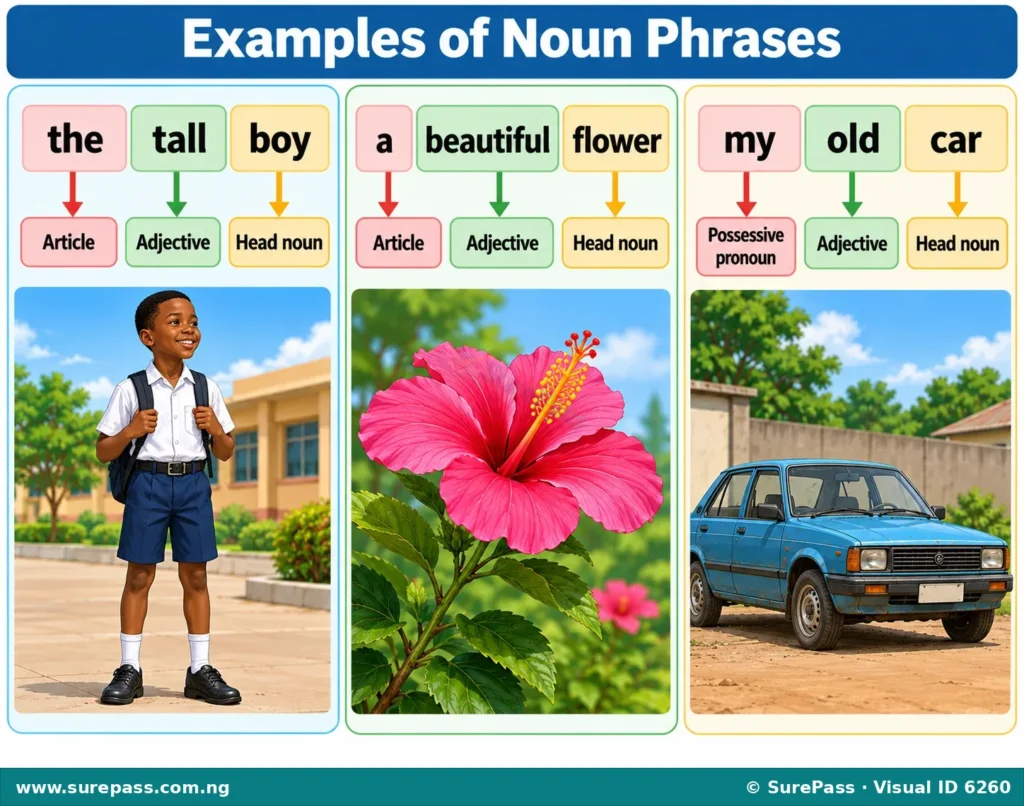
Noun phrases can be simple or complex. They always contain a noun as their central element, along with other words that provide more detail. These additional words can include articles (a, an, the), adjectives, possessive pronouns, or other descriptive words.
Examples of noun phrases include:
- the tall boy
- a beautiful flower
- my old car
- the book on the table
- a very interesting story
- the hardworking students
- her new red dress
- the principal of the school
Identifying Noun Phrases in Sentences
To identify a noun phrase, look for a noun and any words that describe or specify it, all working together as a single unit. If you can replace a group of words with a single pronoun (like ‘he’, ‘she’, ‘it’, ‘they’), that group is likely a noun phrase.
Consider the following sentences:
- The diligent student completed the assignment.
In this sentence, The diligent student is the noun phrase.
- My mother bought a new cooking pot.
Here, a new cooking pot is the noun phrase.
- The old woman with the red headtie walked slowly.
The noun phrase is The old woman with the red headtie.
- I saw a very colourful bird in the garden.
a very colourful bird is the noun phrase.
- Eating healthy food is good for the body.
In this example, Eating healthy food functions as a noun phrase.
Meaning of a Head Noun
The head noun is the main noun in a noun phrase.
It is the central word that the other words in the phrase modify or describe. All the other words in the noun phrase provide information about this head noun.
Let us look at some previous examples to identify the head noun:
- the tall boy (The head noun is ‘boy’.)
- a beautiful flower (The head noun is ‘flower’.)
- my old car (The head noun is ‘car’.)
- the book on the table (The head noun is ‘book’.)
- a very interesting story (The head noun is ‘story’.)
The head noun is the core meaning of the phrase; without it, the phrase would not make sense.
Positions of Noun Phrases in Sentences
Noun phrases can occupy different positions in a sentence, performing various grammatical functions. For SS1, the two main positions to focus on are as the subject of the sentence and as the object of the sentence.
Noun Phrases as Subjects
The subject of a sentence is the person, place, thing, or idea that performs the action of the verb or is described by the verb.
When a noun phrase acts as the subject, it usually appears at the beginning of the sentence, before the main verb.
Examples of noun phrases functioning as subjects:
- The hardworking student passed the examination.
(Here, ‘The hardworking student’ is the noun phrase acting as the subject. It performs the action of ‘passed’.)
- My elder sister lives in Abuja.
(The noun phrase ‘My elder sister’ is the subject of the verb ‘lives’.)
- A large black dog barked loudly.
(The noun phrase ‘A large black dog’ is the subject of ‘barked’.)
- The new school building was officially opened last week.
(The noun phrase ‘The new school building’ is the subject of ‘was opened’.)
Noun Phrases as Objects
The object of a sentence is the person, place, thing, or idea that receives the action of the verb.
When a noun phrase acts as the object, it usually appears after the main verb.
Examples of noun phrases functioning as objects:
- The teacher praised the brilliant boy.
(Here, ‘the brilliant boy’ is the noun phrase acting as the object. It receives the action of ‘praised’.)
- My father bought a brand new car.
(The noun phrase ‘a brand new car’ is the object of the verb ‘bought’.)
- She ate a delicious plate of jollof rice.
(The noun phrase ‘a delicious plate of jollof rice’ is the object of ‘ate’.)
- The children watched an interesting cartoon movie.
(The noun phrase ‘an interesting cartoon movie’ is the object of ‘watched’.)




0 comments
Open the discussion when you need it. Comments stay collapsed until requested so the initial article remains light.