



ARTICLE CONTENTSOn this page 6 sections
Adjuncts (Adverbs)
Performance Objectives
By the end of the lesson, students should be able to:
- explain the meaning of adjuncts;
- identify types of adjuncts;
- identify adjuncts in passages.
Meaning of Adjuncts
An adjunct is a word, phrase or clause that adds extra information to a sentence. It is usually an adverb or an adverbial phrase or clause. Adjuncts provide more details about the verb, an adjective, or another adverb in a sentence, telling us how, when, where, or why something happened.
Adjuncts are not essential to the basic grammatical structure of a sentence. This means that if an adjunct is removed, the sentence can still make complete sense, although some detail will be lost. For example, in the sentence “She sang beautifully,” the word “beautifully” is an adjunct. If it is removed, the sentence “She sang” still makes sense.
Types of Adjuncts
Adjuncts can be classified based on the kind of information they provide. The main types of adjuncts include adjuncts of time, place, manner, and reason or purpose.
Adjuncts of Time
Adjuncts of time tell us when an action happened or how often it happens. They answer the question “When?” or “How often?”.
Examples of adjuncts of time include:
- Words: now, yesterday, tomorrow, often, always, never, soon, daily, weekly, early, late.
- Phrases: last night, next week, every morning, in the evening, at noon, for two hours, since Monday.
Consider the following sentences:
- She arrived yesterday. (When did she arrive? Yesterday)
- They will meet tomorrow morning. (When will they meet? Tomorrow morning)
- He often visits his grandmother. (How often does he visit? Often)
- The train departed at 6 o’clock. (When did the train depart? At 6 o’clock)
Adjuncts of Place
Adjuncts of place tell us where an action happened or where something is located. They answer the question “Where?”.
Examples of adjuncts of place include:
- Words: here, there, everywhere, nowhere, upstairs, downstairs, outside, inside, home.
- Phrases: in the kitchen, at school, near the market, under the tree, on the table, to Lagos.
Consider the following sentences:
- The children are playing outside. (Where are the children playing? Outside)
- She lives in Abuja. (Where does she live? In Abuja)
- The book is on the shelf. (Where is the book? On the shelf)
- They travelled to Kano. (Where did they travel? To Kano)
Adjuncts of Manner
Adjuncts of manner tell us how an action was performed. They answer the question “How?”. Many adjuncts of manner end in “-ly”.
Examples of adjuncts of manner include:
- Words: quickly, slowly, carefully, loudly, softly, well, badly, happily, sadly.
- Phrases: with great care, in a hurry, by hand, like a professional.
Consider the following sentences:
- He drives carefully. (How does he drive? Carefully)
- She sings beautifully. (How does she sing? Beautifully)
- They walked slowly towards the gate. (How did they walk? Slowly)
- The artist painted the portrait with skill. (How did the artist paint? With skill)
Adjuncts of Reason or Purpose
Adjuncts of reason or purpose tell us why an action happened or for what purpose it was done. They answer the question “Why?” or “For what purpose?”.
Examples of adjuncts of reason or purpose include:
- Words: therefore, hence, consequently.
- Phrases: because of the rain, due to illness, for a good cause, to buy food, in order to succeed.
- Clauses: because he was tired, so that she could pass.
Consider the following sentences:
- He stayed home because he was ill. (Why did he stay home? Because he was ill)
- She studied hard to pass her exams. (For what purpose did she study? To pass her exams)
- They cancelled the trip due to bad weather. (Why did they cancel the trip? Due to bad weather)
- The team trained daily in order to win the championship. (For what purpose did they train? In order to win the championship)
Multiple Adjuncts in a Sentence
A single sentence can contain more than one adjunct, providing different types of information about the action. These adjuncts can appear in various positions within the sentence, though there are common patterns for their arrangement.
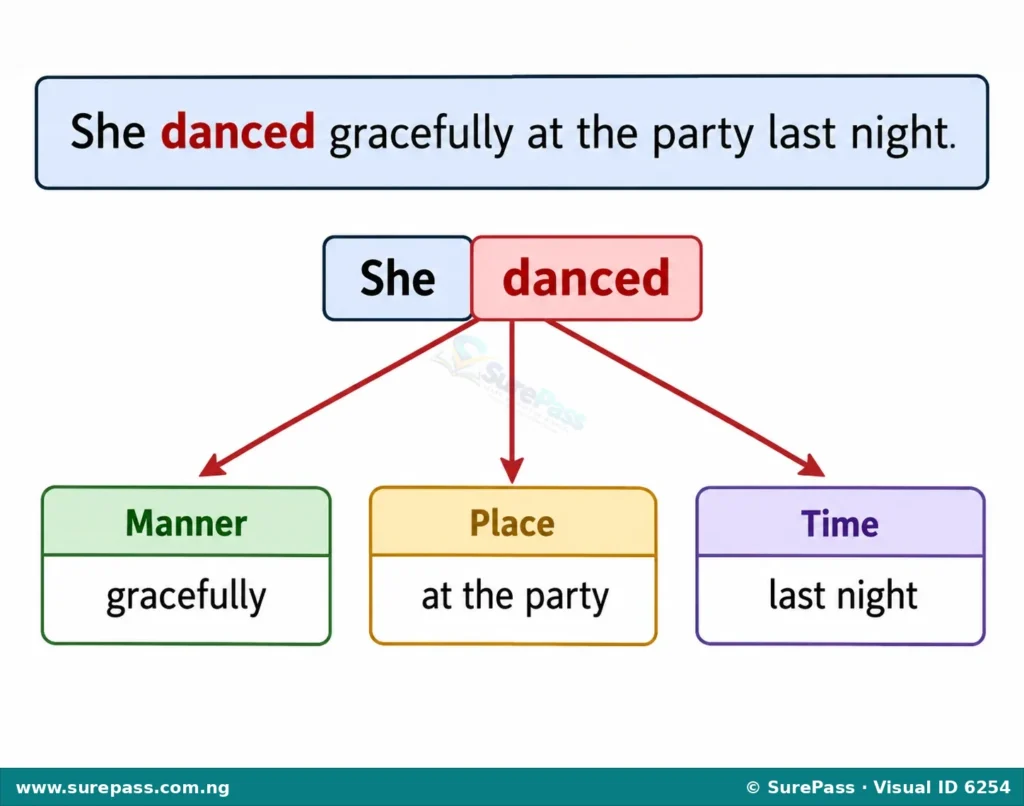
When multiple adjuncts are present, they often follow a general order, such as manner, place, then time (MPT). However, this order is not rigid and can change depending on what the speaker wants to emphasise.
Observe the following examples of sentences with multiple adjuncts:
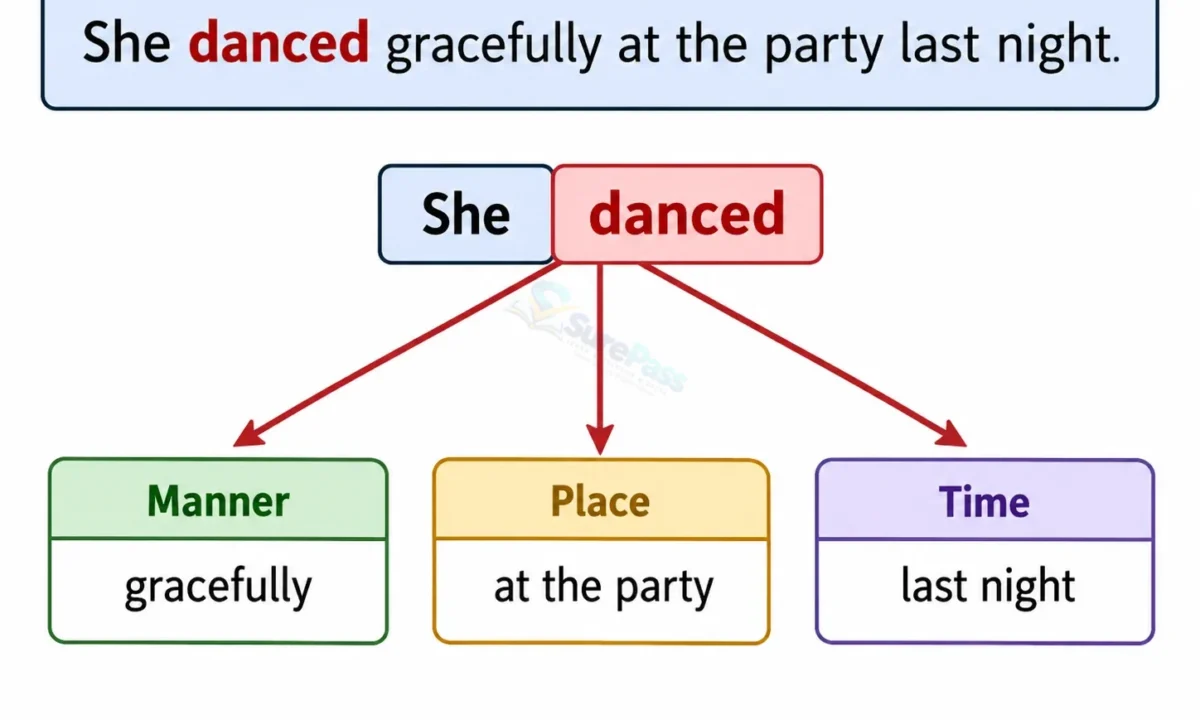
- She danced gracefully (manner) at the party (place) last night (time).
- He spoke loudly (manner) in the hall (place) this morning (time).
- They studied diligently (manner) at the library (place) for hours (time).
- The children played happily (manner) in the park (place) after school (time).
- He left early (time) because of the traffic (reason).
- The meeting was held online (place/manner) yesterday (time) to discuss the project (purpose).
Identifying Adjuncts in Passages
To identify adjuncts in a passage, read each sentence carefully and look for words, phrases, or clauses that add extra information about when, where, how, or why an action occurred. Remember that adjuncts are usually optional parts of the sentence.
Steps to identify adjuncts:
- Read the sentence and identify the main verb.
- Ask questions like “When?”, “Where?”, “How?”, or “Why?” about the verb.
- The words, phrases, or clauses that answer these questions are likely adjuncts.
- Test by removing the identified part. If the sentence still makes grammatical sense, it is an adjunct.
Example Passage:
The young boy woke up early. He quickly ate his breakfast in the kitchen. Because he was excited, he ran happily to school. He wanted to see his friends and learn new things today.
Identification:
- “The young boy woke up early.”
- Verb: woke up
- Question: When did he wake up?
- Answer: early (Adjunct of Time)
- “He quickly ate his breakfast in the kitchen.”
- Verb: ate
- Question: Where did he eat?
- Answer: in the kitchen (Adjunct of Place)
- “Because he was excited, he ran happily to school.”
- Verb: ran
- Question: Why did he run?
- Answer: Because he was excited (Adjunct of Reason)
- Question: How did he run?
- Answer: happily (Adjunct of Manner)
- Question: Where did he run?
- Answer: to school (Adjunct of Place)
- “He wanted to see his friends and learn new things today.”
- Verb: wanted
- Question: For what purpose did he want?
- Answer: to see his friends (Adjunct of Purpose)
- Verb: learn
- Question: When did he want to learn?
- Answer: today (Adjunct of Time)




0 comments
Open the discussion when you need it. Comments stay collapsed until requested so the initial article remains light.