


ARTICLE CONTENTSOn this page 6 sections
Vocabulary Development: Antonyms and Synonyms
Performance Objectives
By the end of the lesson, students should be able to:
- explain the meaning of synonyms and antonyms;
- list words with their synonyms and antonyms;
- use synonyms and antonyms in sentences.
Understanding Synonyms
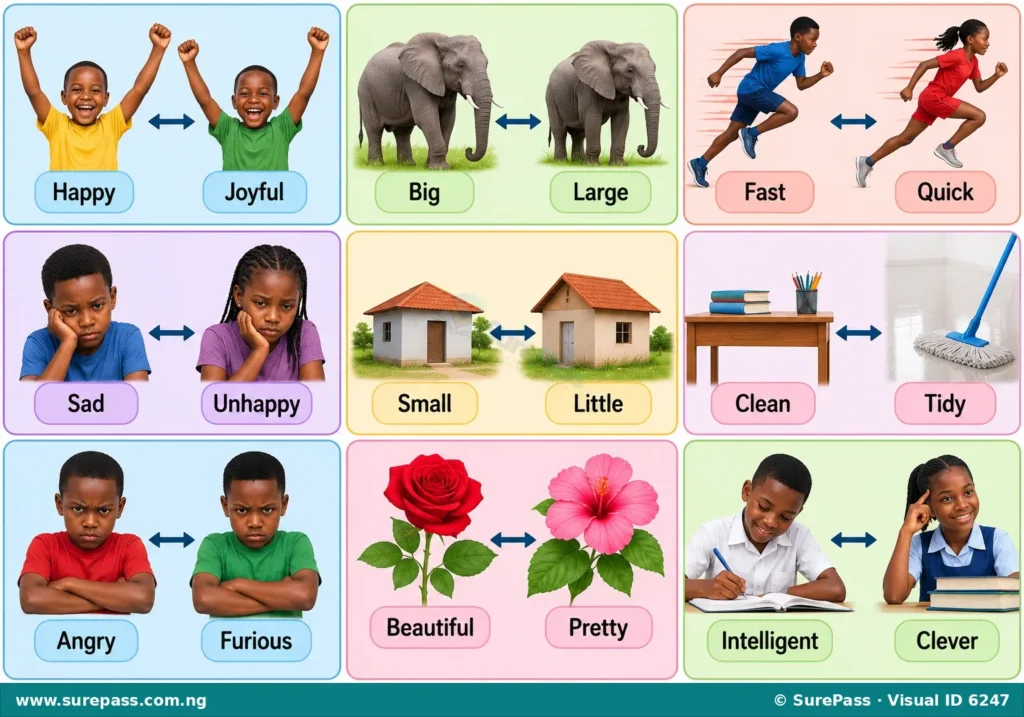
A synonym is a word that has the same or nearly the same meaning as another word.
Synonyms allow for variety in writing and speaking, helping to avoid repetition and make language more interesting. For example, instead of always using “big,” one can use “large,” “huge,” or “enormous.”
Examples of Synonyms
Here are some common words and their synonyms:
- Happy: joyful, cheerful, glad
- Sad: unhappy, sorrowful, gloomy
- Big: large, huge, enormous
- Small: tiny, little, minute
- Fast: quick, rapid, swift
- Slow: sluggish, gradual, unhurried
- Beautiful: pretty, lovely, attractive
- Ugly: hideous, unattractive, unsightly
- Rich: wealthy, affluent, prosperous
- Poor: needy, impoverished, destitute
- Start: begin, commence, initiate
- End: finish, conclude, terminate
- Speak: talk, converse, articulate
- Listen: hear, pay attention, heed
- Buy: purchase, acquire, obtain
- Sell: vend, market, retail
- Old: ancient, aged, elderly
- New: fresh, modern, recent
- Strong: powerful, mighty, robust
- Weak: feeble, fragile, delicate
Understanding Antonyms
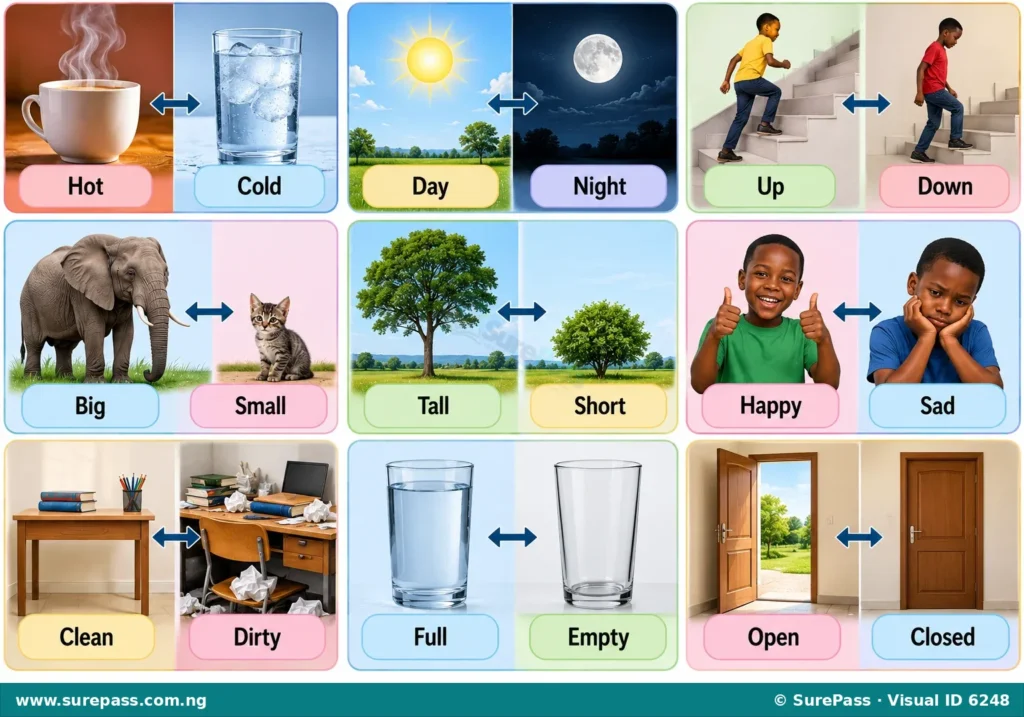
An antonym is a word that has the opposite meaning of another word.
Antonyms are useful for expressing contrast or difference. They help to clarify ideas by showing what something is not. For instance, the opposite of “hot” is “cold.”
Examples of Antonyms
Here are some common words and their antonyms:
- Hot: cold
- Day: night
- Up: down
- In: out
- Good: bad
- Happy: sad
- Big: small
- Fast: slow
- Light: dark
- Love: hate
- Open: close
- Rich: poor
- True: false
- Young: old
- Early: late
- Full: empty
- High: low
- Loud: quiet
- Wet: dry
- Strong: weak
Using Synonyms and Antonyms in Sentences
Using synonyms and antonyms correctly enhances communication. Synonyms can add richness and variety, while antonyms can create clear contrasts.
Using Synonyms in Sentences
Synonyms can be used to replace words to avoid repetition or to choose a more precise word for a specific context.
Examples of sentences using synonyms:
- The boy was very happy when he received the gift. (Synonym: joyful)
The boy was very joyful when he received the gift.
- The house was very big. (Synonym: enormous)
The house was very enormous.
- She has a beautiful voice. (Synonym: lovely)
She has a lovely voice.
- The car moved very fast. (Synonym: rapidly)
The car moved very rapidly.
- It is time to start the meeting. (Synonym: begin)
It is time to begin the meeting.
Using Antonyms in Sentences
Antonyms are used to show contrast or to express the opposite of an idea within a sentence or across sentences.
Examples of sentences using antonyms:
- The tea was very hot, but the water was cold.
- During the day, the sun shines brightly, but at night, the moon appears.
- The elevator went up, then it came down.
- He is a good student, unlike his bad behaviour yesterday.
- The box was full of books, but now it is empty.
Practice: Identifying and Using Synonyms and Antonyms
Developing the skill of using synonyms and antonyms requires practice. This involves recognising them in texts and applying them in your own writing and speaking.
Activity: Finding Synonyms and Antonyms
The procedure involves the following steps:
- Read a passage or a sentence carefully.
- Identify a specific word in the text.
- Think of another word that has a similar meaning (synonym) or an opposite meaning (antonym).
- Check your choices using a dictionary or thesaurus to confirm their meanings.
- Try to replace the original word with its synonym or antonym in the sentence to see if the meaning changes as intended.
Tips for Using Synonyms and Antonyms Effectively
To use synonyms and antonyms effectively, consider the following:
- Context: Always consider the context in which a word is used. Some synonyms may not fit perfectly in every situation. For example, “large” and “spacious” are synonyms for “big,” but “spacious” specifically refers to having a lot of room, while “large” can refer to overall size.
- Nuance: Synonyms often have slightly different shades of meaning or connotations. Choose the word that best conveys the exact meaning you intend. For instance, “walk,” “stroll,” and “march” are all synonyms, but they describe different manners of walking.
- Register: Be aware of the formality or informality of words. Some synonyms are more formal than others. For example, “commence” is a more formal synonym for “start.”
- Clarity: Use antonyms to create clear distinctions and contrasts in your writing. This helps the reader understand opposing ideas.
- Variety: Use synonyms to make your writing more engaging and less repetitive. However, do not overuse them to the point of making your writing sound unnatural.




0 comments
Open the discussion when you need it. Comments stay collapsed until requested so the initial article remains light.