



ARTICLE CONTENTSOn this page 6 sections
Grammatical Accuracy: Meaning and Use of Phrasal Verbs
Performance Objectives
By the end of the lesson, students should be able to:
- explain the meaning of phrasal verb;
- give examples of phrasal verbs;
- discuss the structure of phrasal verbs
- construct sentences with phrasal verbs.
Meaning of Phrasal Verbs
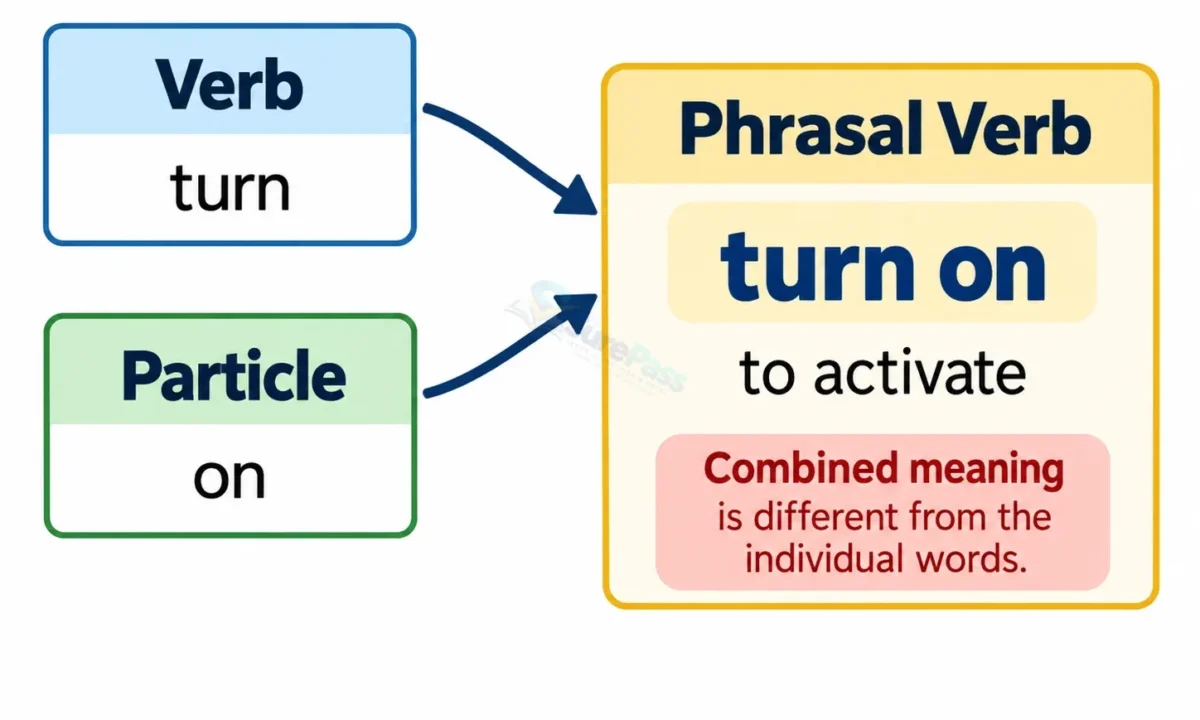
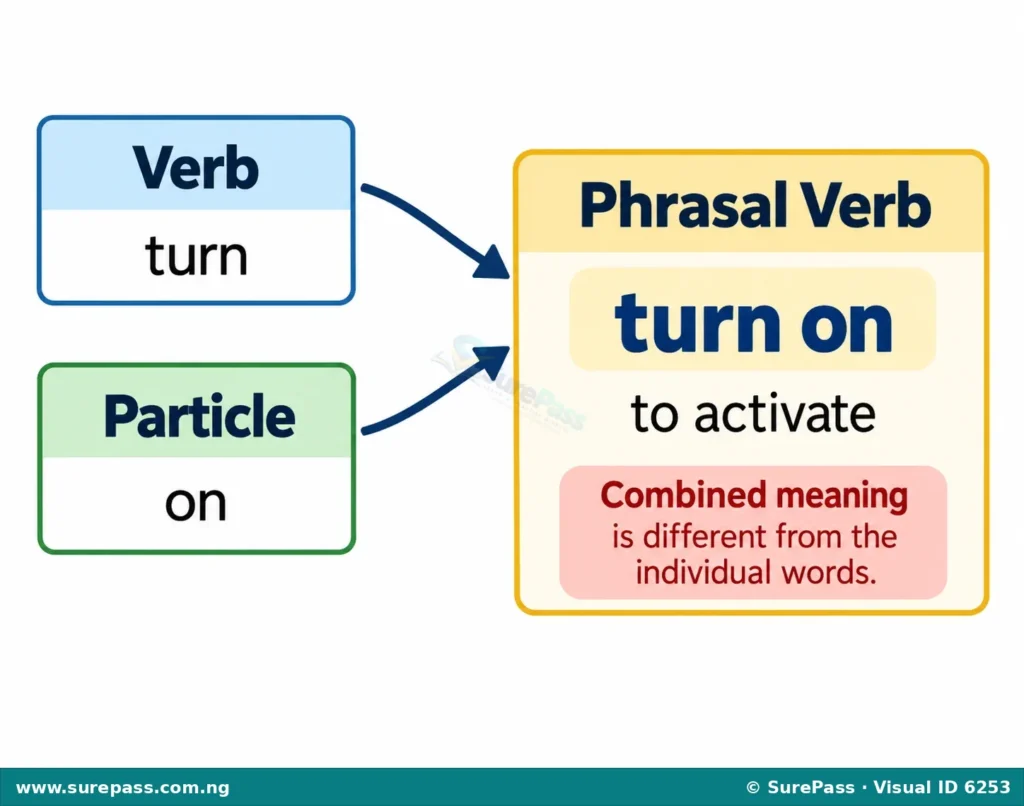
A phrasal verb is a verb combined with an adverb or a preposition, or sometimes both, to give a new meaning.
The new meaning of a phrasal verb is often different from the meanings of the individual words that make it up. For example, the verb “look” means to direct your eyes, but “look up” can mean to search for information or to visit someone.
Structure of Phrasal Verbs
Phrasal verbs typically follow one of two main structures:
-
Verb + Particle (no object)
In this structure, the phrasal verb does not take a direct object. The particle (adverb or preposition) completes the meaning of the verb.
Examples include:
- The plane took off at 7:00 AM. (The phrasal verb “took off” means to leave the ground. There is no object receiving the action.)
- The children grew up in Lagos. (The phrasal verb “grew up” means to mature. There is no object.)
- The car broke down on the highway. (The phrasal verb “broke down” means to stop working. There is no object.)
-
Verb + Object + Particle
In this structure, the phrasal verb takes a direct object, and the particle comes after the object. This type of phrasal verb is often separable, meaning the object can sometimes come between the verb and the particle, or after the particle.
Examples include:
- Please turn off the light. (The object “the light” comes between the verb “turn” and the particle “off”.)
- Please turn the light off. (Here, the object “the light” is placed between the verb and the particle.)
- The teacher called off the meeting. (The object “the meeting” comes after the phrasal verb.)
- The teacher called the meeting off. (Here, the object “the meeting” is placed between the verb and the particle.)
Examples of Phrasal Verbs and Their Use in Sentences
Here are some common phrasal verbs with their meanings and example sentences:
-
Call off
Meaning: To cancel something.
Example sentences:
- The principal decided to call off the school picnic due to heavy rain.
- They had to call the wedding off because of a family emergency.
-
Calm down
Meaning: To become less angry, excited, or upset; to make someone less angry, excited, or upset.
Example sentences:
- After the argument, she needed some time to calm down.
- The mother tried to calm her crying baby down.
-
Figure out
Meaning: To understand or solve something.
Example sentences:
- I need to figure out how to fix this broken phone.
- Can you help me figure out this maths problem?
-
Give up
Meaning: To stop trying; to surrender.
Example sentences:
- Never give up on your dreams, no matter how difficult they seem.
- He decided to give up smoking for his health.
-
Turn on / Turn off
Meaning: To start an electrical device (turn on) / to stop an electrical device (turn off).
Example sentences:
- Please turn on the fan; it’s very hot.
- Remember to turn off the lights when you leave the room.
- Could you turn the television on?
- Don’t forget to turn the gas cooker off after cooking.
-
Catch up
Meaning: To reach the same level or standard as someone else; to meet someone you haven’t seen for a while.
Example sentences:
- After being sick, I had to work hard to catch up on my schoolwork.
- Let’s meet for coffee next week to catch up.
-
Check in
Meaning: To register at a hotel or airport; to report one’s arrival.
Example sentences:
- We need to check in at the hotel before 3 PM.
- Passengers should check in at least two hours before their flight.
-
Eat out
Meaning: To eat a meal in a restaurant rather than at home.
Example sentences:
- On weekends, my family often likes to eat out at a local restaurant.
- We decided to eat out tonight since no one wanted to cook.
-
Hang out
Meaning: To spend time relaxing or socialising, usually with friends.
Example sentences:
- After school, the students like to hang out at the park.
- I’m going to hang out with my friends this evening.
Constructing Sentences with Phrasal Verbs
When constructing sentences with phrasal verbs, it is important to:
- Understand the exact meaning of the phrasal verb.
- Choose the correct structure (verb + particle or verb + object + particle).
- Ensure the sentence makes grammatical sense and conveys the intended message.
Consider the following examples:
- Instead of saying: “The meeting was cancelled.”
You can say: “The meeting was called off.” - Instead of saying: “He solved the puzzle.”
You can say: “He figured out the puzzle.” - Instead of saying: “Do not stop trying.”
You can say: “Do not give up.”





0 comments
Open the discussion when you need it. Comments stay collapsed until requested so the initial article remains light.